A Man of Misconceptions
June 22, 2026
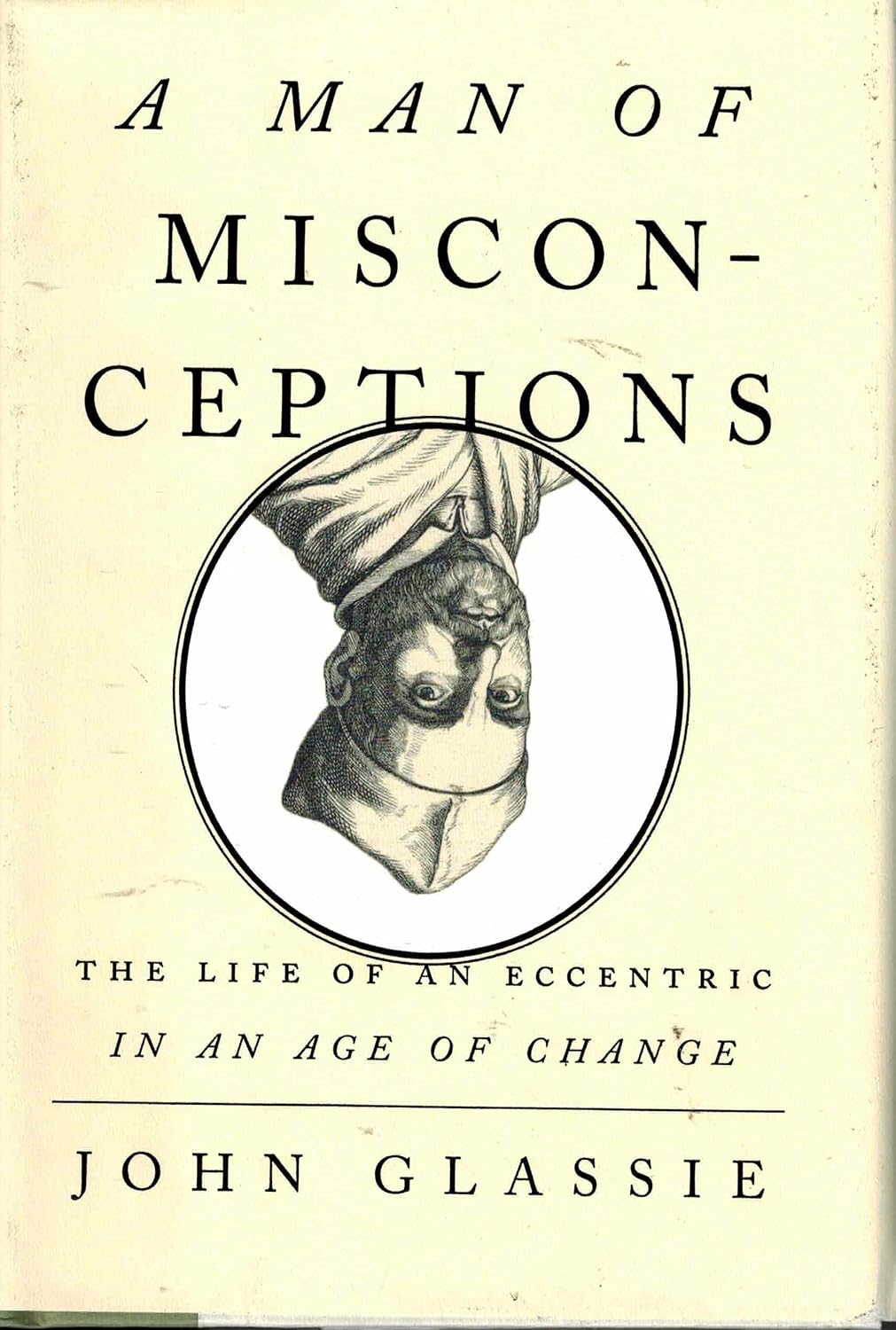
A Man of Misconceptions
by John Glassie
I bought this book on a whim at Jabberwocky books in Newburyport, MA. It is a biography of Athanasius Kircher, an eccentric priest and scientist (sort of?) from the 1600s. He created a museum of curiosities in Rome and was friends with the pope. As the scientific revolution was happening around him, his “art of knowing” was outdated. I’m interested in people who live in new times but remember the old times, and that’s why I bought the book. I was somewhat disappointed by Kircher, though.
Here are my notes:
#Goals: To be described as a “baroque polymath” who is “genuinely and insatiably curious.” A “champion of wonder.”
#Goals 2: To be like “most of Europe’s 40 million peasants” who, re: the earth being at the center of the universe or not, “were not aware of the debate.”
Athanasius Kircher was born in 1602. He was Catholic. Balthazar von Durnbach was returning to Geisa from exile when he was born. Durnbach spent 1602-1606 holding witch trials. He burned ~250 women for witchcraft, most famously Merga Bien. (5)
He applied to join the Jesuits. The Jesuits rejected candidates with stomach trouble, headache trouble, other illness, or even “notable ugliness,” since it did “not help towards the edification of neighbors.” (15)
Medieval thinking: “everything in the earthly realm was connected through a great chain of being – through graduated correspondences and affinities – to the celestial realm above.” (21)
Astrology for divination was banned by the pope in 1586, but “almost no one imagined a world in which some kind of astral influence wasn’t exerting itself.” (23)
The switch from the Julian to the Gregorian calendar came in 1582. Ten days had to be skipped. Gregorian will be good “until 4317, when a single extra day will have to be added.” Russia did not make this change until the Bolsheviks in 1917! (33)
In 15th century Florence, the Medicis commissioned translations of Greek works into Italian. Reminds me of Ptolemy and the LXX. “Gave Europe access to the works of Plate for the first time in a thousand years.” (38)
Augustine treats Hermes Trismegistus and Atlas as real people:
Saint Augustine wrote ... that Hermes lived "long before the sages and philosophers of Greece, but after Abraham, Isaac, Jacob, Joseph, yea, and Moses also: for at the time when Moses was born, was Atlas, Prometheus's brother, a great astronomer, living, and he was grandfather by the mother's side to the elder Mercury, who begat the father of this Trismegistus." (39)

AK keeps almost dying. He drifted down a river on a chunk of ice (29-30), his friends thought he was dead and told everyone so, and then he turned up at the town they had been heading to. Or the time he got sucked under a water wheel while swimming in a river as a kid(8). Or a time when he was robbed and nearly hung by heretics (44).
I had never thought to ask, why kill “witches”? Because then you can sieze their assets and get rich. (49)
The medievals believed in a “weapon salve” – mix the blood or tissue of a wounded man into a salve, then apply it to the weapon that hurt him, to heal him. Paracelsus said to heal gout, implant the afflicted person’s toenails into the trunk of a tree. Weird ideas! (50)
Page 70 describes AK’s sunflower seed clock. Sounds like it was a hoax that used a hidden magnet and was really similar to a compass. AK would have known this – it makes me think of him not as simply ignorant of later discoveries but as deliberately misleading, which is my main disappointment in reading about him. Some said he was “more of a charlatan than a scholar” (109). So why am I reading about this guy?
He steals from Mersenne (123). Builds a fake sunflower seed clock. Fakes a hieroglyphic/Egyptian document. Wrote fake/bad instructions for building a microscope. But he did write a popular book on The Magnet. And articulated “the doctrine of affections” (123), an influence on baroque music. Likely his book “Universal Music-Making” was influential on Bach (124). Even a stopped sunflower clock is right twice a day?
He built a reputation as an “authoritative polymath.” Many began to correspond with him – “the Jesuit to whom missionaries most frequently sent reports, artifacts, and natural specimens.” He was well informed. (128)
AK had a museum at the Collegio Romano (in Rome) which included, as legend has it, a “cat piano” (which he created). Basically, cats were enclosed in a piano box with their tails stretched through holes. The keys of the piano, rather than controlling hammers, caused the cats’ tails to be pricked. “When it was finally played, it produced the sort of harmony as the voices of cats are wont to supply.” (121)
His book “Egyptian Oedipus” was “one of the most learned monstrosities of all times.” (136)
Here are some old space travel stories mentioned on p. 152:
- “The Dream of Scipio” by Cicero, ~54 B.C.
- “The Dream” by Kepler, 1834
- “Ecstatic Journey” by Kircher, 1656
Perhaps AK was the first person to use a microscope to study diseases. (164) Some credit him with being an early understander of contagious disease… by not really. To avoid catching the plague, he did suggest staying away from areas of outbreak. But he also thought you could avoid it by wearing an amulet made from toad flesh over your heart! (169)
He rejected the idea that the physical world was purely physical. (167)
He was “a book-making, knowledge-regurgitating machine.” (170)
“There was a tradition of thinking that after the Flood, Noah traveled the world by raft, vigorously repopulating the flood-drenched continents with the heroic aid of his wife.” (173)
There is a section about the Royal Society on p. 180. AK was “very easy (willing) to communicate whatever he knows… He is also very credulous… He has often made me smile [by the stories he believed and printed].” (so said Robert Southwell, a later president of the R.S.)
His book “Underground World” explained how igneous rocks formed (correctly), his theories about panspermia and a “life force”, erosion, the source of the Nile (including many invented place names), the life of troglodytes in caves in Malta, the bones of giants, and the habits of dragons. This book was read by many important people over the years, including John Locke, Spinoza, Edgar Allen Poe, and Jules Verne. (192)
Francesco Redi tested AK’s claims about spontaneous generation. He “conducted one of the first controlled experiments ever documented,” putting meat in flasks, some corked and some not, proving that maggots, etc. came from eggs, not from spontaneous generation. People believed in spontaneous generation going back millenia. No one thought to regulate their experiments in this way.
“It was as if Redi were making a strangely elegant threat to all long-held assumptions everywhere, while Kircher was trying to reaffirm the concept of the world he sensed was slipping away.” (194)
“As with many of his books, this one [“China Illustrated”] got a lot wrong and had a significant influence on its readers.” It “contributed to the English fascination with tea,” and the British East India Co. started importing tea in 1668, the year after it was published. (201)
Pope Clement IX put a stop to “the racing of Jews during Carnival.” The prostitute races continued, though. (207)
I had to look up the racing of Jews. I found this:
The *palio degli ebrei*, or “race of the Jews” — a ritual of humiliation and abuse that took place along the Corso, or main street, of Rome during the February Carnival — was abolished on this date in 1668 by Pope Clement IX Rospigliosi, who substituted an annual tax of 300 scudi (silver coins) levied on the Jews. According to the Medici Archives, “at one point, Christian ‘jockeys’ in the race rode Jews instead of horses. Another festive ‘game’ ... was to roll a Jew in a nailed barrel down the Testaccio Hill.... By the 1580s, the Jews are known to have run the race naked; later, they evidently began to assume elaborate costumes, thereby reversing the originally humiliating intention of the event.” By the time of Pope Clement’s decree, some 9,000 Jews lived in the eight-acre Roman ghetto; they were required to wear yellow cloths, scarves or veils outside the ghetto’s doors and were subjected to “compulsory preaches” aimed at their conversion.
Someone sent AK a fake, unintelligible hieroglyphic manuscript and requested a translation. Which he provided. (208)
Plato: “Nothing is more beautiful than to know all things.” (212)
Liebniz was interested in “the Great Art of Knowing”. He invented binary! (215) “Virtually every major scientific, linguistic, historical project he embarked on had been directly inspired by reading Kircher’s works.” (215) He was a “non-practicing Lutheran.” A superfan of AK, who was considered “a polymath’s polymath”.
There was some backlast against AK after his debunking of alchemy. (218)
AK claimed he’d solved how to square the circle. (242)
A quote from 1678: “I am fully occupied by penetrating the science of the Saints, which is to be found in Christ crucified, so that when death comes, it will not find me occupied in empty studies.” (243)
I liked this frontispiece from his book “Arithmologia” (244):
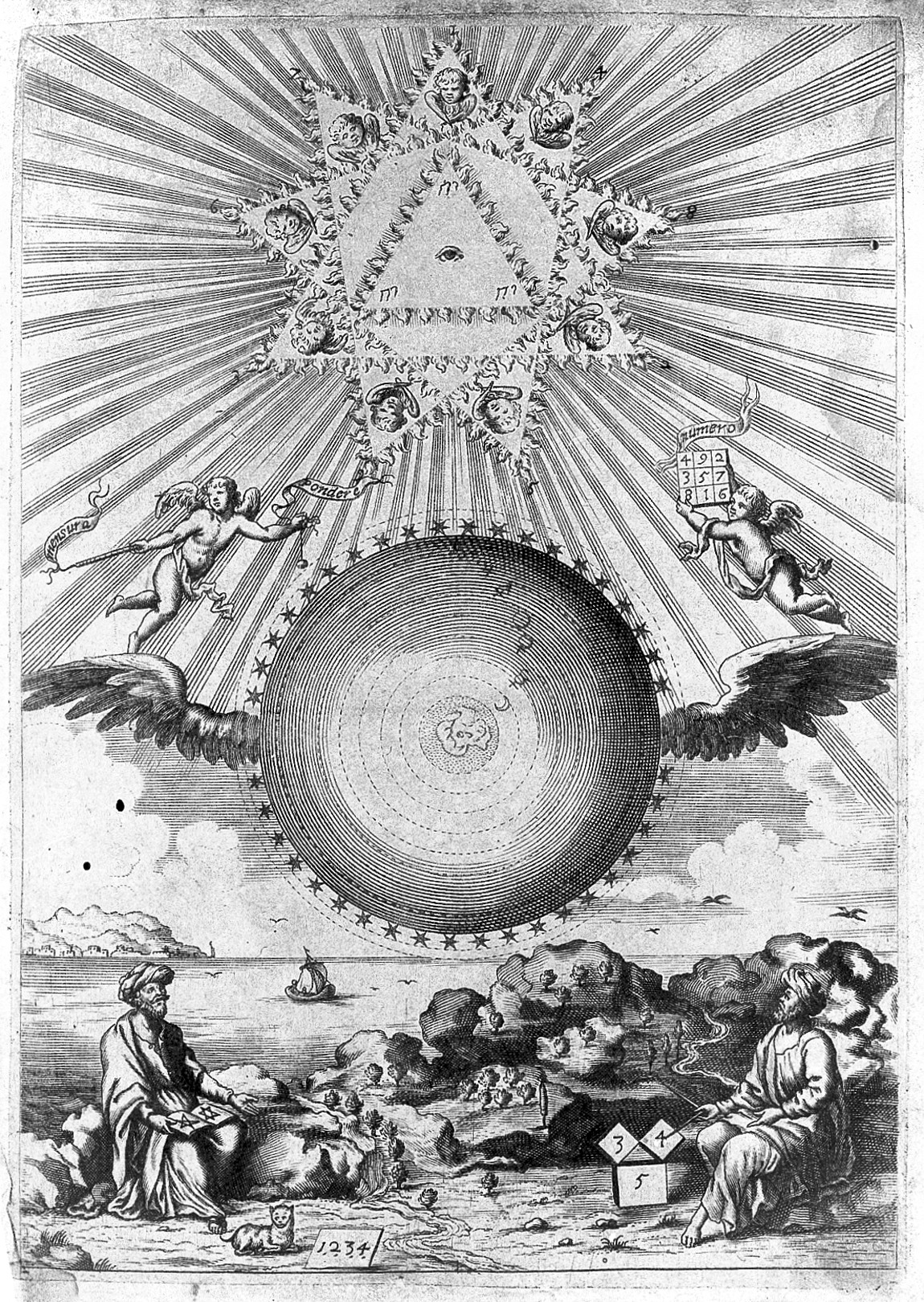
AK died 11/27/1679 at the age of 77.
Newton looked for a correspondence between the 7 notes of the diatonic musical scale and colors. He found one by cheating, adding the 7th color “indigo” to the rainbow. (253)
AK is sometimes called The Father of Egyptology. But also blamed for Europeans viewing the orient as “other,” contributing to imperialism and colonialism. (263)
Egyptian Oedipus and other works helped document and preserve many occult practices (despite his disclaimers).
He had grand ambitions and “a certain flexibility with the truth.” (269)
Poe mentioned Kircher in A Descent into the Maelstrom. And AK is possibly the model for the German professor who takes Verne’s Journey to the Center of the Earth. (269)
In summary:
In the meantime, it's clear that the modern perspective is simply not the right one to take when it comes to Kircher and to the entire, incredible Kircherian enterprise. There's something to be said for his effort to know everything and to share everything he knew, for asking a thousand questions about the world around him, and for getting so many others to ask questions about his answers; for stimulating, as well as confounding and inadvertently amusing, so many minds; for having been a source of so many ideas—right, wrong, half right, halfbaked, ridiculous, beautiful, and all-encompassing. (272)