The Seventy-Two Servants of the Word of God
May 15, 2026
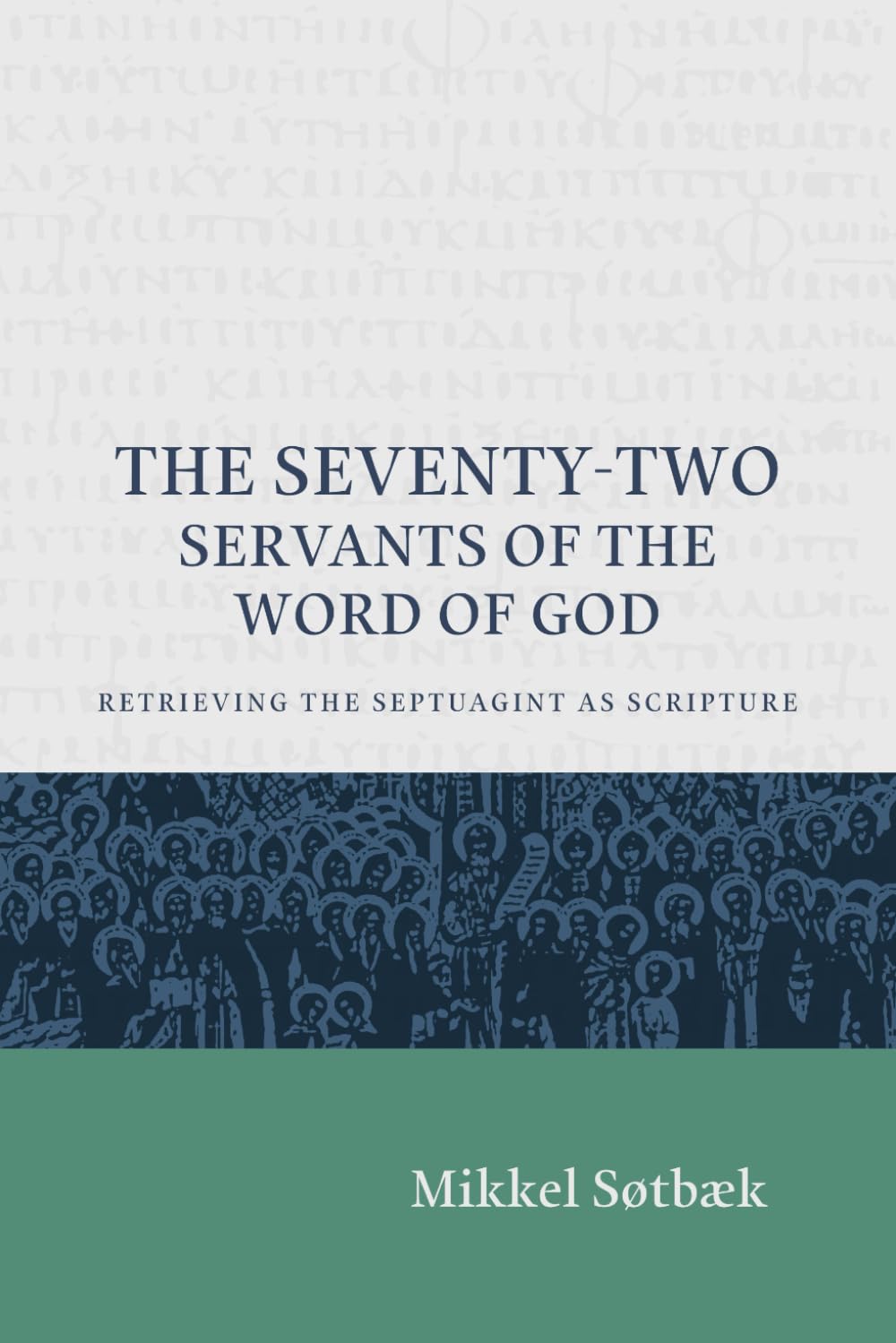
The Seventy-Two Servants of the Word of God
by Mikkel Søtbæk
A friend loaned me this book so I could read it and we could talk about it.
The main points of the book
- Since the time of Jerome, most Bible translations have been based on the Masoretic Text (MT). It’s easy to think of MT as “the original Hebrew,” but this is not true. It’s not even the same alphabet.
- LXX came from a Hebrew text from the Jerusalem Temple around 250 BC. This Hebrew text is no longer available itself, but it was a better source than the MT.
- LXX retains Messianic language and language about grace to the Gentiles in some places where MT seems to have removed or changed it.
- The Church fathers preferred LXX.
- Jerome thought the MT was better. He broke with tradition and used MT for the Vulgate.
- Christ and the apostles quote from LXX the majority of the time.
My take-aways
This author believes LXX to be inspired in the same way the books of the Bible were. He quotes from Church fathers who believed this; they believed it based on the story that the LXX translators all worked independently and came up with identical translations. I do not deny God’s work in producing the LXX, but I do not believe that story or think the translation was inspired. I just think it was a good translation. It should be (and is) used along with other resources to produce the best texts we can for our modern translations.
Christ and the apostles quoted from it (primarily though not exclusively). I agree with Chemnitz that the LXX shows that “translating the sacred books into other native and popular languages was approved by the Son of God.” If Jesus can say, “as it is written…” and then quote a translation, I can say, “as it is written…” and quote the NASB, ESV, KJV, or whatever. These are faithful translations, and while any may have an issue here or there, the issues are not core to Christian doctrine. Good translations can be read as the Word of God.
Notes
This is published by Weidner Institute – associated with Jordan B. Cooper, Just & Sinner, the AALC.
In Mark 7:6-7, Christ quotes Isaiah 29:13, and he says, “as it is written…”, but the words don’t match exactly with the words in Isaiah. Maybe “what readers today denote as the OT differs from the actual OT text which the NT authors used.” (7)
Right off the bat, here is a point which you have to deal with carefully, even pastorally. I don’t like his implication that the OT I read may be wrong, doubted, not the true Word of God. But implying that may be unavoidable with this topic.
Still, when talking about different manuscripts, translations, textual variants, etc., I think it’s important to note that the majority of our modern English translations are very good and are mostly in agreement, even with the LXX. The things they differ on generally don’t affect important doctrinal points. Therefore, Christians should read their Bible as the Word of God, accepting that there may be small mistakes in the text while still reading it devotionally, as God’s Word, which is indeed without error.
Jerome thought the apostles must have used the Masoretic text (MT). The church used the LXX. Jerome’s view was unpopular but became dominant.
The author asserts this thesis: “The LXX should serve as the textual basis for the OT of the Christian church.” (8)
History
The Hebrew language died and was replaced by Aramaic, probably around the end of the Babylonian exile. The Aramaic translation of the Law is called The Targum (meaning “translation” or “interpretation”). (14-18)
The Hebrew script we see today is actual using Aramaic characters. An older Paleo-Hebrew script is much different. Moses et al. would have used this. (20)
Based on this, the author says, “OT writings were not necessarily kept in an unbroken chain of transmission.” Based on 2 Kings 22 and 23, when Hilkiah the high priest found the Law in the Temple, and it was read to the people by Josiah the King, the OT was not even always kept track of. On the other hand, the author uses the change to the Aramaic script to support this point – but changing alphabets is transmission and is not inherently lossy.
Alexander the Great spread Greek culture to the world. Israel and Judah were between Ptolemy (in Egypt) and the Seleucids (in Iran), so it was just a question of which Greek kingdom would rule there. Even the Jewish nationalist Maccabeans were Hellenized and wrote in Greek.
Mark 7:26 calls the Syro-Phoenician woman “Hellenes” (Greek), so “Greek” was a cultural identity even for those not ethnically Greek. She would have come from the Phoenician region of Syria, near Tyre and Sidon. (26)
Hebrew went from being the native tongue to a liturgical language, spoken and kept alive only among the priests, scribes, and scholars. At the same time, Greek became more familiar, until the Israelites used it even for first names and burial customs. (30)
During the Babylonian exile, some Jews (including Jeremiah) went to Egypt – the Egyptian Exile (Jer. 43). About 300 years later, Alexandria was founded, and it had a significant Jewish population. (32)
How LXX was written
The story goes: Ptolemy II (king from 281 to 246 BC) wanted a Greek copy of the Jewish Law for the library at Alexandria. He wrote to Eleazar, the high priest in Jerusalem. Eleazer sent 6 translators from each of the 12 tribes. They spent 72 days on a quiet island near Alexandria and completed the LXX. (34)
They Hebrew text they worked from was provided by Eleazer, from the Temple in Jerusalem.
If elements of this story seem legenday, it appears to be basically true.
Other notes on how it was written
Philo of Alexandria (20 BC to 50 AD) also gives the origin story for the LXX in his “Life of Moses”. He viewed the 72 “not as translators but as prophets” and saw the LXX as inspired. This was a common view at the time. (44)
Variants of the story say that the 72 translators each worked independently to produce a translation, then compared their work and found them all to be identical. The church fathers refer to this sometimes.
Josephus knew Hebrew and Aramaic as well as Greek. He quotes LXX and the Hebrew text both, but often paraphrases. When he quotes the genealogy of Adam, he follows LXX, not MT, and says he translated these himself. If so, a Hebrew textual tradition consistent with LXX existed at his time (AD 38-100). One scholar noted that his Hebrew text may have come from the Temple library. (46)
Ancient Textual Traditions
- the LXX
- precursors to the MT
- the Samaritan Pentateuch
The Dead Sea Scrolls include LXX fragments. (52) Among them were found Hebrew texts supporting LXX readings and variants. DSS are from the 200s BC to 100 AD. MT is medieval (~1000 years later).
At Qumran, the LXX fragments are a minority, but they are also the oldest. Some scholars think the Hebrew Vorlage of LXX “might actually have been in the form of ancient Paleo-Hebrew scrolls.” (57)
Conclusions so far
- LXX was widely available at the time of Christ
- many Jews read the Scriptures in Greek; “the ancient Hebrew manuscripts were incomprehensible for most Judeans”
- LXX translated from a very ancient Hebrew text. The Samaritan Pentateuch probably shared this source – it has 2000 variants with MT which are consistent with LXX (58)
Augustine on inerrancy: “If we are perplexed by an apparent contradiction in Scripture, it is not allowable to say, the author of this book is mistaken; but either the manuscript is faulty, or the translation is wrong, or you have not understood.” (60)
NT quoting LXX
Grinfield (19th c.) found that Christ quotes the OT 37 times. Of these, 33 are verbatim LXX (or nearly verbatim), 2 MT, 1 neither, 1 ambiguous. (67)
“On account of Christ’s persistent use of it, the Lord himself presented LXX as the OT that ought to be used.” (71) So far, I don’t agree. He presents it as a generally valid translation and one His hearers would not question. Since He also quotes MT, my conclusion is, translations (faithful ones) are generally valid and are to be treated as God’s Word.
Galatians 3:16 quotes Genesis 22:18. Here Paul’s argument hinges on the Greek word for “seed” being singular. But the Hebrew word in Gen 22:18 is “uncountable” (the same word whether singular or plural, like the word “offspring”). So Paul is using the Greek to make his argument. The author sees this as evidence that the translation is inspired. (He says this, p. 79.)
I looked up an example of a verse where people say Christ quotes MT. In Matthew 26:31, He says, “I will strike the shepherd, and the sheep of the flock will be scattered” (NASB, quoting Zechariah 13:7). LXX has “smite the shepherds, and draw out the sheep”. MT has “Smite the shepherd, and the flock shall scatter”. Not vastly different, but I agree that He uses the MT version’s wording here.
LXX in the early church
Jerome’s Vulgate followed the LXX structure but the MT text. (84)
The Nicene Creed follows the LXX (“maker of heaven”, singular), not MT (“heavens”). (The print book has the translations swapped, so this part is confusing, but I looked it up.) (87)
Augustine writes about the LXX in City of God 18:42. (89)
Following the Temple’s destruction, Judaism increasingly distanced itself from the LXX, possibly feeling that the Christian church had appropriated it. (90)
Justin Martyr complains of texts removing Messianic prophecies that were present in LXX.
Iraneus believed the story that all the translators independently produced identical translations. (92)
The author likes Origen’s argument that God would obviously preserve His word in the church. Thus, LXX > a Hebrew version from unbelieving Jews. If this is right, the modern church’s use of MT-based translations should be impossible. I do think God preserves His Word for His Church, but I don’t think this proves the superiority of the LXX.
Origen produced the Haxapla – a book with 6 columns comparing Hebrew with several Greek translations plus a transliteration. This helped other scholars learn Hebrew. (97)
The Hexapla took Origen 15 years to produce and filled 6500 pages (50 volumes!). Jerome used it in the late 4th century. Origen lived 184-253 AD. The Hexapla is lost – this probably happened when the Library at Caesarea was burned by Muslims in 651 AD. (99)
Eusebius also thought the LXX was directly inspired. Also Cyril of Jerusalem. (100)
Rufinus of Aquileia wrote an Apology Against Jerome. Jerome “was the first major figure to break with the patristric concensus regarding the LXX.” (102) That “Patristic concensus” appears to be based on the story that the 72 translators produced identical translations. The author quotes this repeatedly without comment, but he never says he believes that story.
The book of Psalms in the Vulgate was originally translated from the LXX. Later, Jerome redid it using the MT, but the Church had already learned the first version and used it liturgically, so the new MT version didn’t catch on. (108)
LXX among the Reformers
Melanchthon: “Scripture cannot be understood theologically unless one has first understood it grammatically.” (117)
Our modern Hebrew texts were “more of less established in the second century CE”. (117)
Luther used mainly the MT but also LXX, especially in the Psalms. He included The Song of the Three Sons in his translation of Daniel, which is only in LXX.
LXX’s use of Greek (grammar, idioms) was used by the reformers to better understand the NT.
Chemnitz: The apostles made use of the Greek translation of the OT. “Therefore the custom of translating the sacred books into other native and popular languages was approved by the Son of God Himself and by the apostles.” (121)
LXX texts
The oldest/best version of the LXX is called the “Lucianic” version, but it probably long predates Lucian (who died in 312 AD). (143ff)
Variants in Lucian are in simple grammar, like changing the gender of a noun, adding the definite article, and removing the “historic present” (when you’re telling a story in the past but use the present tense).
“The LXX… [is] basically a faithful translation of an ancient Hebrew text form of each book, sometimes earlier than or superior to the MT.” –Eugene Ulrich (152) This seems like a reasonable take.
The Biblia Hebraica Stuttgardensia (BHS) is a “diplomatic edition” of the Leningrad Codex. I learned that a diplomatic edition is a careful copy of a single manuscript. A text-critical edition consults multiple manuscripts to seek a “best text” which is closest to the “ur-text” (original). The Leningrad Codex is from the 11th century. (154)
Consonantal Text
I liked this example of consonantal text (p. 156):
Jn rn t th str t by brdJon ran to the store to buy bread.
Jon, run to the store to buy bread!
Jon ran to the store to buy a board.
Jan ran to the stair, at a bay beard.
Jane, I run to thee, a star to obey, a bride!
(taken from When God Spoke Greek, by Timothy Law, p. 22)
And imagine the possibilities if we removed the spaces as well!
He calls the LXX “a divine illumination” and “part of God’s ongoing revelation.” As the NT illuminates the OT, the Greek LXX illuminates the Hebrew OT. This (p. 156) is the first place in the book where the author claims the LXX was divinely inspired.
He gives some examples of errors in MT. For example, Psalm 145 is an acrostic in Hebrew, but the MT version of it is missing the verse that should start with nun. That verse is present in LXX. So this looks like a scribal error.
Psalm 22 has a chiastic structure. Based on that, it is evident that the MT’s text for verse 16 was changed. The LXX has “they have pierced my hands and my feet,” but the MT has “like a lion, they are at my hands and feet.” The MT can accomplish this with minor changes to the Hebrew (one or two letters plus vowel points), and it removes a connection to Christ. (170)
Several other examples are given to show the MT changes/removes Messianic language, as well as language about the salvation of the Gentiles. The Church fathers say this, too, and we can’t dismiss that as anti-Jewish polemic.
Final Thoughts
Christ “read the Septuagint He Himself had authored.” (179) Again the author shows he believes the translation itself to have been inspired.
The final sentence of the book: In LXX “is found full fidelity to the words as they were written.” This seems to overstate things.
Vocab
- Vorlage - the original text which translators worked from. (I think this has a German pronunciation, like “FOR-log-uh”) (53)