The MANIAC
May 27, 2026
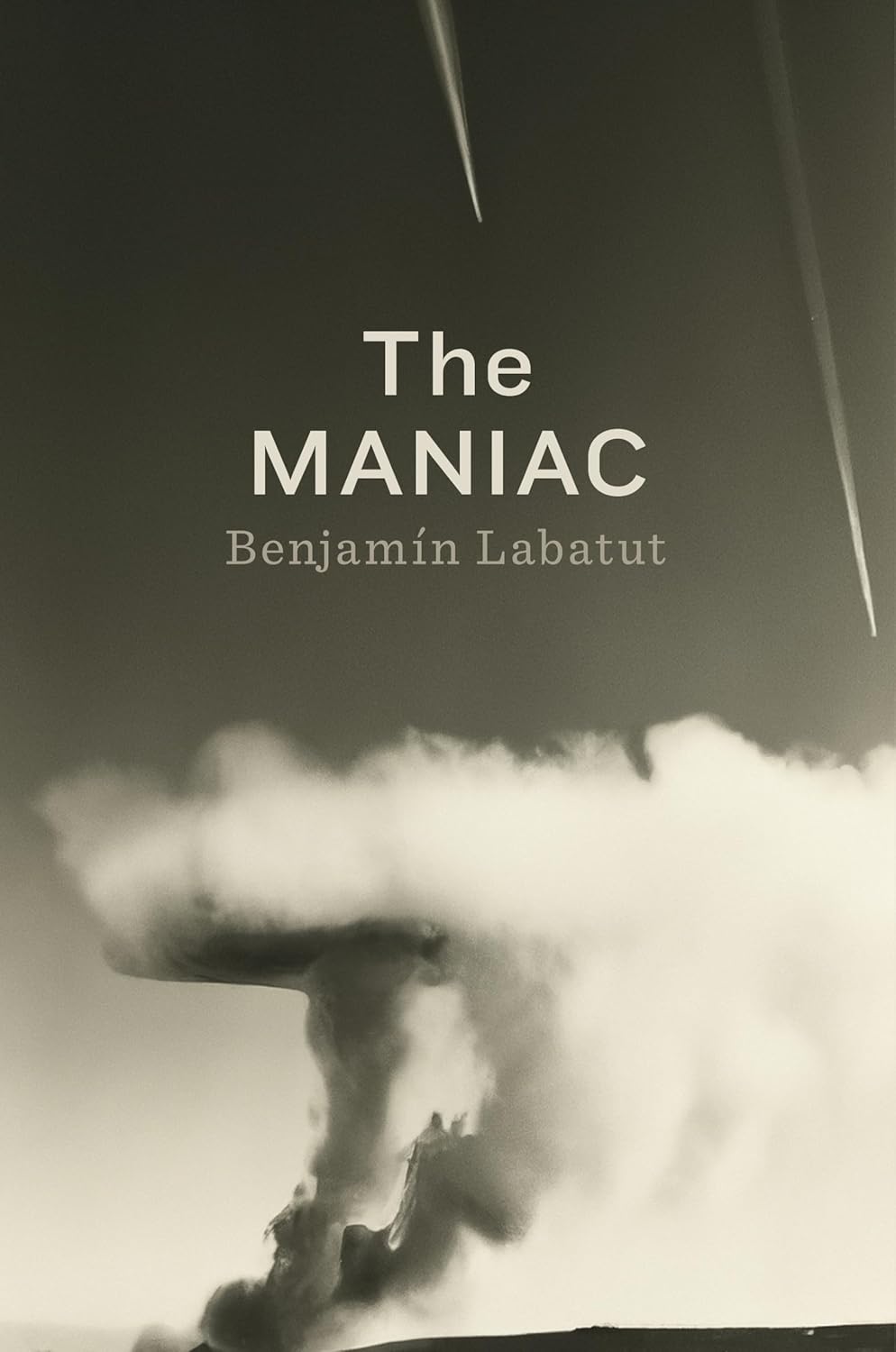
The MANIAC
by Benjamin Labatut
Some people seem to LOVE this book. I thought it was interesting and well written, but I was expecting more of a point.
The first part of the book is about Paul Ehrenfest, a physicist who becomes depressed and ends up shooting his son and then himself. The son had Down’s Syndrome. The facts of the story are true.
“Live almost all modern developments, mathematics was hostile to life. It is inhuman, like every truly diabolical machine, and it kills everyone whose spinal marrow isn’t conditioned to fit the movement of its wheels.” (10) This reminded me of Jacques Ellul. Technology presses forward and nothing can stop it, and it crushes things you don’t miss until they’re gone.
Then the second, largest part of the book is about John Von Neumann. “His intelligence was playful, not tortured.” (97) Again, the facts seem to be true. Each chapter is about Von Neumann but told from the perspective of various scientists, relatives, etc.
Godel modeled a universe where one could travel back in time, as a gift for Einstein. (99) I googled this, and it appears to be true.
Page 134 compares Von Neumann to Einstein. VN was incandescent. Einstein was like a drab old turtle, “but his insight was deeper.”
Mutually assured destruction was VN’s idea, along with Oskar Morgenstern, from a book they wrote about game theory. (137)
VN preferred noisy environments for working and thinking. (140) When people tell me this about themselves, I can never quite believe it. How can this possibly be preferrable? But apparently it’s true for VN.
Many Cold War-era nuclear weapons remain, “preserved inside sarcophagi like the long-dead bodies of the ancient pharaohs, ready and waiting for the life that begins with death.” (143)
After seeing ENIAC (military computer in Philadelphia), VN designed a computer. The same architecture is still used – I/O, RAM, ALU, CPU, etc. His computer was The MANIAC. (156)
They programmed the MANIAC to play a game they called “Anti-clerical Chess” – a 6x6 chess variant with no bishops, castling, or pawns moving two spaces. This was the first time a computer beat a human at a chess-like game. (The human was a grad student or something, who had only learned the rules yesterday.) (164)
Stan Ulam caught encephalitis and nearly died. Doctors drilled a hole into his brain, pumped him full of antibiotics, and he went into a coma for a while. They thought he might be brain damaged when he came out of it, but he was seemingly fine. So, while he was convalescing, the doctors told him not to think too much, to rest his brain. So he played solitaire, but he began noticing a way to predict the outcome after only seeing a few cards, and this led him to develop a statistical approach called the Monte Carlo method. (170)
“Truth – deep truth – is something that you must behold, but that you cannot speak aloud, at least not while making sense” (197). This is very true. The most profound thoughts that I cherish are impossible to really share with others. I’ve tried, and they just sound flat or cliched.
It’s too long to quote here, but I liked the extended explanation starting on page 166 of the hydrogen bomb as a sin. It was so big, its only purpose was a kind of destruction man should never be able to cause.
The third section of the book is about the history of AlphaGo, an AI engine that has beat Go masters.
“It did not take a genius to realize that scientific breakthroughs were transforming every aspect of our lives, while leaving the most fundamental questions unanswered.” (290)
The Go section talks a lot about Demis Hassabis. He got accepted to Cambridge at 15 but had to take a gap year, so he won a job at a computer game company, where he wrote the game Theme Park, sold millions of copies, and made enough money to pay for college. (291)
Lee Sedol retired from playing Go at age 36. “AlphaGo did not beat me, it crushed me.” No matter how hard he tried, “there is an entity that cannot be defeated. But it takes all the fun out of it – less an art, just computation. (350)
Both Sedol and KeJie (352) expressed a feeling of helplessness when playing AlphaGo.
I enjoyed this book but didn’t “get” it. I thought he’d connect the Von Neumann section to the Go stuff more. This was like reading a book about Von Neumann, then a long article about Go. Both were good, but they don’t seem very related.