Boone
June 24, 2021
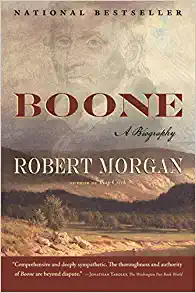
Boone
by Robert Morgan
This book was recommended by Steven Rinella on the Tim Ferris podcast. Reading it, I quickly learned how little I knew about Daniel Boone. For example, I did not know, to within 50 years, when he lived. I would have said he was at the Alamo, maybe. But he fought in the Revolutionary War and died in 1820.
The book is thoroughly researched and exhaustive, and consequently a little dry, especially early on. Boone had a lot of failed business ventures, and the details of his various debts proved about as interesting as you might expect. About 200 pages in I was about to give up on it, but then his daughter Jemima was kidnapped by Indians, and things got very interesting. Here are some highlights and things I noted.
Freemasonry
He was a Freemason (xxi). “His membership in that society connected him in unexpected ways with leading figures in the American Revolution… and with the new spirit of brotherhood, liberty, and reason spreading through Europe and North America.” Sounds like the spirit of the Enlightenment to me.
Religion
He was raised a Quaker, and a history of the Quakers is given (page 4ff). Quakerism took root in Wales, where people had always “loved music and praise. One of their own in the fifth century, named Morgan, had called himself Pelagius, translating Morgan (‘of the sea’) into Latin, when he rose to high office in Rome and preached a doctrine denying original sin…” (5-6)
“Quakers referred to the months by numbers to avoid using the pagan names such as January and February.” (6)
“Though he showed a reverent spirit, treated others with respect and kindness, demonstrated an inner calm, and developed the habit of daily Bible reading, he never belonged to any church nor ever confessed to any established creed.” (27)
“His worship was in secret and he placed his hopes in the Savior” according to his son Nathan (71).
Uses of Corn
There are a lot of ways to use corn. Corn could be:
- roasted for eating
- “gritted” into bread
- ground into grits or meal
- made into mush, pudding, or bread
- fed to horses, cattle, and hogs
- used to fill mattresses (the shucks)
- used to start fires, for pipes, and as toilet paper! (the cobs)
(page 35)
Indians
In Europe, hunting was done by nobility. Europeans who came to America learned to hunt from the Indians. (18)
“Class, the manner of a gentleman, the air of authority, were very important in the eighteenth century, even in the fronteir valleys.” Boone was admired by many but different, never quite fitting in with the “ruling class.” He was too much of a “white Indian.” (151)
“Many [Indian] warriors felt the missionaries were trying to turn them into women, for farming had traditionally been considered women’s work.” (247)
The Shawnee religion (female supreme deity, sacred plants, praying to the spirit of the underworld) is described a bit on pages 243-247.
Indian torture is described on pages 306-307. Ears cut off, prodded with burning sticks and coals, pushed face down into embers and scalped, roasted over a fire. “Crawford died like a hero; never changed his countenance, tho they scalped him alive, then laid hot ashes upon his head; after which they roasted him by a slow fire.” (307) Accounts of such torture inspired rage (and fear) among the white settlers of Kentucky.
Adventures
Boone came from Kentucky to North Carolina with John Stewart and a hunting party to hunt and get furs. Indians, who disapproved of hunting for sport or money, confiscated the furs and their horses. So Boone and Stewart sneaked into the Indian camp and retrieved the horses. The Indians caught them again two days later and took them as prisoners. Watching for the perfect moment, they escaped into a cane break at dusk, walked for 24+ hours, and rejoined their party! Amazing that they were able to find them. (102-106) Stewart later disappeared, with Boone discovering his body years later. (108)
He told a story about coming upon an Indian and shooting him. (114) It sounds like murder, like he was not really in danger (so not self defense), and he told the story in a joking manner, possibly because he felt guilty about it and was trying to confess.
The story of Jemima being kidnapped by Cherokees (on July 14, 1776) is one of my favorites, on pages 202-210. Too much to recount here, but definitely worth revisiting. I have scanned these pages here.
When a guy was pinned down by Indians next to a fort, but people inside dug a hole under the fort to reach him and get him to safety. (220)
He was kidnapped by the Shawnees in 1778. He was made to “run the gauntlet” (231). He was fed dog, elm bark, boiled deer entrails. (232) They would adopt people they liked into the tribe, and abducted whites often chose to remain with their Indian families (235). They named Boone “Sheltowee” (“Big Turtle”), and he was adopted as a son of the chief, Blackfish. (237) He learned the locations of all their towns. After living among them for 4 months, he gets a chance to escape and takes it. (249) He rode a horse till it collapsed, then continued on foot, taking measures to throw off pursuers trying to track him (he later found out this had worked). He built a raft from a dead poplar tree and took that down the Ohio River. (250) He had a rifle with a broken stock, so he carved a new stock for it from a sapling, then shot a buffalo and ate its hump – his first meal in two days. When he arrived back at the settlement (Boonesborough), he had traveled 160 miles in under four days, having eaten only one meal.
Blackfish and the Shawnees later tried to attack Boonesborough, aided by the British. At a peace meeting, they tried to trick the whites and capture their leaders. (263) Jemima was shot in the butt (269). Squire Boone made “squirt guns” to put out fires started by the attacking Indians (270). The Shawnees painted a fake face on some wood; they would stick it out from behind a tree and watch to see where shots were fired from, revealing the location of marksmen in Boonesborough.
[In the summer of 1780] Boone and a large party of men hunted deer south of the Kentucky River... One evening by the campfire Boone warned that he heard or sensed Indians nearby. He quietly directed his men to roll up some of the hides they had taken in blankets and arrange them around the campfire, then hide in the trees with their rifles. All night they waited and near dawn shots were fired, thudding into the blankets. Then the Shawnees rushed into the camp with their tomahawks and were killed or routed by the hidden hunters. (300)

Brave Women
The attack on Bryan’s Station in 1782 “began with eerie silence.” (311) The Indians and British silently took positions around the fort overnight. The settlers had little water, and access to water was outside the fort. But the Indians did not know that the settlers had seen them.
“It was decided to let the women and children and some slaves go out to the spring, as if no Indians were suspected.” They gambled that the Indians would not reveal their presence. After a prayer service inside, they went out in twos and threes, not as a big group. “They saw moccasins in the brush and a hand holding a tomahawk but pretended not to notice.” They chatted as if unconcerned, tediously dipping water with gourds. The British and Indians thought they retained the element of surprise and let the women return to the fort!
Misc
Daniel Boone led Abraham Lincoln (grandfather to the president) over the Cumberland Gap into Kentucky in 1779. (30)
He brought a copy of Gulliver’s Travels to read around the campfire. (107) Also influenced by Robinson Crusoe (339).
A comment about wars between Indian tribes in the spring (122) reminded me of “spring, the time when kings go out to war” in 2 Samuel. Making war in the spring may be a human universal (at least, unless technology mutes the effects of the seasons).
“Without women there would be no settlement” (134)
“Frontiersmen were remembered and honored more for character and dependability than marksmanship or scouting ability, Boone included. In the dangerous world of the West, integrity counted above all else.” (134)
“As in most wars, the greatest problem seemed to be boredom.” (148) At Moore’s fort, the men became so careless that the women (including Rebecca Boone and two daughters) took some guns, sneaked outside the fort, and fired them to scare the men and see them panic. (148)
“Boone was a complex man… and a good actor, who could assume almost any point of view. He could reflect the manners and opinions of Shawnees, British Officers, Spanish officials, or backwoodsmen.” He was a high self-monitor. (240)
Another man who escaped the Shawnees got lost in the woods and laid down to die. Then he noticed his own initials carved in a nearby tree, which proved he was close to the fort! (252) It’s interesting how many times someone’s carved initials come up as helpful clues in these stories.
“On this raid young Simon Kenton shot two Indians with the same bullet, killing one and wounding the other.” (254) Such things do happen!
The biography “Adventures of Col. Daniel Boone” by John Filson made Boone famous in America, Europe, and Britain. (337) It was written in 1784 and sold out its first printing. Rousseau’s idea of the “natural man” had taken hold of academics in Europe and prepared them to embrace the romantic legend of Daniel Boone and “the image of America as the new Eden.” (342) Filson, though undistinguished in other ways, “created the prototype of our national hero” in his bio of Boone (345).
“Boone the frontiersman, as an acknowledged agent of progress, sanctioned the civilizing process, whatever the cost to the Indians and to his own kind, and thereby put a happy face on a matter which somewhat troubled the American conscience.” (343)
“Supposedly uneducated people will sometimes surprise you with odd bits of information accumulated by hearsay or random reading.” (344) I like the idea of “random reading,” and I think you could describe almost all of my reading that way! “Anyone who has served in the army, or worked on a construction crew, or sailed on a ship, knows that unlikely people can demonstrate surprising bits of erudition.” (This reminds me of Dwayne.)
Boone’s family is listed as owning seven slaves in 1787. They likely served in a tavern he had opened (Boone’s Tavern, in Limestone, KY). “Though some writers have tried to argue that Boone disapproved of slavery, there is little evidence for that argument.” (348)
Some brutal wild west killing on pages 354 and 355.
Later in life, he was nearly crippled by arthritis. Even so, “Boone killed more deer than any of his neighbors because he knew their habits so thoroughly.” (380)
He named his favorite trap “Old Isaac.” (380)
Becoming Legendary
In his midthirties a man either reaches out toward risk and glory or stays within the routines of the expected and ordinary. It is the age when men leave safe homes and jobs and go on voyages, odysseys, perform transforming sacrifies. It is the age when Whitman wrote Leaves of Grass and Columbus started to plan his voyage to the Indies. It is the age at which visionaries become prophets or explorers or inventors, or make fools of themselves trying. Putting behind him his accumulated failures and humiliations, such a man must seize the new prospect and ride with it into greatness or defeat. There is no turning back. (109)
He was spying on the western wilderness, as if there was a secret he must obtain. It was beyond the next ridge, and it was farther down the river of his days, the intelligence he must gather. (110)
Daniel Boone did most of the things for which he is remembered between 1770 and 1782. He lived until 1820 and was a legend for the last thirty-six years of his life. But the legend is based almost entirely on the events of those eleven or twelve years.
Another hunter, hearing an odd sound while out hunting, went to investigate. It was Daniel Boone, lying on a deerskin in a clearing, singing to the sky, “indulging his love of song and craving a human voice, even if it was his own.”
Doubleness (and Honesty)
Richard Calloway disliked Boone, and there is an interesting passage about it on page 278:
Boone, like other gifted and innovative people, played the role of double agent throughout much of his life. It could be said that in that doubleness, seeing the world at once from two or more points of view and acting on that multiple vision, lies the very essence of originality and greatness. F. Scott Fitzgerald wrote in The Crack-Up, "The test of a first-rate intelligence is the ability to hold two opposed ideas in the mind at the same time, and still retain the ability to function." It was possibly this difference, this knack for dealing with Indians, this doubleness, that made men such as Calloway and Logan suspect and despise Boone. Complex and original people know that truth is rarely simple, almost never all of this or all of that, but elusive minglings and mixtures, evolving shapes, with tinctures of irony and paradox. Boone's actions often reveal his understanding and even relish for the complexity and shadings of experience. (278)
However duplicitous he might have seemed, he was essentially honest. His genius in the woods failed him in the courthouse and law office (290); he assumed that others were honest as he was, he trusted people, and this often burned him.
His doubleness comes up again on page 429, re: the comment “I have never been deceived by an Indian.” He had many times, but was able to hold this idea to be true along with all the stories from his own life that run counter to it.
Other Stories
When the Boone family left Kentucky for Missouri in 1799, his 18 year old son Nathan “was crushed to be leaving Olive Van Bibber,” who was only 16. When they reached Limestone, KY, Nathan bought a marriage license and left the group to go back up the Ohio and propose. He and Olive were married on September 26, 1799. (395) They would be married for 55 years and have 14 children.
Around 1810, Boone met John James Audubon. He showed him how to “bark” a squirrel, shooting the bark beneath it so that the animal died from the concussive force without being hit by the bullet. (420)
Romantic Innocence
The spirit of the Enlightenment comes up again at the end, when discussing Boone as the legendary hero after his death. Thoreau mimics the Apostles’ Creed to say, “I believe in the forest, and in the meadow, and in the night in which the corn grows.” Walt Whitman “celebrated himself and his body as the measure of all nature and society.” They don’t know where these things lead, though. “In his visionary zeal Whitman seems completely unaware that the Open Road he invites the reader to follow may lead ultimately to the shopping mall, the choked and smelly expressway, the polluted landscape. As the poet Louis Simpson would write in 1959, ‘The Open Road goes to the used-car lot.’” (454)
This is referencing Whitman’s poem, “Song of the Open Road.” Like Emerson, he sits above God and judges all. “From this hour I ordain myself loos’d of limits and imaginary lines, / Going where I list, my own master total and absolute.” Very much like Emerson in Self Reliance: “No law can be sacred to me but that of my nature. Good and bad are but names very readily transferable to that or this; the only right is what is after my constitution; the only wrong what is against it.”
Again from that poem: “I am larger, better than I thought, / I did not know I held so much goodness.” Or so much arrogance!
The End
“Heroes such as Boone were essential to the settlement of the frontier, but once the wilderness and Indians were gone the society had little use for the men themselves. It was the legend that was important.” (361) This reminds me of Gus and Call in Lonesome Dove. After spending their young lives rounding up Indians as Texas Rangers, Gus says, “We’ll be the Indians, if we last another twenty years. The way this place is settling up it’ll be nothing but churches and dry-goods stores before you know it. Next thing you know they’ll have to round up us old rowdies and stick us on a reservation to keep us from scaring the ladies.”
“Timothy Flint perceived an almost mystical fervor in the oldest settlers as they recalled the surpassing beauty of Kentucky in their youth, when they set about destroying the scene which was ever to be their fondest recollection.” (413)
Boone eventually decided to leave Kentucky. “Kentucky had gotten away from him. The beavers and buffalo and Indiands had been replaced by lawyers and politicians and crooks.” (369) “The irony could not have been lost on Boone that he, as much as any other single human being, had helped create the world that was now repugnant to him.” “The paradox had been present in almost everything he had done, and yet he had ignored or misunderstood it.” As KY got more prosperous, it became more cultured, and “it was that pretension to gentility that Boone wanted to escape.” (390) When he left, he intended to never return. (394)
Sick unto death, he wanted to keep his mind clear, and refused painkillers. People in his time talked about “a beautiful death." Deaths were described, critiqued, commended on like works of art. These days, death is hidden away, and most people die in a hospital or similar institution. In Boone’s day, people generally died at home, often with family gathered and keeping a death vigil. “The old felt death coming on, recognized it.” They had their final say, with hugs and kisses and shared memories, and hopefully forgiveness.