Planet Narnia: The Seven Heavens in the Imagination of C. S. Lewis
January 1, 0001
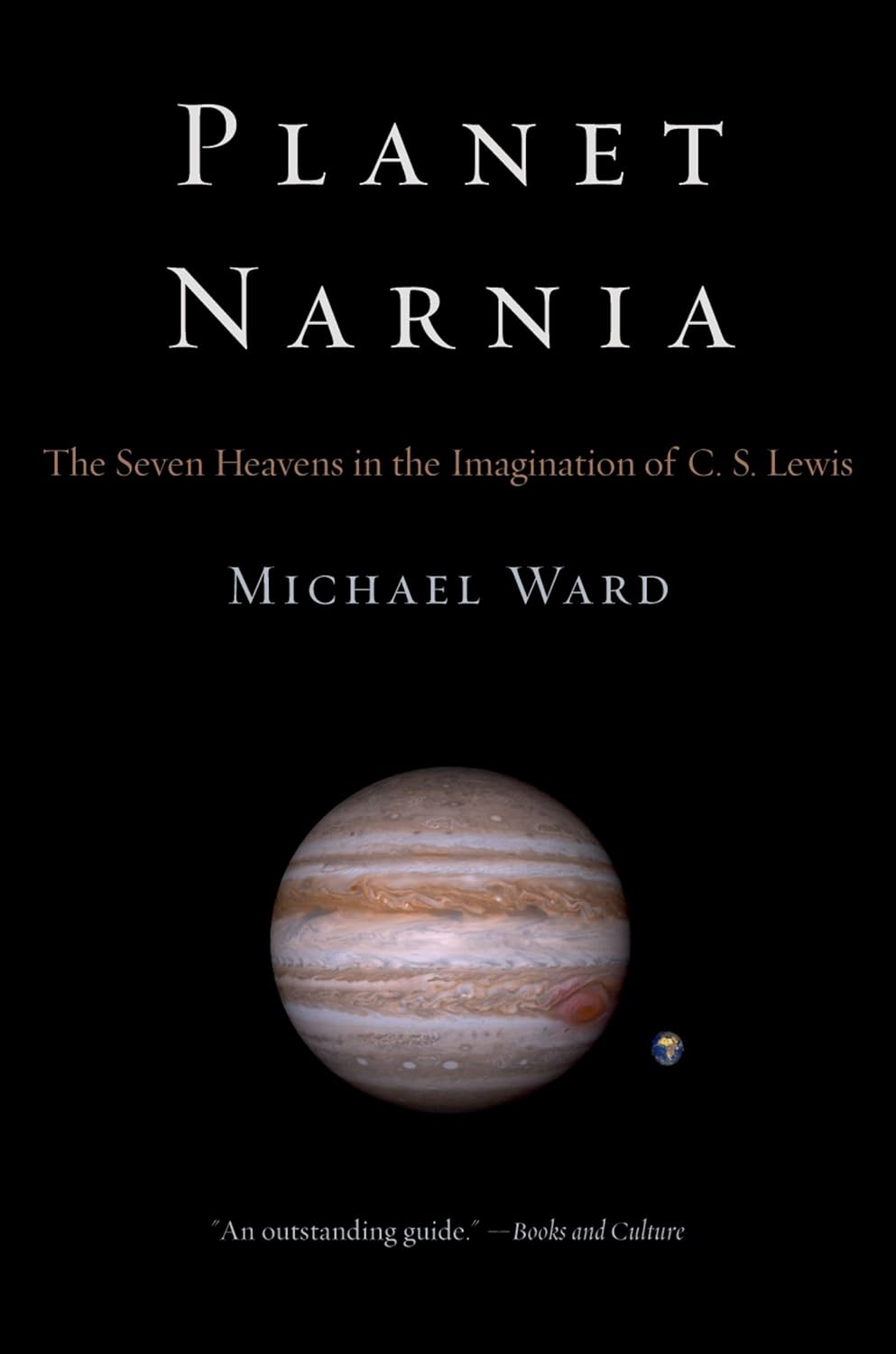
I learned about this book from a blog post by Robin Sloan. That piqued my interest and led me to this excellent 90-minute talk by the author, which covers many of the most interesting points from the book: https://www.youtube.com/watch?v=h_beSe2cLQI.
In short, Ward believes that the seven books in the Chronicles of Narnia (or the “Narniad,” as he sometimes calls it) are in various ways patterned on the “seven heavens” of medieval cosmology.
These were (moving out from the earth), these seven heavenly objects: the Moon, Mercury, Venus, the Sun, Mars, Jupiter, and Saturn. To the medieval mind, they had influence (similar to astrology), impacting things on earth in specific ways. In Lewis’s conception, they each reflect true things about Christ, different aspects of God.
Ward goes to great lengths to make this case, with a million examples, which is very convincing but kind of too much for casual reading. Once I got past Jupiter (the bases for The Lion, the Witch, and the Wardrobe), I skimmed the next several chapters.
Here are my notes:
CSL regarded Till We Have Faces as his best work. (In The Fellowship, I read that it was considered hard to read and a second-tier work by most people. I haven’t read it.) (6)
“The Lord of the Rings was largely written to keep Lewis quiet.” In a letter, Tolkien wrote that he did not think he’d have completed or published it without CSL’s encouragement. (9)
“Intricacy is a mark of the medieval mind.” In his poetry, “the poems which look as if they are free verse are actually in the most complicated meters of all.” (11)
In Medititation in a Toolshed, we get the difference between looking at a beam of light – “From where I stood that beam of light, with the specks of dust floating in it, was the most striking thing in the place. Everything else was almost pitch-black.” – and looking along the beam: “Then I moved, so that the beam fell on my eyes. Instantly the whole previous picture vanished. I saw no toolshed, and (above all) no beam. Instead I saw, framed in the irregular cranny at the top of the door, green leaves moving on the branches of a tree outside and beyond that, 90 odd million miles away, the sun. Looking along the beam, and looking at the beam are very different experiences.” (17)
Looking at the beam is Contemplation. Looking along the beam is Enjoyment.
The key here is that, when you are looking along the beam, you don’t see the beam. You see everything else by the beam. In the Narniad, each book is illuminated by a certain heavenly body, but this is (importantly!) never discussed or called out directly. It is hidden to such a degree that it took 50 years before a critic discovered it!
Enjoyment = participation, inhabited, personal, committed knowledge
Contemplation = abstract, external, impersonal, uninvolved knowledge
The modern mind sees veiling truths and embedding secret meanings as “elitist.” E.g., doing Mass in Latin only. “But in earlier times the distinctions which these habits of thought maintained would have been felt to be real and valuable. Since both pearls and swine exist, it was important not to throw the former before the latter.” (20)
George Macdonald: “If I cannot draw a horse, I will not write THIS IS A HORSE under what I foolishly meant for one. Any key to a work of imagination would be nearly, if not quite as absurd.” (20) So if you are creating with some key inspiring you, keep it to yourself!
“The medieval universe was… a festival, not a machine.” The modern view of the universe is very mechanical.
Milton was the first to call it “space” and not “the heavens.” (26) “…He marked the transition to the new disenchanted model of the universe.”
Spenser thought, and CSL agreed, that God spoke on Parnassus as well as on the Mount of Olives. All truth is God’s truth. (For the other side of this, see Pastor Harris’s blog) Tertullian vs. Clement – Clement wanted Christianity built on and argued from Plato. See also the Scholastics.
Non-occult aspects of astrology were accepted by Christians pre-Copernicus. The stars influence us – see Judges 5:20, Job 38:31. (29)
Allegory and symbolism. You can view our world as the allegory for another, invisible world. The allegorist is a teacher, the symbologist a pupil. (30) Symbolism is a mode of thought, allegory a mode of expression. (31)
Dante was Lewis’s favorite poet. (41)
A Jupiter day is 10 hours!
Jupiter’s red spot – a king with a wound in his side, like Christ. (56)
“Jovial nations are ‘just and gentle’ according the [CSL’s poem] The Planets. It is significant that Edmund is given the title ‘Just’ and Susan the title ‘Gentle.’ Peter’s title is also Jovial. He is known as ‘Magnificent,’ a designation which, on the face of it, has no specific link to the semantic field out of which Lewis habitually works when writing about Jupiter. On closer inspection, Lewis is deliberately perpetuating an error Spenser made (‘due to some bad Latin translation’) when he mistook Aristotle’s megaloprepeia for megalopsychia, ‘Magnificence’ for ‘Magninimity’.” (64)
So he should have been Peter the Magnanimous, but CSL wanted to tip his hat to a mistake from Spenser. This is next-level language nerdery, and I love it.
“I am contending for an atmosphere or a flavour; I am not suggesting that Lewis pedantically selected every single word of this story for its unequivocal Joviality.” (65) This view is confirmed by a quote from CSL on p. 66:
The irregularities in _The Winter's Tale_ do not impair, but embody and perfect, the inward unity of its spirit.... A supreme workman will never break by one note or one syllable or one stroke of the brush the living and inward law of the work he is producing. But he will break without scruple any number of those superficial regularities and orthodoxies which little, unimaginative critics mistake for its laws. The extent to which one can distinguish a just "license" from a mere botch or failure of unity depends on the extent to which one has grasped the real and inward significance of the work as a whole. (66)

A possible meaning of the name Cair Paravel:
True human kingliness (taking its form from Christ) finds its authority in submission to the commands of the higher king and issues in service of the lower king, who in turn communicates royalty to the rank below him, and so on through all creation. This principle may have guided Lewis's choice of the name 'Cair Paravel, a combination of cair' meaning walled city or castle, and 'paravail,' meaning beneath or under (a 'tenant paravail' holds property under another person who is himself a tenant). Cair Paravel thus means something like 'Castle Under Castle.' (69)
He was moved by Queen Elizabeth II’s coronation:
He was...deeply moved when he watched the coronation of Queen Elizabeth II: The pressing of that huge, heavy crown on that small, young head becomes a sort of symbol of the situation of humanity itself: humanity called by God to be His vice-gerent and high priest on earth, yet feeling so inadequate.... One has missed the whole point unless one feels that we have all been crowned and that coronation is somehow, if splendid, a tragic splendour. (69)
Ward explains his concept of “Donegality”:
Surveying the various words which Lewis uses to denote ipseitas, I propose to elect 'Donegality' for this particular destiny. Biographically it is appropriate because Lewis loved Donegal all his life. Semantically it is appropriate because of the imagined etymology: 'don' (as presiding intelligence) + egalité (equality), yielding a word meaning something equal to a presiding intelligence.' But the best reason to coin 'Donegality' in this sense has to do with Jovial imagery. Jupiter gives rise to 'the waves' joy and jubilee,' and Donegal, that Irish county whose craggy coast-line fronts the Atlantic, was the place which Lewis especially associated with the joy of waves.
…
'Donegality' then will serve very aptly as a technical term. By donegality we mean to denote the spiritual essence or quiddity of a work of art as intended by the artist and inhabited unconsciously by the reader. The donegality of a story is its peculiar and deliberated atmosphere or quality; its pervasive and purposed integral tone or flavour; its tutelary but tacit spirit, a spirit that the author consciously sought to conjure, but which was designed to remain implicit in the matter of the text, despite being also concentrated and consummated in a Christologically representative character, the more influentially to inform the work and so affect the reader. (75)
Lewis attempts to awaken an awareness of Jupiter “in the hearts of readers born under Saturn.” (76)
He gives a good list of martial vices and virtues on p. 78:
Lewis knows that Mars is a bad planet, Infortuna Minor, and so he readily acknowledges Martial cruelty, trouble, haughtiness, gracelessness, mercenariness, insolence, coldness. On the other hand, he knows that, above the orbit of the Moon, there is nothing bad per se. And so we find listed alongside many Martial vices, many Martial virtues: righting wrongs, rescuing the meek, laughter, beauty, keenness, blitheness, happiness, achievement, courage, strength.
Mars Silvanus - not just a god of war but also of growth, greenery. Hence the month of March.
Martial hardness is not heartlessness. It “gives backbone to the milksop” but also “reins in machismo.” (94)
I skimmed most of the planet-by-planet chapters, up to chapter 10 (p. 214). He hammers home his point with dozens of examples in great detail – much more than I require to be convinced!
Fairy tales became associated with kids only when they became out of fashion in literary circles. (216)
How the supernatural has been forgotten:
The fact which is in one respect the most obvious and primary fact, and through which alone you have access to all the other facts, may be precisely the one that is most easily forgotten-forgotten not because it is so remote or abstruse but because it is so near and so obvious. And that is exactly how the Supernatural has been forgotten. (226)
(Like the fish asking, “what’s water?”)
Knowing God is like breathing a new atmosphere:
Coming to know God, for Lewis, is not like learning a subject but like "breathing a new atmosphere," and it is of the highest significance that the word atmosphere, which is his preferred term for the kappa element in romance, should also serve for his description of the nature of the Christian life. As a story's inner meaning is cryptic, so, Lewis believes, is one's spiritual state. Standing sentinel at the door of one's mind in order to check up on one's spiritual life is the surest way to inhibit it. When Lewis himself became a Christian in Surprised by Joy there was no part of him left over or outside the act, no officious spectator observing the transformation from a distance. He had entered into joy. (227)
Just as Boethius is considered the last “classical mind”, Lewis is the last medieval mind. He read the medieval texts as a native, where the rest of us can’t; we just don’t think that way. In the Narniad, he attempted to translate the medieval mind into something we could appreciate and understand:
This is where Lewis, the self-proclaimed dinosaur who read as a 'native' texts that his students had to read as foreigners, felt he had a vocation. If the all-but-extinct thing "infused its quality into some other thing which we can get inside, then this other, more penetrable, thing would now be the only medium through which we can get back to the experience itself. Such a 'more penetrable thing' might be provided by a work of plastic or literary art which we can still appreciate," for "it is either in art, or nowhere, that the dry bones are made to live again." (229)
“Intricacy is a mark of the medieval mind.” (236)
“The scientific method does not give us a new way of knowing, only a new way of testing.” (242)
“When a Russian cosmonaut claimed not to have found evidence of God in outer space, Lewis’s response was, ‘Much depends on the seeing eye.’” (243)
Ward’s account of his discovery that Lewis used the seven heavens as the imaginative framework for the Narniad, pp. 249-252, is delightful. “I did not shout ‘Eureka!’ and run naked down the street like Archimedes, but I did jump from my bed in a state of undress and began to pull books from my shelves, chasing links from work to work.” I can imagine!
Vocab
- discarnate - having no material body or form (237)
- ectype - a copy from an original (56)
- Empyrean - the highest heaven, paradise, home to God and His angels (55)
- festschrift - a collection of writings presented as a tribute or memorial, especially to a scholar (47)
- gradgrind - one who relies solely on scientific measurements and observable facts, without taking into account human nature. (Gradgrind is a character in Dickens’ Hard Times) (27)
- guttering - dim, nearly extinguished, as in “the guttering lights” (28)
- sidereal - of the stars (56)