Tunnel in the Sky
December 20, 2025
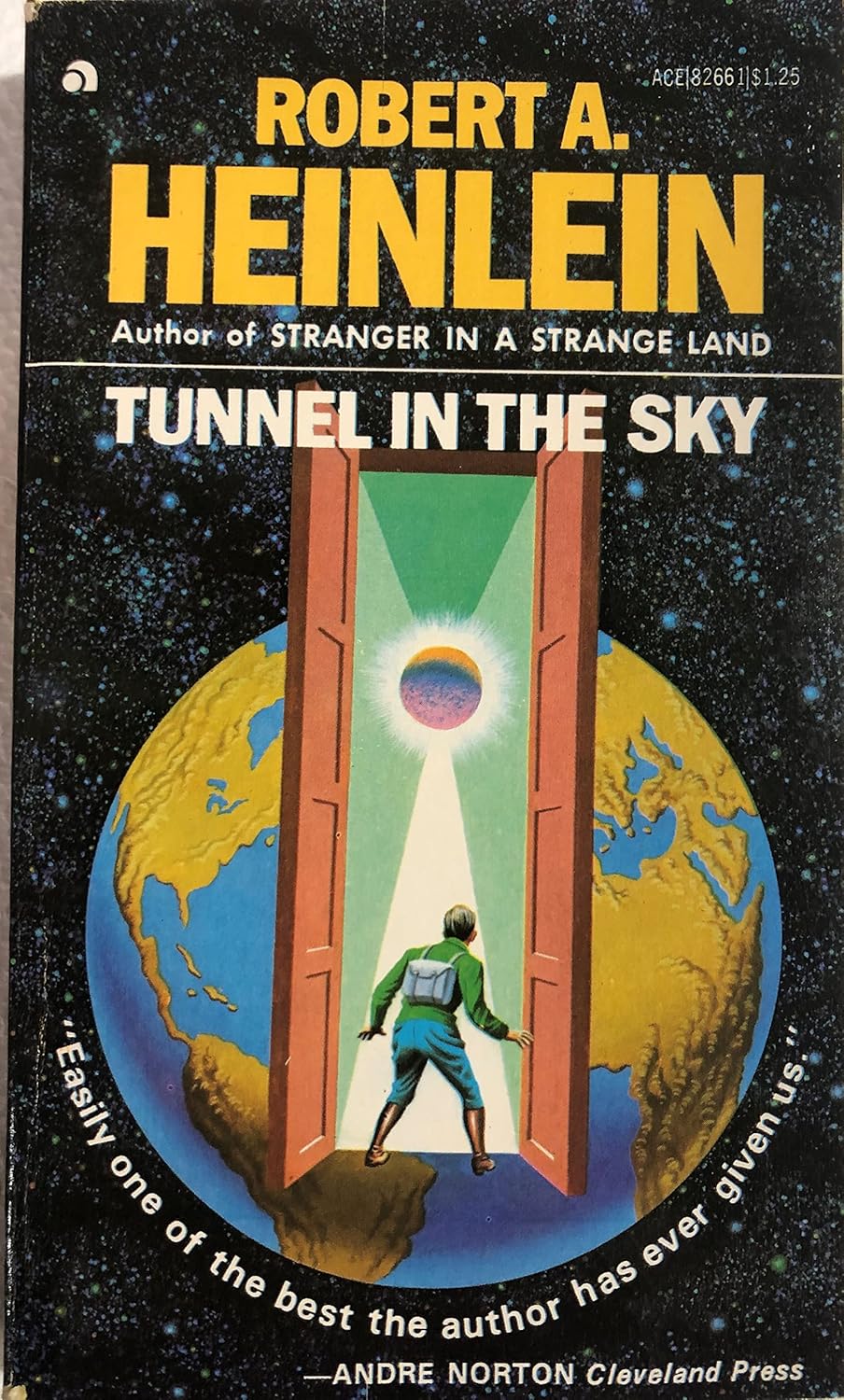
Tunnel in the Sky
by Robert Heinlein
I read this in bits while waiting on long-running computer processes, and it was a good choice for that. I like the premise (LOTS OF SPOILERS FOLLOW): Students in a survival class must complete a final exam, living for a few days (up to a couple of weeks) on a remote planet. They don’t know anything about the planet and must pack for anything. Some team up, some prefer going solo. They reach the planet by passing through a portal (the “tunnel in the sky”). Right before doing so, they pass a sign warning them to “beware of the stobor.”
Once they get there, it’s a survival story, but one that takes up interesting threads and then doesn’t do much with them:
Rod (the main character) encounters creatures that make a horrible, terrifying noise and stare at him all night. But in the light of day, they are not threatening.
Then he finds that someone is killing students and taking their weapons and stuff. He meets Jack, who has Rod’s knife, so Rod thinks Jack is the killer, but it turns out Rod found the knife on the killer’s body after an animal killed the killer. So that could have been an interesting setup for something, but it went nowhere.
Then it turns out that Jack is actually a girl but was concealing that fact from Rod. Could we now have a love story? Nope. Nothing much comes from that either.
The portal is supposed to open to end their exam, but it never does. Eventually they decide something must have gone wrong, and they must form a colony. They group together, figure out the patterns of the animal life, and eventually form a constitution.
Although Rod started the colony, some older boys kind of take over running it, and they seem to be conniving and plotting to edge Rod out. So… political intrigue? Not really, it all kind of peters out. Rod is eventually the mayor of Cowpertown, their settlment.
And then, just as nothing much is happening, the portal opens back up. It turns out there was a supernova in the area which screwed up the tunnel system for … years? A long time.
And now Rod, who has lived with autonomy and been in charge of a settlement must return to being seen and treated as a child. This chafes too much, and at the end of the book, he is leading a group of settlers back to that planet to stay.
“Remember, your best weapon is between your ears and under your scalp – provided it’s loaded.” (14)
A robot is called a “robut”! This book was written in 1955.
“Intelligence is an aimless byproduct” of our drives to survive and reproduce. (29) Um, no.
On nominative determinism: “It is useless to speculate as to the course of history had Jesse Evelyn Ramsbotham’s parents had the good sense to name their son Bill instead of loading him with two girlish names. He might have become an All American halfback and ended up selling bonds and adding his quota of babies to a sum already disastrous. Instead he became a mathematical physicist.” (30) (Note how the idea of overpopulation is casually accepted.)
“Einstein, Newton, and Columbus” – three kinds of explorers. (32)
“Man is not a rational animal; he is a rationalizing animal.” (42)
“The greatest invention of mankind is government.” (130)
In the end, we learn that the “beware of the stobor” sign was kind of a trick. The kids figured out which animal was the “stobor,” and near the end of the book, Rod gets the chance to ask his teacher, “These are stobor, aren’t they?”
"I suppose these must be stobor," Matson admitted, "but I did not know what they looked like."
"Huh?"
"Rod, every planet has its 'stobor'... all different. Sometimes more than one sort... You remember me telling the class that every planet has unique dangers, different from every other planet in the Galaxy?"
"Yes..."
"Sure, and it meant nothing, a mere intellectual concept. But you have to be afraid of the thing behind the concept, if you are to stay alive. So we personify it, but we don't tell you what it is. It is to warn you that the unknown and deadly can lurk anywhere... and to plant it deep in your guts instead of in your head."
"Then there *weren't* any stobor! There never were!"
"Sure there were. You built these traps for them, didn't you?" (240)

In the end, I liked the original premise and the atmosphere of the book, but none of it paid off all that well. Also, their struggles had surprisingly little to do with human nature – sin was not much of a factor, other than a few lazy and stubborn older kids who had to be dealt with. Family closeness was lacking, too – Rod and his sister Helen get along, but there doesn’t seem to be much love between the kids and the parents. All in all, the book was entertaining but lacked significance.