The Pale King
November 30, 2025
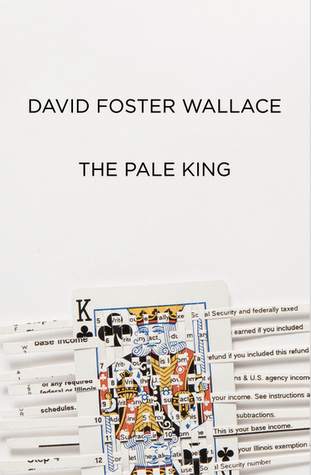
The Pale King
by David Foster Wallace
DFW had been working on this book for over a decade when he killed himself. He left behind the work in progress, somewhat neatly organized for his surviving wife and editors to turn into something. So it’s incomplete, and you can tell. People reviewed this book like it’s still a work of genius, but I struggled to complete it. It does contain some brilliant sections. It assembles some fascinating characters but doesn’t seem to have them do much of anything, or the plot is so buried in pages of IRS minutiae that you don’t care to find it. Which might be part of the point (having to suffer through boredom to get to something good), but come on!
Here are my notes:
The name Merrill Errol Lehrl, presented without comment. (6) I like funny names from postmodern writers (Pynchon does this a lot).
“The dark Service joke” was that the director’s desk “had a Trumenesque plaque on it which read: WHAT BUCK?” (8)
Sylvanshine thinks that if he fails teh CPA exam, he’ll end up a janitor. Here’s how DFW expresses that:
He tried the incline-to-the-side thing of stretching out his neck's muiscles on each side very gently and gradually but still got a look from the older lady, who with her dark dress and staved-in face appeared more and more skill-like and frightening and like some type of omen of death or crushing failure on the CPA exam, which two things had collapsed in Sylvanshine's psyche to a single image of his silently, expressionlessly pushing a wide industrial mop down a corridor lined with frosted-glass doors bearing other men's names. (10)

“He’d been so nervous [on a date] that he’d yammered on and on about himself and never asked her about herself…, which was why she hadn’t liked him enough and they hadn’t connected… What appears to be egoism so often isn’t.” (16)
Goals:
Thought blocking, overinclusion. Vagueness, overspeculation, woolly thinking, confabulation, word salad, stonewalling, aphasia. Delusions of persecution. Catatonic immobility, automatic obedience, affective flattening, dilute I/Thou, disordered cognition, loosened or obscure associations. Depersonalization. Delusions of centrality or grandeur. Compulsivity, ritualism. Hysterical blindness. Promiscuity. Solipsismus or exstatic states (rare). (60)
(This is a list of diagnoses about the girl in ch. 8, Toni Ware.)
The “Author’s Foreword” is… chapter 9. DFW inserts himself as a character, a fictionalized version of himself who worked for the IRS one summer. In ch. 9, he says The Pale King is a “portrait of a bureaucracy.” (68)
Mendacem memorem esse oportet. A liar should have a good memory. (78)
Quo vide. On this matter, go see… (79) (Use c.f. to point to articles or docs that prove your point. Use q.v. to refer to another part of the same work. Maybe?)
“Abstruse dullness is actaully a much more effective shield than secrecy.” (83)
Why do we require stimulus and avoid boredom? “The terror of silence with nothing diverting to do”:
To me, at least in retrospect, **the really interesting question is why dullness proves to be such a powerful impediment to attention. Why we recoil from the dull.** Maybe it's because dullness is intrinsically painful; maybe that's where phrases like 'deadly dull' or 'excruciatingly dull' come from. But there might be more to it. Maybe dullness is associated with psychic pain because something that's dull or opaque fails to provide enough stimulation to distract people from some other, deeper type of pain that is always there, if only in an ambient low-level way, and which most of us spend nearly all our time and energy trying to distract ourselves from feeling, or at least from feeling directly or with our full attention. Admittedly, the whole thing's pretty confusing, and hard to talk about abstractly... but surely something must lie behind not just Muzak in dull or tedious places anymore but now also actual TV in waiting rooms, supermarkets' checkouts, airports' gates, SUVs' backseats. Walkmen, iPods, BlackBerries, cell phones that attach to your head. This terror of silence with nothing diverting to do. I can't think anyone really believes that today's so-called 'information society' is just about information. Everyone knows it's about something else, way down. (85)
When I go to page 99, I stopped and made a list of the characters so far, to help me keep up. I would not say this really helped much.
On p. 107ff, this obviously intelligent, mostly coherent agent keeps saying “type of thing” to punctuate thoughts or soften details. A verbal tick, part of his “voice,” like “and stuff like that,” “that’s what’s up,” or even just, “like.”
Sylvanshine is a “fact psychic.” He has “Random Fact Intuition,” which means he Just Knows Things. But they are all pointless and irrelevant. (119) “The fact psychic lives part-time in the world of fractuous, boiling minutiae that no one knows or could be bothered to know even if they had the chance to know.” In other words, Twitter.
Coin collecting seems like a “debased and distorted” hobby to Lane, “as a Christian.” I wonder why DFW thinks Christians wouldn’t like coin collecting? (It is it more subtle: that the kind of legalistic Christian Lane is wouldn’t like it?)
“We [Americans] think of ourselves as citizens when it comes to our rights and privileges, but not our responsibilities.” (130) We abdicate these to the government and expect the government to legislate morality.
“There are all kinds of conservatives depending on what it is they want to conserve.” (132)
Corporations:
But the whole dark genius of corporations is that they allow for individual reward without individual obligation. The workers' obligations are to the executives, and the executives' obligations are to the CEO, and the CEO's obligation is to the Board of Directors, and the Board's obligation is to the stockholders, who are also the same customers the corporation will screw over at the very earliest opportunity in the name of profit, which profits are distributed as dividends to the very stockholders-slash-customers they've been f-ing over in their own name. **It's like a fugue of evaded responsibility.** (136)
“The customer’s psyche [is] in bondage to conformity and the way to break out is not to do certain things but to buy certain things.” (145)
Chapter 22 (pp. 154-252) is the best part of the book. Nearly 100 pages long, this chapter has been published separately as the novella,. “Something to Do With Paying Attention.”
“I remember once, in I think 1975 or ‘76, shaving off just one sideburn and going around like that for a period of time, believing the one sideburn made me a nonconformist – I’m not kidding – and getting into long, serious conversations with girls at parties whou would ask me what the lone sideburn ‘meant.’ A lot of the things I remember saying and believing during that period make me literally wince now…” (161) We all cringe remembering our younger selves.
The long paragraph (aren’t they all, in this book? This paragraph is 5 pages long!) beginning on p. 167, where he thinks about his father, how he misunderstood him. He was actually smart, witty, kind of bored. But dismissed by his son.
He takes a drug that causes him to “double” – to have sensations and also be aware of himself having the sensations, basically. Music does this, when you are having emotions while listening, but also are aware of them, “able to say to yourself, this song is making me feel both warm and safe… There’s an emptiness at the center of the warmth like the way an empty church or classroom with a lot of windows through which you can only see rain on the street is sad, as though right at the center of this safe, enclosed feeling is the seed of emptiness.” (183)
His dad didn’t give advice. Wise enough to be suspicious of his desire to seem wise. (208)
“I never seem to recognize important moments at the time they’re going on – they always seem like distractions from what I’m really supposed to be doing.” (218)
I liked this realization he has: He’s sitting in his dorm room, being a “wastoid,” watching a soap opera on TV. Every time it goes to commercial, the announcer says, “You’re watching As the World Turns.” And it strikes him, after hearing that dozens or hundreds of times in his life, that the announcer is talking to him directly. He is watching As the World Turns. And later, he hears the double entendre: “You’re watching, as the world turns.” “It could not have felt more concrete if the announcer had actually said, ‘You are sitting on an old yellow dorm couch, spinning a black-and-white soccer ball, and watching As the World Turns, without ever even acknowledging to yourself this is what you’re doing.’ This is what struck me. It was beyond being feckless or a wastoid – it’s like I wasn’t even there.” (222)
The problem with nihilism (one of them, anyway): If nothing matters, you don’t matter either:
I knew, sitting there, that I might be a real nihilist, that it wasn't always just a hip pose. That I drifted and quit because nothing meant anything, no one choice was really better. That I was, in a way, too free, or that this kind of freedom wasn't actually real -- I was free to choose 'whatever' because it didn't really matter. But that this, too, was because of something I chose -- I had somehow chosen to have nothing matter. It all felt much less abstract than it sounds to try to explain it. All this was happening while I was just sitting there, spinning the ball. The point was that, through making this choice, I didn't matter, either. I didn't stand for anything. If I wanted to matter -- even just to myself -- I would have to be less free, by deciding to choose in some kind of definite way. (223)
Childhood’s end: “To experience commitment as the loss of options, a type of death, the death of childhood’s limitless possibility, of the flatter of choice without duress – this will happen, mark me. Childhood’s end.” (228)
How his father expresses worry:
For instance, it was during this argument that I overheard my father say the thing about my being unable to find my ass even if it had a large bell attached to it, which my mother heard mainly as him passing cold, rigid judgment on somebody he was supposed to love and support, but which, in retrospect, I think might have been the only way my father could find to say that he was worried about me, that I had no initiative or direction, and that he didn't know what to do as a father. (235)
Around p. 262, I’m questioning whether I want to finish this book. There’s gold in here, but it requires so much digging. Since there’s not much plot, maybe I can skip through and read parts that seem interesting. I read chapter 22, so it already “counts” as reading a book in my mind (since that chapter is published as its own book).
I skipped most of chapter 24. Chapter 25 is mostly four pages of names. 27, brutal. 28, no.
Chapter 29 - okay. Fat Marcus the Moneylender, who sat on the faces of sleeping freshmen. Diablo the left-handed surrealist. Chapter 32, a girl does an amazing impression of the girl from The Exorcist. Page 383ff, a history of words for boredom. Chapter 36, a boy who daily stretches to be able to touch his lips to every part of his body.
“If you are immune to boredom, there is literally nothing you cannot accomplish.” (438)
Drinion levitates slightly when he’s fully immersed in something. This happens in a long, sometimes interesting sometimes tedious, conversation with Meredith Rand in chapter 46. (485)
At the end of the book, there are Notes, with more about DFW’s plans for the novel. IRS Examiners with “special abilities” are being collected. Sylvanshine is a fact psychic. Fogle knows a sequence of numbers that gives him perfect concentration. Drinion levitates.
Leonard Stecyk: “What happened to make him realize that the Niceness of his childhood was actually sadistic, pathological, selfish.” (542) I thought he was an intereting character, someone so over-the-top nice (see chapter 5) that it basically drives everyone around him insane.
Bliss “lies on the other side of crushing, crushing boredom.” (546)
Vocab
- agnate - coming from a common source, related on their father’s side (53)
- anfractuous - tortuous, full of twists and turns (53)
- dyadic - twofold (54)
- éclat - conspicuous success (9)
- ephebes - youth agest 18-20 in ancient Greece (80)
- etiology - the study of causes or origins (475)
- imbrication - overlapping like fish scales or shingles (58)
- latent content - the hidden, symbolic meanings behind the events of a dream (Freudian, 99)
- plaint - lamentation (59)
- “said her decade” - of the Rosary, i.e. 10 Hail Mary’s and one Our Father (64)
- semions - evidence of a divine commission (73)
- swivet - panic (70)
- temblor - earthquake (220)
- thanatoid (68)