A Swim in a Pond in the Rain
November 16, 2025
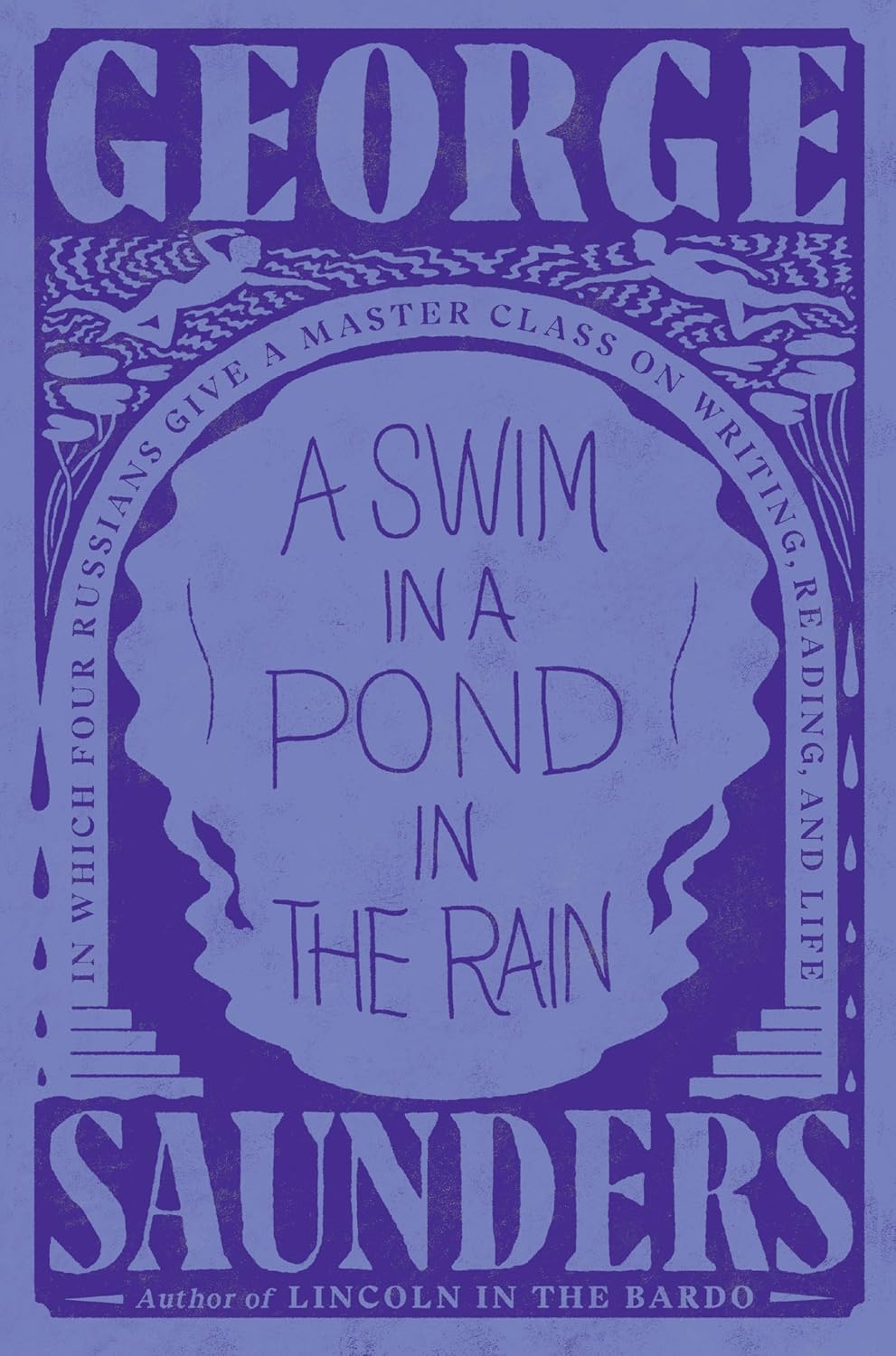
A Swim in a Pond in the Rain
by George Saunders
In the intro, Saunders says that some of his happiest, most satisfying moments have come while teaching a particular English class to MFA students at Syracuse University. So, he turned that course into this book. In it, there are seven short stories written by four Russian masters in the 19th century. They are:
- In the Cart, Chekhov
- The Singers, Turgenev
- The Darling, Chekhov
- Master and Man, Tolstoy
- The Nose, Gogol
- Gooseberries, Chekhov
- Alyosha the Pot, Tolstoy
After each story, there is an essay discussing it in detail from a writer’s perspective. The one exception is the first story, which you read one page at a time, with comments from Saunders between pages to track your feelings about the story and characters.
After reading these, my uncontroversial opinion is that Tolstoy is a genius. Master and Man was by far the longest story here (about 50 pages), and it flew by. Alyosha is the shortest (6 pages) but packed a lot into few words. Chekhov, I’ve decided, is not for me – the essays helped me appreciate him more, but I would not enjoy reading those stories on their own. Turgenev, same thing. Gogol was funny and weird, and I might want to read The Overcoat sometime.
Below are my notes, mostly about the writing process (from the essay portions of the book).
“In the first pulse of a story, the writer is like a juggler throwing pins in the air. The rest of the story is the catching of those pins.” (14) The story sets expectations. You’ll be pleased if it takes them into account, but not if it addresses them too neatly. (12)
Structure = call and response. “A question arises organically from the story and then the story, very considerately, answers it.” Be aware of what questions you are causing the reader to ask.
There should be a name for this moment in a story when, a situation having been established, a new character arrives. **We automatically expect that new element to alter or complicate or deepen the situation.** A man stands in an elevator, muttering under his breath about how much he hates his job. The door opens, someone gets in. Don't we automatically understand that this new person has appeared to alter or complicate or deepen the first man's hatred of his job? (Otherwise, what's he doing here? Get rid of him and find us someone who will alter, complicate, or deepen things. It's a story, after all, not a webcam.) (21)

Don’t hold back on a big reveal. “If you know where a story is going… make the story go there, now.” Get past the obvious to discover something better.
The (Stuart) Cornfield Principle: Each unit of a screenplay needs to 1) be entertaining, and 2) advance the story in a non-trivial way. (42)
A story is not like real life. It is a limited set of elements that we read against one another. (48) Don’t make things happen for no reason.
An artist takes responsibility. Tak care. Do things with purpose. (62)
“It’s hard to get any beauty at all into a story. If/when we do, it might not be the type of beauty we’ve always dreamed of making. But we have to take whatever beauty we can get, however we can get it. I teach The Singers to suggest to my students how little choice we have about what kind of writer we’ll turn out to be. (105) (He thinks Turgenev is clumsy but makes something beautiful, similar to Yashka, one of the singers in the story’s singing contest.)
“The writer can choose what he writes about, but he cannot choose what he is able to make live.” -Flannery O’Connor (106)
Art reflects the artist – even parts of you that you are ashamed of. You may not “approve” of your own art.
In a “pattern story”, you establish the pattern, then meaning comes from variation. What’s different in each cycle of the pattern? (147) Refuse to repeat beats. (153)
Good endings create “an entire future world.” (156)
“The writer is one who, embarking on a task, does not know what to do.” -Donald Barthelme
“[Death] did not seem particularly dreadful, because… he always felt himself dependent on the Chief Master, who had sent him into this life, and he knew that when dying he would still be in that Master’s power and would not be ill-used by Him.” (205, from Master and Man)
Nabokov described Tolstoy’s Christian-anarchist movement as “Jesus without the church.” A young Gandhi was a follower of Tolstoy!
Tolstoy writes in facts, lots of description of action. Very little authorial opinion, philosophy, religious statement. He makes accurate perceptions. Tolstoy says things that strike the reader as true.
“Great novels are always a little more intelligent than their authors.” (220) -Milan Kundera
Two things that separate writers who publish: 1) willingness to revise, and 2) learning to make causality. Causation requires the appearance of meaning. (216)
Skaz = a Russian form of unreliable narrator, characterized by rambling digressions. “So, this [the Nose] isn’t graceless writing. It is a great writer writing a graceless writer writing.” American examples of skaz include certain Twain characters, Borat, and Dwight Schrute. (281)
Gogol’s point (284): “We each have an energetic and unique skaz loop running in our heads” – our own rambly view of life, our problems, and others. We are the center of our own universe, and this leads us to misunderstand others.
When Kovalyev sees the Nose, now wearing doeskin breeches, a plumed hat, and having “the rank of state councillor,” what does he see? “Does the Nose have a nose?” He focuses on hte Nose’s change in status. This “improper narrative emphasis” sidesteps the question. “The Nose is both a nose without a face and a nose with a face, at once. Or neither, exactly, or both, as needed by the syntactic moment.” (285)
“Every soul is vast and wants to express itself fully. If it’s denied an adequate instrument [and aren’t we all?], out comes… poetry, i.e., truth forced through a restricted opening.” (287) This makes me think of the poetic phrases little kids use. Jonah’s “I doo-did that!”
“A poem: a machine for conveying bonus meaning.” Yes! Think of Poetic Diction, how words carry layers of meaning (and used to, to a greater extent). A metaphor is a way to put spin on the ball, to carry forward the meaning but include bonus meanings.
The description of Gogol on p. 289 says he was obsessed with noses, afraid of leeches, could touch his tongue to his nose, and his school nickname was “the Mysterious Dwarf.” He was a mousy weakling with dirty hands, greasy hair, a Ukrainian mama’s boy.
In later life, Gogol “veered off into grandiosity and mysticism.” “Abandoning… the comic sense that had produced his best works, he comes increasingly to resemble one of his own caricatures.” (290) I sometimes fear this is happening to me as I get older – losing my sense of humor, becoming pompous.
This paragraph from p. 301, in GS’s notes about The Nose, gives my own interpretation of the story’s meaning pretty well:
So, Kovalyov is a fool. But he's also any one of us. There are some issues with a medical test. Could this be it? Our life suddenly seems precious, our habits stupid. Why do we golf so much? Why are we always on email, when our precious wife is sitting right there? The results come back: all is well. The mind relaxes into its previous torpor, and we're happy again, and hop on email to see about booking a tee time, as our wife sits there watching.
Skaz mode. Follow the voice of a character. Write in a voice you like, make it expand, see where it takes you. Have fun. Don’t think about themes or plot, just improv in the voice. Sometimes you pick a voice to make fun of it, but after a while you start to love the person you’re making fun of.
In Chekhov’s Gooseberries, he comments on city folk wanting to buy a farm to live on: “It is a kind of monasticism, but monasticism without works.” (316)
“A story means… not what it concludes but how it proceeds.” (336) Gooseberries “proceeds by a method of persistent self-contradiction.” Chekhov moved beyond opinions. Wary of having a program or agenda.
In mature fiction, “causation is more pronounced and intentional.” (344)
Some prime virtues of fiction (from 344): Be specific and efficient. Use lots of details. Always be escalating. Show, don’t tell.
All writing is this: Read a line, react, trust our reaction, respond intuitively. Get better at hearing the voice inside you that knows what it likes. Start with a chunk of prose, then energetically mess with it according to your taste.
“Christ did not, on finding there were money-lenders in the temple, meekly walk out, full of love. What he did was trash the joint, full of love.” (372)
Gorky said Tolstoy spoke “coldly and wearily” when the subject was God.
We want to say fiction is essential and good. But the 70-year Russian rennaissance that gave us Tolstoy et al. “was followed by one of the bloodiest, most irrational periods in human history.” How did all this prestige fiction contribute? “Whatever fiction does to or for us, it’s not simple.” (~382)
“God save us from manifestos, even mine.” (386)
Do what pleases you, with energy.
On p. 387, someone marked a sentence in pencil, in the margin, similar to how I do. Nice to know someone was hear before me. They made it to the end of this library book without writing in it, and then they couldn’t help themselves. They marked this: “So much of the worrying we do is a way of avoiding work, which only delays the (work-enabled) solution.”
How Saunders Writes
This is my summary of how GS writes. This is crazy (and maybe genius). First, he just gets something down on the page – covers the page with crap, he might say. Then he reads over it, with an imaginary needle (like from a fuel gauge) sticking up in the middle of his forehead. As he’s reading, if he’s pleased, the needle moves to the right; displeased or bored or whatever, it moves to the left.
When the needle moves left, he makes a change. He’s trying to move it to the right. He just makes a change by gut feel and keeps going. My impression is that he does dozens or hundreds of revisions over years. Revision is “a chance for the writer’s intuition to assert itself over and over.” (113)
He made an analogy about this process that I thought was really helpful. Imagine you move into a house that is fully furnished. The furnishings are fine, but they don’t reflect your personality, so you are going to redecorate. If you redecorate everything all in one day, will that reflect your personality? Sure, but kind of in a snapshot way. What if you change out one item per week over two years – would that reflect your taste better? Absolutely. The decor will represent more facets of your taste, from different times and moods. His method of revision is like that.
Of course, this only works if there’s no deadline and you have infinite time to work on something. Which may explain why his books come out somewhat infrequently! But he does finish things, so maybe there’s a less extreme version of this that would still be helpful in producing good work.