Muybridge
June 12, 2025
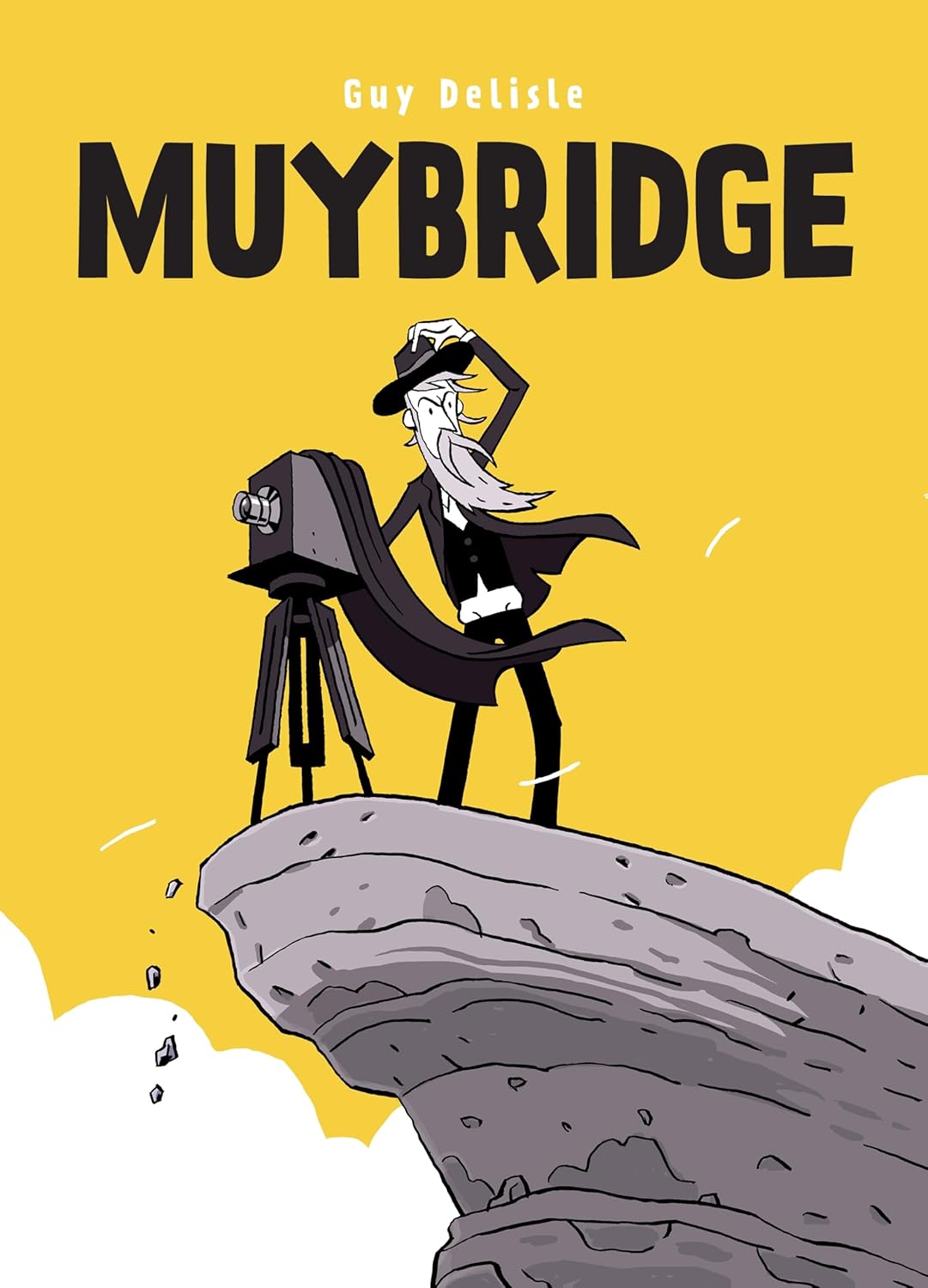
Muybridge
by Guy Delisle
A double rarity for me: reading a graphic novel (er, graphic biography?), and reading a book in the year it came out. The original (French) version came out in 2024. This was highly recommended by Austin Kleon, and I really enjoyed it!
Lots of interesting bits about the early history of photography and film. Niepce created the first photograph in 1827, with an exposure that took 10 hours. (10) Daguerre discovered that his plates developed images when he left them in a specific cabinet, and it took him a while to figure out that a thermometer had broken in that cabinet, leaving mercury in cracks in a shelf. Mercury vapor was helping the development process. (12-13)
Edward Muggeridge rechristened himself Eadweard Muybridge because he thought it sounded cool (more archaic, Anglo-Saxon). He moved from England to California and worked as a book seller. That was a bust, and he returned to England in 1860, just in time to avoid the Civil War. While traveling across the country to return to England, he was in a serious stagecoach accident and was in a coma for nine days. His hair turned gray, and his behavior became much more erratic after the that.
He learned about the new art of photography, got married, began traveling and taking photographs (a lot at Yosimite) and selling them. His wife (Flora) got pregnant, but he learned she had been cheating on him with a guy named Larkyns, and he seemed to think the baby was Larkyns’s. Muybridge shot and killed Larkyns, but the jury found him not guilty by reason of “justifyable homicide” – basically, they thought Larkyns deserved it! (71)
The child was born, a boy named Florado. Flora died when he was a year old. Page 78 is devastating: Muybridge put Florado in an orphanage after Flora died. The boy last say Muybridge when he was 9. When he was older, people who knew them both said he looked like Muybridge.
Muybridge invented a projector that used real photos to show a motion picture. He toured with a unique show that combined a lecture and projections. The world’s first powerpoint.
He worked with Leland Stanford (railroad tycoon) to photograph the motion of horses, proving that their motion had not been painted accurately by artists. Using a bank of twelve (or more) cameras, he took similar images of other animals and later published “Animals in Motion,” which is still in print and used by artists.
When Stanford’s son died of typhoid fever, he and his wife Jane founded Stanford University in his honor. Leland died of old age, and then Jane was mysteriously murdered with strychnine, a murder that was never solved.
Lots of stuff about various French people inventing early versions of cinema, 30-50 second films of people doing ordinary things. These were a huge hit at first but became boring until a new crop of filmmakers began telling longer stories with the medium.
Overall, a fascinating but kind of sad tale. Muybridge had a lot of ups and downs. He was an inventor who photographed things that were at the edge of what was possible in his time. He was a murderer who abandoned his son to an orphanage. His wife, twenty years his junior, cheated on him. Stanford published details of their work together without giving him credit. Edison tried to steal some of his ideas. He had success as a photographer of nature and animals, as a lecturer, and with the publication of a couple of books of his work near the end of his life.