High Bias
April 9, 2025
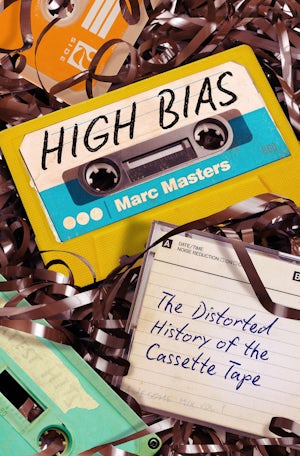
High Bias: The Distorted History of the Cassette Tape
by Marc Masters
My employer gave us all $25 to spend on a book, and this is what I got. I get very nostalgic for cassettes, and this book reminded me of some things about them that are really great. I started reading this book while hanging out with the fam at Monkey Nest Coffee, and the guy sitting next to us was doing a Zoom interview for a data science job. He told them he’s a competitive Scrabble player and has been the US National Champ!
“The people’s format.” “Its uses and benefits and anomalies form a language.” You capture sounds, put them next to each other, listen over and over, and “the tape realigns your brain.” (3)
“If a record sucks, it sucks. If a tape sucks, you can put something better on it.” (4)
Copy. Steal. Curate. Create. Control your own private soundscape. (7)
Amstrad made inexpensive dual cassette decks. Ads “included a plea not to reproduce copyrighted material,” but they later acknowledged that this was reverse psychology – a way to sell more tape decks! (8)
The telegraphone was the first magnetic recording device. It used a piano wire! The process of coating paper with iron oxide to make “sounding paper” was invented by a guy named Pfleumer who was working on a cheaper replacement for the gold leaf bands on the ends of cigarettes. (13)
The word “cassette” is French for a “small case.” (14)
Lou Ottens led a team at Philips and invented the modern cassette. They agreed with Sony to standardize – this decision “was the big bang for the compact cassette.” (15-17) The cassette debuted in 1963.
In the early 80s, rich people would pay to be driven around in cars with tape decks playing new mix tapes. (37) In Houston, DJ Screw chopped up songs and slowed them down. Sold as much as $15k in a day from his house. People drank codeine-infused beverages called “syrub” or “drank” and listened to the slowed-down music. (38-9)
Go-go music was big in Washington DC in the mid 70s. One beat played for a long time. The band, the lead “talker,” and the crowd. Crowd interaction fed the band’s energy. (41) I listened to Bustin’ Loose by Chuck Brown and the Soul Searchers. Sounds like funk to me, but with more talking and crowd interaction.
Page 41 describes Nico Hobson, go-go historian, and his improvements to archiving and distributing go-go recordings. I can relate to this guy.
Fans wanted shout-outs. They hoped to end up with their names on a PA tape of a go-go show. This got a little out of hand. “We do try to play music in between the names.” (42) Trading PA tapes was crucial to the success of go-go in DC, although it didn’t spread nationally like hiphop did.
Daniel Johnston and Stress Records are mentioned (54). R. Stevie Moore (53). Lou Barlow (56). When Barlow met people who liked his tapes, “it was like, oh, okay, you’re my friend for life now… and we will soon be spending days and days together in a van.” (57) Robert Pollard (58).
Dennis Callaci “would stay up all night dubbing copies of Shrimper releases at home one at a time. ‘I just like the ritual of it,’ he says. ‘You’re tethered to this machine, and every eight to twelve minutes, you have to flip the tape. It reminds me of working graveyard shifts at the gas station.” (58)
“What makes the worldwide cassette movement so unique is that it is a society of real participants, producers instead of passive consumers.” (72)
The Flaming Lips, Parking Lot Experiments, using cassettes as instruments:
As a teen in the late 1970s, Wayne Coyne was cruising a parking lot before a Kiss concert and became entranced by a swirl of sound from 8-track tapes booming out of car windows. About twenty years later, a decade into the career of his group the Flaming Lips, he and bandmate Steven Drozd imagined gathering a bunch of cars and giving each driver a tape containing a segment of a multipart song. The pair made upward of forty such tapes, working meticulously to cut and paste music onto each. "I went out and bought fifty or sixty little tape decks so I could do a dress rehearsal right in my house," Coyne told author Mark Richardson.
In the spring of 1996, cars packed into a mall parking garage in Coyne's hometown of Oklahoma City for the first of what the Flaming Lips would call their Parking Lot Experiments. Once Coyne yelled "Play!" each tape announced a number in sequence, then a round of music erupted in the garage. Drivers were encouraged to get out and walk around, experiencing their own personal mix of this collective com-position. "Some of the tapes don't have much on them at all, but as a big piece they all work together," Coyne recalled to Richardson. "Sometimes driving around, we'd pop one in and wonder What's on that thing?' And it would announce, 'This is tape #28, and for ten minutes there would be absolutely nothing, and then there'd be some scream or something." (73)

The sound of a Lou Barlow tape collage “was magical and mysterious but strangely attainable, too.” (81) That attainability is why I find lo-fi art inspiring. I probably can’t match a glossy studio recording. But I might be able to record a grainy, fuzzy, intimate sound to tape.
Tape collecting as a “weird adult’s musical Lego set.” (82)
“I’ve had songs where the tapes have worn themselves to a point where they sound very different. I even have songs that have decommissioned themselves from my set because they just wear away, and I think, well, I should have stopped playing that song anyway. But what told me is the tape itself. It basically said, you’re done playing this song.” You can love tapes, but nothing lasts forever. There may be value in having a more perishable medium.
The lengths tapers went to to smuggle in gear – like a mic hidden in a sandwich! – “kept the underground nature of audience taping strong.” (92) Nowyou can just download everything, and it’s way less interesting. When it was hard, you’d go to the trouble. Now that it’s easy, do you even bother? (Reminds me of Naaman.)
In Egypt, critics of cassettes said they were more dangerous than cocaine. They “spread vulgar sounds by making it possible for anyone to be an ‘artist’ regardless of training.” This is true (not the cocaine part) but can be both good and bad. (119)
The “world music” we get in the West is “pretty sterilized.” Foreign governments want to control their image. (Check out these Syrian Cassette Archives)
“Cassettes are the most unpretentious format out there, where you can find the most genuine, undistilled music that was ever made.” (131) “It put everything in people’s hands.” So did the iPhone – but seemed to have a similar effect in video more than audio.
The structure of a mixtape:
"If the mix taper values coherence-and coherence is especially favored among those who consider mix taping to be an art form-the selection of each song will be informed by at least five constraining considerations," posited Bas Jansen in the 2009 book Sound Souvenirs. "The song must fit the overall theme, continue the flow of the tape, be 'true of the mix taper,' take into account the tape giver's assessment of the musical taste of the recipient, and fit the predetermined time frame and two-act structure of the tape cassette. The result is a cohesive tape in which no song can be randomly replaced with another without destroying the structure." (139)
"The mix tape is a list of quotations, a poetic form in fact: the cento is a poem made up of lines pulled from other poems," he writes. "Similarly an operation of taste, it is also cousin to the curious passion of the obsessive collector. Unable to express himself in 'pure' art, the collector finds himself in obsessive acquisition."
(Like a commonplace book for songs.)
A problem with streaming is that you never sit with anything. I can’t listen to something without thinking about what I’d rather be listening to. Thus, Bandcamp is better than Spotify for actually listening to music (although they have playlists now, too). A “Me Talking” or “All Songs Considered” episode beats a playlist. Anything that forces me to listen to music without the option to easily change it.
After moving to Spotify, one lady decided to write out one of her playlists on paper, like she used to do when making a mixtape. “And I’m glad I did it; it led me not just back to making mixtapes but to doing things that bring me joy again generally.” (149)
“Cassettes are the perfect medium for children.” (155) I have this idea that when I’m a grandpa, I’ll get tape players for my grandkids and make them tapes when they are little (maybe 6). Kids can learn to use a tape player easily, and they can learn to record their own tapes. Could be great. They might listen to my voice and to music and stories I put on the tapes as they drift off to sleep. What could be better?
“Giving someone a handmade mixtape is surely more personal than sharing a playlist, whose creation is more akin to data entry.” (156)
Great things about tapes: Affordable, durable, portable, personalizable. (173)
This story is amazing:
In 2017, British artist Mandy Barker took a vacation in Fuerteventura, a Spanish island near the northwest coast of Africa. As she walked along the beach, she came across a cassette that had washed ashore. Barker's art deals in part with environmental concerns, specifically with the way we discard and waste plastic products, so the tape was a good fit for her work. She found an audio professional who could restore the music from the tape, and incorporated that and a list of the songs into a piece she called Sea of Artifacts. Two years later, a Spanish tourist named Stella Wedell was traveling in Stockholm, Sweden, when she happened upon Barker's exhibit at a gallery. The list of songs on the tape—a diverse lineup that included reggae, dance music, and Disney tunes-seemed familiar to Wedell. She snapped a photo and took it home, where she still had some CDs based on mixtapes she made in the early 1990s. One of those CDs had the exact same track list as the one Barker had found, and Wedell realized that the tape was actually hers. She had lost it when visiting the Spanish island of Majorca, more than 1,200 miles from where Barker discovered it.
"I always made tapes from my CDs at this time to listen to them with my Walkman, especially for holidays," Wedell told CNN. "To think that a tape I could have lost more than twenty years ago had been found was incredible. "Even after getting the tape to play, it was then an astounding chance for Stella to walk into my exhibit and recognize her tape,” Barker told Sky News. “She said she was shocked to find it, and when I read her email I couldn’t believe it either. It was shock all around.”