Gates of Fire
August 30, 2025
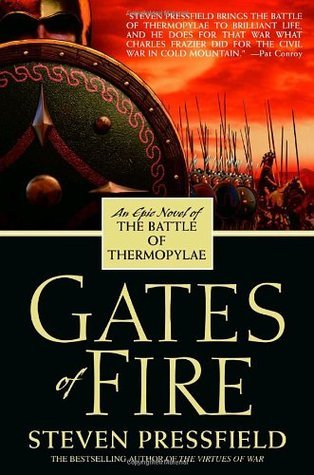
Gates of Fire
by Stephen Pressfield
I tried to read this a few years ago, got maybe 20 pages in, and thought it was boring. Recently, though, I’ve been more interested in the events of this time period, largely due to studying the book of Daniel. Here’s a little timeline:
- 539 BC - The Persians under Cyrus conquer the city of Babylon (Daniel 5)
- 492 BC - Persia invades Greece for the first time
- 490 BC - Greece (mostly Athens) defeats them at the Battle of Marathon
- 486 BC - Darius (aka Cyrus?) dies; Xerxes I succeeds him.
- 480 BC - Persia invaded Greece for the second time under Xerxes. Battle of Thermopylae.
The Greeks will go on to defeat the Persians decidedly.
Not super-relevant here, but to extend the timeline a bit:
- 431–404 BC — Peloponnesian War (Athens vs. Sparta). This internal conflict weakens Greece, setting them up for…
- …338 BC - Philip II of Macedonia defeats Athens and Thebes, plans an invasion of Persia
- 336 BC - Philip is assassinated, Alexander the Great takes the throne.
Anyway, back to this book. I took another crack at it, and it was great. There are (according to the author) about 24 lines of ancient text that deal directly with these events. So he had to make a lot up, but he did his research and made it as realistic as possible. The back story between some of the characters unfolds in some very moving ways, so that when things happen to various people in the battle later, you really care about them.
I was also very impressed with the way he wrote about the women of Sparta. He wrote very strong female characters without simply writing them as men. They are feminine but not weak.
Here are things I noted while reading:
An Egyptian emmissary from Persia “inquired of the Spartans why they wore their hair so long. Olympieus replied, quoting the lawmaker Lykurgus, ‘because no other adornment makes a handsome man more comely or an ugly one more terrifying. And it’s free.’” (46)
A key concept in the book is katalepsis, or possession. This can come over men in battle as either fear or anger, and neither can be tolerated. Either cowering in fear or attacking blindly in anger will lead to defeat.
The book is told from the perspective of Xeones, a helot (subjugated, though not really a slave, at least in this book). For part of the book, he serves Dienekes, a Spartan officer. Of Dienekes: “His was not, I could see now, the heroism of an Achilles. He was not a superman who waded invulnerably into the slaughter, single-handedly slaying the foe by myriads. He was just a man doing a job. A job whose primary attribute was self-restraint and self-composure, not for his own sake, but for those whom he led by his example. A job whose objective could be boiled down to the single understatement, as he did at the Hot Gates on the morning he died, of ‘performing the commonplace under uncommon conditions.’” (113)
An example of how he writes about women: There is a lot of talk about the Spartan training of the young men for war. They are not even allowed to pursue any other career. But the women are also trained. At one point, Xeones is serving as a squire and sparring partner to Alexandros, and they are becoming close. Alexandros defies his mother Paraleia and goes to watch a battle; Xeones goes along. Later, Xeones is summoned to a house, and Paraleia is there, along with her daughters (age 11 and younger, I think). She begins grilling Xeo for information, to know how Alexandros conducted himself, whether he has courage, what all happened on their trip, etc. At one point she turns to her daughters: “Is he telling the truth?” She was training them on how to grill a servant!
Dienekes says, “war is work.” They train so that they will keep doing the job even in war’s horrendous conditions (hunger, exhaustion, death). When the battle begins, the Spartan line is like a gristmill, holding strong and grinding up Persians. Few of them die, but the work is exhausting.
Polynikes to Alexandros:
**War, not peace, produced virtue.** War, not peace, purges vice. War, and preparation for war, call forth all that is noble and honorable in a man. It unites him with his brothers and binds them in selfless love, eradicating in the crucible of necessity all which is base and ignoble. (137)

After Polynikes is extremely hard on the younger Alexandros for a failure when training, Dienekes tells the boys, “We spend tears now that we may conserve blood later.” (139)
The “dance floor” (battle field) “looked like a field ploughed by the oxen of hell.” (274)
Seeing his cousin Diomache again when they have grown up apart: she had “that expression of feminine wisdom which apprehends truth directly, through the blood, unobscured by the cruder faculty of reason.” (294)
A Scythian nicknamed Suicide gives a speech to a few comrades near the end, when they are about to raid Xerxes’s camp:
When I first came to Lakedaemon and they called me "Suicide," I hated it. But in time I came to see its wisdom, unintentional as it was. For what can be more noble than to slay oneself? Not literally. Not with a blade in the guts. But to extinguish the selfish self within, that part which looks only to its own preservation, to save its own skin. That, I saw, was the victory you Spartans had gained over yourselves. That was the glue. It was what you had learned and it made me stay, to learn it too. (332)
There is a theme of dying to oneself which overlaps with the Christian concept of dying to self (e.g., Romans 6:4 - “We were buried therefore with him by baptism into death…”, Galatians 2:20, “I have been crucified with Christ. It is no longer I who live, but Christ who lives in me…”).
At one point leading up to the battle, Dienekes asks some of them what the opposite of fear is, and they discuss it around the fire. Later, he concludes, “The opposite of fear is love.” (333) Maybe in some sense, but this does not capture all that is encompassed by “fear.” E.g., the fear of God is not only a trembling, terrified fear but also a reverential one. The meanings of all the commandandments begin, “We should fear and love God…” So they are not opposites, although they do complement each other.
Dienekes speech to the warriors before the final day of battle, when they know they will die: “Act for this alone, for the man who stands at your shoulder.” (355)
Vocab
- celerity - swiftness (380)
- charnel sward - charnel = cemetary, place of bones; sward = grassy meadow (278)
- recrudescence - renewal (381)
- serried - pressed or crowded together (266)