The Fellowship: The Literary Lives of the Inklings
December 31, 2025
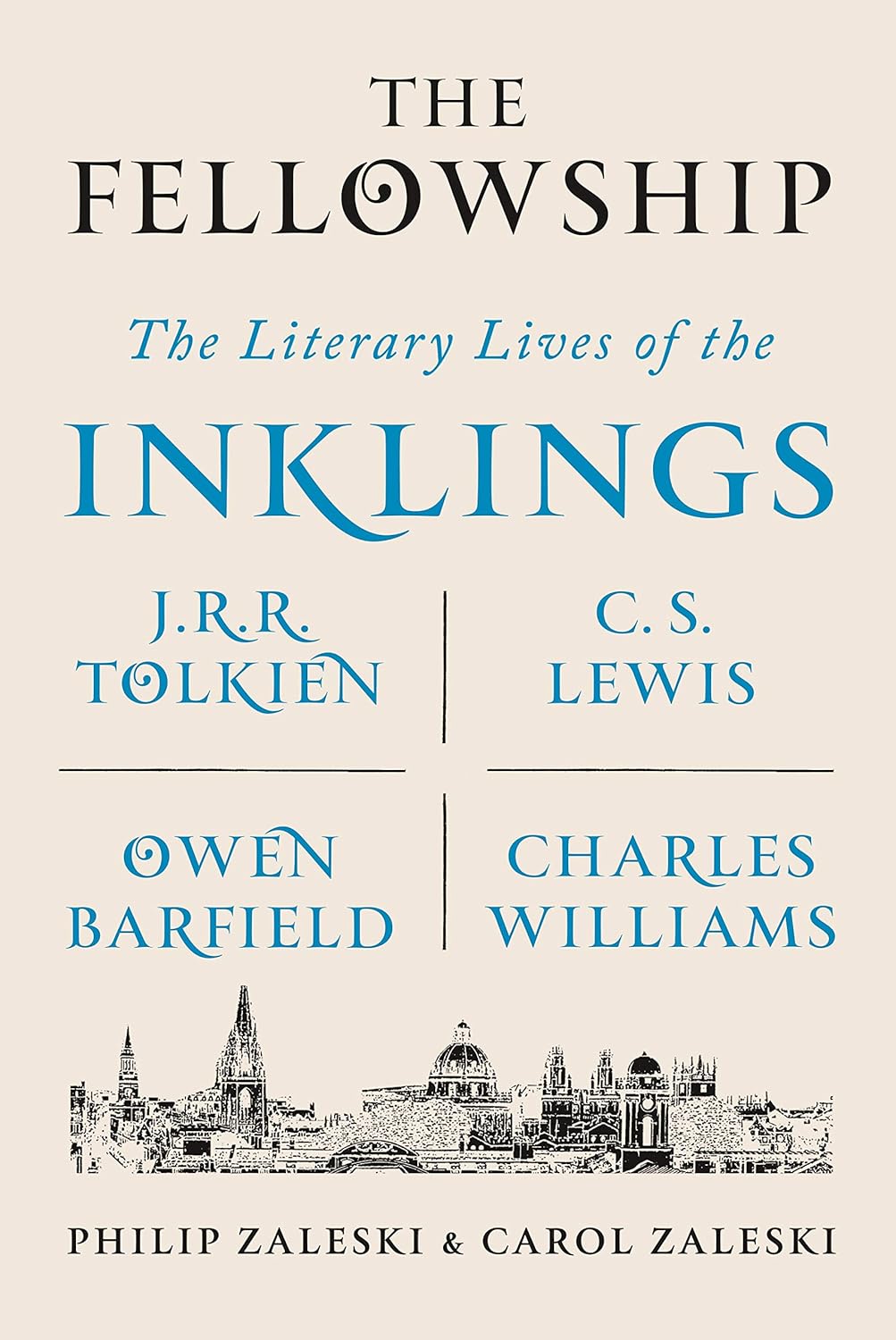
The Fellowship: The Literary Lives of the Inklings
by Philip and Carol Zaleski
This book was excellent – a biography of four men, their friendship, work, and faith. They were C.S. Lewis, J.R.R. Tolkien, Owen Barfield, and Charles Williams. For years, they met (mostly in Lewis’s home, The Kilns, or at a pub called The Eagle and Child, which they called The Bird and Baby) to drink, smoke, read whatever they were working on, argue, etc.
They are considered Christians. I agree about Lewis and Tolkien, but it’s harder to make the case for Barfield (who was an Anthroposophist, believing in reincarnation, two Christ’s being joined into one at the age of twelve, and other weird esoteric ideas). And Williams, who delved into ritualistic magic. But the book doesn’t give enough of their confession on faith to really know.
The book was thoroughly enjoyable, but as I listened to it rather than read it, my notes are haphazard and thin. Here are the passages I marked:
Charlotte Bronte’s opinion of Roman Catholicism in 1842: anyone favorable to the Catholic Church should “attend mass regularly for a time to note well the mummeries thereof also the idiotic, mercenary, aspect of all the priests and then if they are still disposed to consider Papistry in any other light than a most feeble childish piece of humbug let them turn papists at once that’s all.” (18)
Caedmon’s poem includes the first appearance in English of middengeard, Middle Earth, that portion of creation reserved for human beings. (127)
Owen Barfield was a lifelong devotee of Rudolf Steiner and Anthroposophy, an esoteric spiritual movement. Not quite a cult, but weird.
There is an interesting connection between Middle Earth and the Advent hymn O Come, O Come, Emmanuel on pp. 63-64. I wrote about it in detail here.
This Tolkien quote on marriage:
It should be noted also that at times his views on marriage possess a startling originality, as when he asserts -- this was not a popular view in England at the time -- that "nearly all marriages, even happy ones, are mistakes," as a better partner might easily have been found, but that, nonetheless, one's spouse is one's "real soul-mate," chosen by God through seemingly haphazard events. Edith, despite her lack of intellectual depth, her religious recalcitrance, and her fading beauty, was his real soul mate, and to her he pledged his body, his energies, his life. (211)

C.S. Lewis’s common theological themes (from p. 310):
- the unquenchable desire that tells us we are made for heaven
- the error of mistaking proximate for ultimate goods
- the complementarity of rational freedom and trust in authority
- the solemn merriment that characterizes Christian life
- the realization that “there are no ordinary people” – we are all immortals whose mortal pilgrimage will end either in the beatific or the “miserific” vision
An Apologist’s Evening Hymn, p. 314:
(C.S. Lewis, 1942)
- From all my lame defeats and oh! much more
- From all the victories I have seemed to score;
- From cleverness shot forth in Thy behalf,
- At which, while angels weep, the audience laugh;
- From all my proofs of Thy divinity,
- Thou, who would'st give no sign, deliver me.
- Thoughts are but coins. Let me not trust, instead
- Of Thee, the thumb-worn image of Thy head;
- From every thought, even from my thoughts of Thee,
- Oh thou fair Silence! fall and set me free.
- Lord of the straight way and the needle's eye,
- Take from me all my trumpery lest I die.
Moving from Oxford to Cambridge in 1954, Lewis delivered an inaugural address, “On the Description of the Times.” He began by arguing that dividing history into the standard periods (Antiquity, the Dark Ages, the Middle Ages, the Renaissance) is “greatly exaggerated, if indeed it was not a figment of Humanist propaganda.” These divisions might be useful, but the through-line of Western thought holds throughout.
However, there is one “cataclysmic break in the historical record, one division between eras that must be acknowledged:”
This fault line cuts across the **early nineteenth century**, immediately following the time of Jane Austen and Walter Scott, isolating all that comes after -- the Victorians, the Edwardians, all that we call modern or postmodern -- from all that came before: "somewhere between us and the Waverly Novels, somewhere between us and Persuasion, the chasm runs." Lewis begins assembling his evidence for this extraordinary claim with a look at poetry. In the past, poems, even difficult ones, could be readily understood; readers agreed on what they meant. But now poetry has gone adrift. Consider, Lewis says, a recent symposium of seven experts —- two of them Cambridge scholars -- that had assembled to analyze the little poem *A Cooking Egg* by T. S. Eliot. The experts could find "not the slightest agreement among them as to what, in any sense of the word, it means." Modern poetry's rejection of meaning is, Lewis argues, unprecedented "in the whole history of the West," comparable only to a similar revolution in the visual arts, exemplified by Cubism, Surrealism, Dadaism, and the work of Picasso. Lewis perceives, too, a parallel disruption in the history of religion, manifested by the split between Christian and post-Christian cultures. But these examples pale beside what Lewis calls his "trump card": the nineteenth-century emergence of industrialization, with its obsequious worship of progress, its enthrallment to "a new archetypal image... of old machines being superseded by newer and better ones." The rise of the machines-one hears echoes of Tolkien's great fear spells the fall of tradition. Today new trumps old; future, past; change, permanence; and "the very milestones of life are technical advances." (445)
Studies in Words, which I loved, is “a minor work,” rarely read and little rememebered (471). Lewis thought “it belonged alongside… Poetic Diction,” and I agree.
Some nasty words from F.R. Leavis when Lewis died. He told a class of students at Cambridge: “C.S. Lewis is dead. It said in the Times that we will miss him. We will not. We will not.” (475) Very ugly. Their differences had to do with textual criticism. This is a reminder not to take your work too seriously, and to not demonize those you disagree with, lest you turn into a demon yourself.
Tolkien’s reaction after Lewis’s death: “So far I have felt the normal feelings of a man of my age – like an old tree that is losing all its leaves one by one: this feels like an axe-blow near the roots.” (479)
And Barfield wrote “Moira” (Greek: fate, destiny), a poem linking Lewis’s death to his own and contrasting his friend’s posthumous enlightenment to his own earthbound ignorance: “You came to him: when will you come to me? / He knows what matters from what matters not. / I hurry to and fro and seem to be.” (480)