The Consolation of Philosophy
March 2, 2025
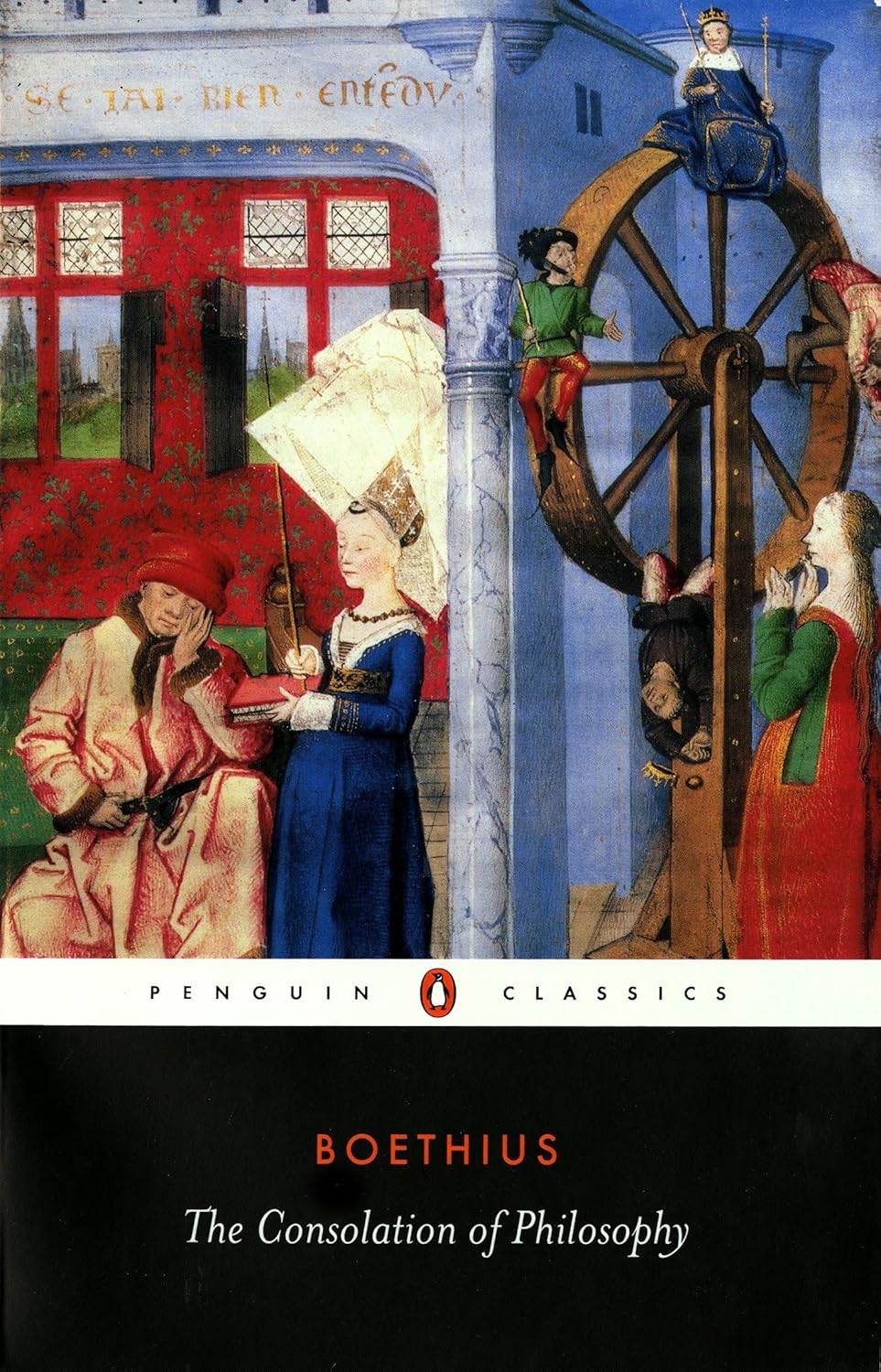
The Consolation of Philosophy
by Boethius
Boethius is considered the last philosopher to have a classical mind, the last to be able to think like the Greek and Roman philosophers. He lived 480–524 AD and was a senator, Roman consul, and advisor to the Ostrogoth king Theodoric the Great. He translated Plato and Aristotle from Latin into Greek. He was falsely accused of plotting against the king, and Theodoric then threw him in prison. There, he wrote The Consolation of Philosophy. A little later, he was tortured and executed for treason.
In Consolation, Boethius is visited by Lady Philosophy. She reminds him that happiness cannot exist in things Fortune can take away. Not romantic love, not career success. We become philosophers by realizing how little of our lives is in our hands.
“It was only through Boethius’s translations of his logic that the knowledge of Aristotle survived in the west.” (xvi)
He coined the term quadrivium (xvii).
Theodoric and the Goths were Arians. (xix)
He lived in an age where memory was keener, more retentive. He may have written Consolation without access to his books. (xxii)
The Lady (Lady Philosophy) calls the poetic muses “hysterical sluts.” “They habituate men to their sickness of mind instead of curing them.” (4)
A poem about despair on page 5. “The mind forgets its inward light / and turns in trust to the dark without.”
Like an angel, Lady Philosophy has come to bring Boethius to his senses. Reminds me of Dante lost in the woods, finding Virgil. (6)
“The clouds of my grief dissolved, and I drank in the light.” (7)
The problem of evil has a corrollary: the problem of good. “Where does evil come from if there is a god, and where does good come from if there isn’t?” (12)
Why was B in prison? An informer brought evidence that the Roman Senate was guilty of treason. B, wanting to preserve the Senate, initially worked to prevent the informer from presenting his evidence. He did not persist in this, but it was enough to get him arrested for treason.
“The world does not judge actions by their merit but by their chance results.” (14)
B firmly confesses that God watches over His creation – things do not happen at random. But by what means? He doesn’t know. And he thinks of himself (of man) as a “rational and mortal animal” and nothing more. Lady P says, “You have forgotten your true nature.” (20)
Re: Fortune, “change is her true nature.” Don’t seek happiness in her, for “do you really hold dear the kind of happiness which is destined to pass away?” (23)
“All luck is good luck to the man who bears it with equanimity.” (31)
Lady P discounts the beauty of Nature because you can’t take credit for it. (34) And the honesty of others because you can’t process it. (35) But the Lord blesses us apart from our possessions, and I can take pleasure in these things when I attribute them to Him and not to Fortune.
B got into politics “so that virtue should not grow old unpraised.” (40)
He speaks of earth’s circumferance, knows the earth is tiny relative to the heavens. (41)
Book 2, things that don’t lead to happiness: Good fortune, money, power, fame/reputation.
He talks about “being freed from the earthly prison” of the body (43). Kind of Gnostic. But also emphasizes storing up treasures in heaven.
“Good fortune deceives, but bad fortune enlightens” (by revealing fortune’s fickleness). (44)
Lady P says her destination/goal is “true happiness” for Boethius. (47)
“The desire for fortune is planted by nature in the minds of men.” (48) Compare to Romans 8:7 – “The mind set on the flesh is hostile to God, for it does not submit to God’s law; indeed, it cannot.”
“The friend that success brings you becomes your foe in the time of misfortune.” (57)
I think things are better than Philosophy makes out. She says to ignore fortune as a foundation for happiness – whether good or bad things happen doesn’t matter. But if God is working all things for the good of His children, there is no such thing as bad luck. The result is similar – don’t look at what happens to make you happy. Look to your baptism and know you are loved, forgiven, and have already received the gift of eternal life.
All pleasures “drive their devotees with goads” and lead to sorrow. (60)
If you have cares and wants, you’re not a king but a slave. Caring and wanting are (to an extent) within my power. Philosophy’s solution is kind of Buddhist? Empty yourself of desire… (58)
“Think how excessive this desire for the good of the body is, when, as you know, all that you admire can be reduced to nothing by three days of burning fever.” (62)
Philosophy argues that “sufficiency, power, glory, reverence, and happiness differ in name but not in substance.” A perverse man “who pursues one of them to the exclusion of others cannot even acquire the one he wants.” (65)
Where to begin when looking for supreme happiness? Boethius: “We ought to pray to the Father of all things. To omit to do so would not be laying a proper foundation.” (66)
“True happiness is to be found in the supreme God.” And God cannot receive His supreme goodness from outside Himself, or the giver would be greater than the receiver. His is good and the source of goodness. (69)
Any Deist could accept Boethius’s description of God on p. 79.
Book 4 (beginning on p. 85) takes up the problem of evil. Philosophy claims that sin never goes unpunished or virtue unrewarded. B is kind of sucking up to Philosophy – every time she makes a point, he’s like, “Your words are perfect and right, wiser than any ever spoken.”
Why do people abandon virtue for vice? Ignorance of what is good, lack of self control, or knowingly (evil) (90)
“Wicked men… do not exist.” (91) You cannot call them men, in the same way that you wouldn’t refer to a corpse as simply a man. “A thing exists when it keeps its proper place and preserves its own nature.” This is a weird usage of “exists.”
Removing free will from the wicked would be like relieving criminals of their punishment. (96)
He alludes to hell (punishment after death), and maybe purgatory? (98) Punishment in the form of “purifying mercy.”
Ordinary men see getting away with crimes as good, punishment as bad. “Their eyes are used to the dark, and they cannot raise them to the shining light of truth.” John 1, the darkness comprehendeth it not, woe to them that call evil good.
The wise man hates no one. The wicked have a “disease of the mind” and should be pitied. (Does Boethius believe in original sin?)
Boethius asks how we can tell the difference between God and random chance. Philosophy says it may look chaotic, but “a good power rules the world” and “everything happens aright.” So far, so good, but he presses her to explain, “to unfold reasons veiled in darkness.” (102)
Providence = God’s plan, Fate = how it unfolds. (104-5) By Philosophy’s definition, Fate is the working of God, not random. Can be done by divine spirits, “woven by the soul of the universe,” “by the obedience of all nature,” “by the celestial motions of the stars, by angels or other spirits, or by any combination of these. Whatever the case, the point is that Fate disposes of the plan of Providence.” (These definitions seem weird by okay.)
Fate follows the unchanging chain of causes originating with Providence. (106) Is this Fatalism? God acts according to each persons temperament, which explains why the good may seem to be treated more harshly than the wicked.
The “wonder of the order of fate”: “A Knowing God acts and ignorant men look on with wonder at His actions.” (107)
“Whenever, therefore, you see something happen here different from your expectation, due order is preserved by events, but there is confusion and error in your thinking.” (107) “Thy will be done” is a prayer of submission to God’s higher thoughts, and of trust in His perfect will.
“Evil is thought to abound on earth. But if you could see the plan of Providence, you would not think there was evil anywhere.” (110) On the contrary, there is evil, and God in His Providence has provided Himself as a sacrifice to atone for our sins and overcome evil.
“All fortune is certainly good.” I haven’t agreed with all his arguments here, but I love this conclusion. I believe this. Coupled with the acknowledgement that God’s thoughts/ways are higher than ours, so we can’t expect to always see how things are good, this is very comforting. (111)
“A wise man ought no more to take it ill when he clashes with fortune than a brave man ought to be upset by the sound of battle.” (113)
From a poem on p. 115:
    Go now, ye strong, where the exalted way
    of great example leads.
    Why hang you back?
    Why turn away? Once earth has been surpassed
    It gives the stars.
Book 5: Do you think there is such a thing as chance?
Intelligence vs. Reason: “We are enjoying intellectus when we ‘just see’ a self-evident truth; we are exercising ratio when we proceed step by step to prove a truth which is not self-evident. A cognitive life in which all truth can be simply ‘seen’ would be the life of an intelligentia, an angel. A life of unmitigated ratio where nothing was simply ‘seen’ and all had to be proved, would presumably be impossible; for nothing can be proved if nothing is self-evident. Man’s mental life is spent in laboriously connecting those frequent, but momentary, flashes of intelligentia which constitute intellectus.” (126)
Here there is a long discussion of free will, divine foreknowledge, and predestination. We can only imagine foreknowledge in a certain way, but God is not just a bit person – His foreknowledge may be beyond our imagination, “the boundless immediacy of the highest form of knowing.” (131)
Eternity = the simultaneous and perfect possession of everlasting life. Not the same as baing “in time” and just going on and on. An eternal being “embraces and comprehends its whole extent simultaneously.” (132)
God is not older than creation in extent of time but in “the property of the immediacy of His nature.” (133) Plato said, “God is eternal, the world perpetual.” (134)
God is able to foreknow events without depriving them of their true nature (being free to occur or not). An event can be necessary “with reference to divine foreknowledge” but still free/individual with reference to itself. (136)
Luther on Genesis 35:19
A final thought, since I came across this while writing up these notes. Compare the consolation of philosophy to the consolation of Christ:
“But it is necessary to learn the consolation by which we sustain ourselves at the death of wives, children, and friends. For although our death and that of our relatives is very sad, it is nevertheless a sure fact that we will live forever. It was certainly better for Rachel to die in this way while praying to God and believing in Him than if she had been permitted to enjoy all the joys of this life, even those which God had promised. For after death we will be happier in infinite ways and the possessors of more blessings than we left behind in this life. For the latter are momentary and perishable, and in place of them we obtain eternal things.”
(quoted here)
Vocab
- gelid - cold, icy (110)
- prolixity - verbosity (110)
- propaedeutic - providing introductory instruction (xvii)
- prosodist - a student of poetic meter (xxiv)
- slough - dead outer layer of a reptile (23)
- sybarite - one devoted to pleasure and luxury (56)
- theodicy - an attempt to resolve the problem of evil (xxvi)
- withy (or withe) - a tough but flexible twig, especially of a willow. Used to bind things together. (51)