Colonel Roosevelt
October 23, 2025
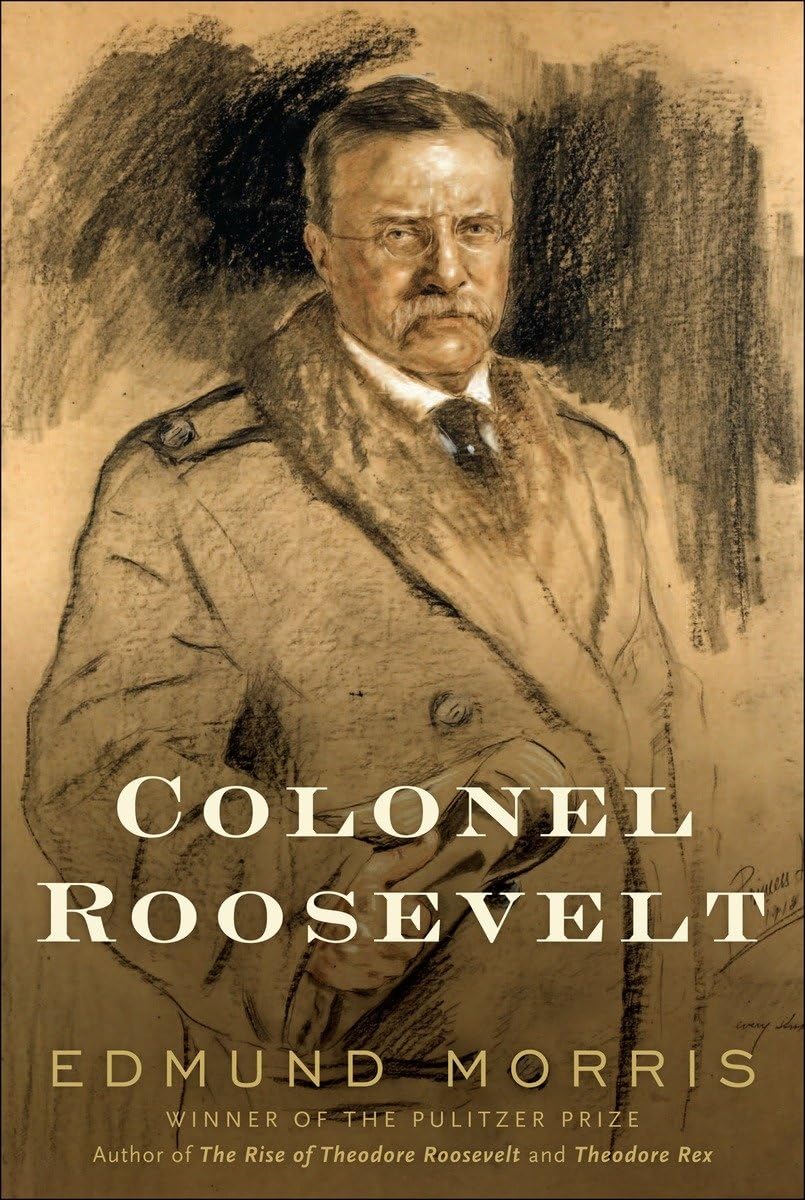
Colonel Roosevelt
by Edmund Morris
Although I have the print version of this, I mostly listened to the audiobook. I can’t decide if that’s doing myself a disservice. I definitely got less out of the book, and the print volume has extensive photographs and notes that I barely looked at. On the other hand, I doubt I would have had time to read the book at all and may never have started it this year if not for the audio version. Even so, it took my 4 months to finish.
I take very few notes on audiobooks. Briefly:
After the Presidency, TR went on a safari to Africa, writing about it and sending specimens to the Smithsonian. Page 26 has a list of his kills (9 lions, 8 elephants, 13 rhino, etc.!).
Touring around Europe after that, he was invited to the Vatican, “providing he did not embarrass His Holiness [Pope Pius X] by associating with any Methodists while in Rome.” (35) “Roosevelt was prepared to stop by the mission. But he could not permit Vatican officials to tell him whom he might see or not see, as a private traveler en route through the Eternal City. To him, no faith was superior to another.”
His religion and politics were pragmatism and progress:
He had done his Sunday School bit as a teenager, teaching children the rudiments of Christianity, more out of duty than conviction. Throughout adulthood he had been a regular worshiper, gradually switching from the Dutch Reformed Church of his forefathers to Edith's Episcopalian Church -- though without her piety. He had no capacity for devotion, unless his love of nature qualified as that. He scoffed at theories that could not be proved, sentimentalities that put a false face on reality, and extremes of religious belief, whether morbid or mystical. As President, he had tried to remove the phrase "In God We Trust" from the national coinage. When consoling bereaved people, he would awkwardly invoke "unseen and unknown powers." Aside from a few clichés of Protestant rhetoric, the gospel he preached had always been political and pragmatic. He was inspired less by the Passion of Christ than by the Golden Rule -- that appeal to reason amounting, in his mind, to a worldly rather than heavenly law. (36)

He wanted “In God We Trust” removed from the coins for aesthetic reasons. Congress voted to make it an official motto on all currency to keep him (and future presidents) from easily removing it.
A passage about meeting Kaiser Wilhelm:
Lifting his hat every time Wilhelm touched his helmet, Roosevelt mantained a genial façade, but was aware only of the vast difference between himself and his host. It was not simply that the Kaiser held power, while he had none, nor the obvious fact that they were king and commoner. It was that he, self-made, had an integrated point of view, whereas Wilhelm personified the classic German neurosis of the Doppelgänger. Born to power, but also to disability, the Kaiser had "a sort of double-barreled perspective" on everything. One self -- the imperial -- surveyed the passing troops, exulting in supreme command. The other self -- Wilhelm's "mental ghost" -- had ridden some way off, and was observing the whole scene with a quizzical detachment. Of the two, man and ghost, the former was the more disturbing to Roosevelt. "He was actually, as far as I could discover, one of the last of those curious creatures who sincerely believed himself to be a demi-god." (55)
His “man in the arena” speech was given at the Sorbonne, then quickly printed throughout France. “Roosevelt was surprised at its success.” (47)
It is not the critic who counts: not the man who points out how the strong man stumbles or where the doer of deeds could have done better. The credit belongs to the man who is actually in the arena, whose face is marred by dust and sweat and blood, who strives valiantly, who errs and comes up short again and again, because there is no effort without error or shortcoming, but who knows the great enthusiasms, the great devotions, who spends himself in a worthy cause; who, at the best, knows, in the end, the triumph of high achievement, and who, at the worst, if he fails, at least he fails while daring greatly, so that his place shall never be with those cold and timid souls who knew neither victory nor defeat. (Speech at the Sorbonne, Paris, April 23, 1910)
Touring Europe, he kept meeting kings. He walks upstairs and sits down at a desk, intending to work on his correspondence, when, “The King of Norway is below, sir.” “Roosevelt threw down his pen in mock annoyance. ‘Confound these kings; Will they never leave me alone!’” (61) “I felt if I met another king I should bite him!” (70)
Alice, wishing TR to become president again, “had buried what she called ‘a voodoo’ in the White House garden.” (62)
TR considered Churchill “a boor and a turncoat, and refused to see him” (69).
At a dinner party:
The hero of Omdurman repelled him as a large, squinting loudmouth, "everlastingly posing as a strong man." Just back from seven years in command of the Indian Army, Kitchener was as overbearing as he was opinionated. He said that the United States had made "a great mistake" in not building a sea-level canal in Panama. Roosevelt cited the advice of engineers to the contrary.
"All I would do in such a case," Kitchener declared, "would be to say, 'I order that a sea-level canal be dug, and I wish to hear nothing more about it."
"If you say so. But I wonder if you remember the conversation between Glendower and Hotspur, when Glendower says, 'I can call spirits from the vasty deep,' and Hotspur answers, 'So can I, and so can any man, but will they come?'" (70)
He wrote an essay in 1910 called, “The Search for Truth in a Reverent Spirit.” It was his religious confession and a look at the spiritual qualities of materialistic pursuits. He wrote against “a hard, dogmatic materialism” (154). Said that evolution should not upset religious belief (155).
TR identified most with Alfred Russel Wallace, “prophet of natural selection.” He wrote about “the ancient antithesis of fides versus ratio.” Haeckel “refused to accept mystery as a part of knowledge,” but TR called this “unscientific.” (155)
“Faith, too, must evolve.” (157 – rolling my eyes at this)
There is a lot of (to me) boring stuff about TR running against Taft. Like LBJ, he waits way too long to announce, so his ardent supporters have already had to move on to other candidates. Animosity grows. TR’s Bull Moose Party is a progressive party. He wants women’s suffrage and direct democracy (primaries for Senate candidates, for example).
About Taft’s character as a selfish bore:
Taft knew that he bored people, and did not much care. Archie Butt had been dismayed at the President's lack of concern for the feelings of others. He kept people waiting for as many hours as suited him, even while he napped, and never apologized, At dinner, he would help himself to two-thirds of a beef tenderloin, before allowing his guests to share the remainder. He made no effort to shorten his speeches, aware that audiences could not walk out on a President. When his faults were pointed out to him, he listened placidly, registering nothing. (232)
Pages 243-247 cover the assassination attempt against TR in Milwaukee. He was shot by John Schrank, who was crazy. In a dream, Schrank saw William McKinley’s body rise from the casket during his funeral to say “Avenge my death!”, pointing at a corner where a “form clad in Monkish garb” stood; Schrank recognized the form in the corner as Theodore Roosevelt. When TR ran for president in 1912, Schrank became obsessed with keeping him from winning.
What slowed the bullet:
[The bullet] lay embedded against the fourth right rib, four inches from the sternum. In its upward and inward trajectory, straight toward the heart, it had had to pass through Roosevelt's dense overcoat into his suit jacket pocket, then through a hundred glazed pages of his bifolded speech into his vest pocket, which contained a steel reinforced spectacle case three layers thick, and on through two webs of suspender belt, shirt fabric, and undershirt flannel, before eventually finding skin and bone. Even so, its final force had been enough to crack the rib. (247)
A witness noted, “There was no other place on his body so thoroughly armored as the spot where the bullet struck.” (248)
Having been shot, TR still delivered his speech. As he delivered a page of the speech, he would drop it to the ground, and these were snatched up as souvenirs.
At the hospital, when a press camera flashed and popped, he remarked: “Ah, shot again.” (249)
A guard escorting Schrank noticed him looking out at fields and wildlife. He asked him if he liked to hunt, and he replied, “Only Bull Moose.” (257)
TR and Taft were seated near each other at a funeral:
By no attempt at a smile, or even a nod of the head, did Taft acknowledge his predecessor's presence across the chancel. After the benediction, he rose quickly and marched down the stone aisle, his aides clattering after him. Eleanor, sitting with her father-in-law, asked if it was protocol for a president to walk out ahead of the coffin.
"No, dear, no," Roosevelt said. "It is not customary, but in this case Mr. Taft probably thought there should be precedence even between corpses!" (265)
For a while, TR’s public influence wanes. He goes to South America and explores a river off the Amazon, nearly dying from a fever.
TR wrote a review of an art exhibition including cubist works. “Unable to conceive of the head as a metal egg, Roosevelt abandoned reverence for humor:”
In this recent exhibition the lunatic fringe was fully in evidence, especially in the rooms devoted to the Cubists and the Futurists.... The Cubists are entitled to the serious attention of all who find enjoyment in the colored puzzle-pictures of the Sunday newspapers. Of course there is no reason for choosing the cube as a symbol, except that it is probably less fitted than any other mathematical expression for any but the most formal decorative art. There is no reason why people should not call themselves Cubists, or Octagonists, or Parallelo-pipedonists, or Knights of the Isosceles Triangle, or Brothers of the Cosine, if they so desire; as expressing anything serious and permanent, one term is as fatuous as another. Take the picture which for some reason is called "A Naked Man Going Down Stairs." There is in my bathroom a really good Navajo rug which, on any proper interpretation of Cubist theory, is a far more satisfactory and decorative picture. Now, if for some inscrutable reason, it suited somebody to call this rug a picture of, say, "A Well-Dressed Man Going Up a Ladder," the name would fit the facts just about as well.... From the standpoint of terminology each name would have whatever merit inheres in a rather cheap striving after effect; and from the standpoint of decorative value, of sincerity, and of artistic merit, the Navajo rug is infinitely ahead of the picture. (271)
After all his travels, TR “no longer believed that civilization was improved by expanding.” (283)
Woodrow Wilson “wanted to remove all Negroes from the federal bureaucracy.” (283)
World War I is brewing. TR advocates entering the war fairly early. Lots of talk about military preparedness. He tries without success to get permission from Wilson to lead a group of troops himself.
Quentin is killed in the war (shot down). TR dies not long after that, at age 60.
His favorite hymn – How Firm a Foundation, Ye Saints of the Lord – was recited, not sung, at his funeral. No music. “The service was almost cruelly short and spartan.” (557)
“Roosevelt’s grave awaited him at the top of a steep knoll… Typically, his chosen site involved a long hard climb.” (557)
His children: Ted Jr. and Alice both criticized FDR’s New Deal. Ted, at age 56, was on the first boat to hit Utah beach at Normandy on D-Day! He fought and led men bravely, dying a month later of a heart attack. He fought in both world wars. Patton was a pallbearer at his funeral.
Kermit shot himself. Archie lived until 1979, becoming a confused paranoiac recluse. Ethel lived till 1977, a Republican supporter of the civil rights movement. Alice lived till 1980, hosting famous dinner parties.
The final sentence in the book, quoting a child in Oyster Bay, sums him up well and is worth aspiring to: “He was a fulfiller of good intentions.” (570)
Vocab
- cortege - retinue, funeral procession
- malgre lui - French for “in spite of himself”
- propaganda - originally (and still in 1912) just meant “publishable information”