Bust Hell Wide Open: The Life of Nathan Bedford Forrest
January 5, 2025
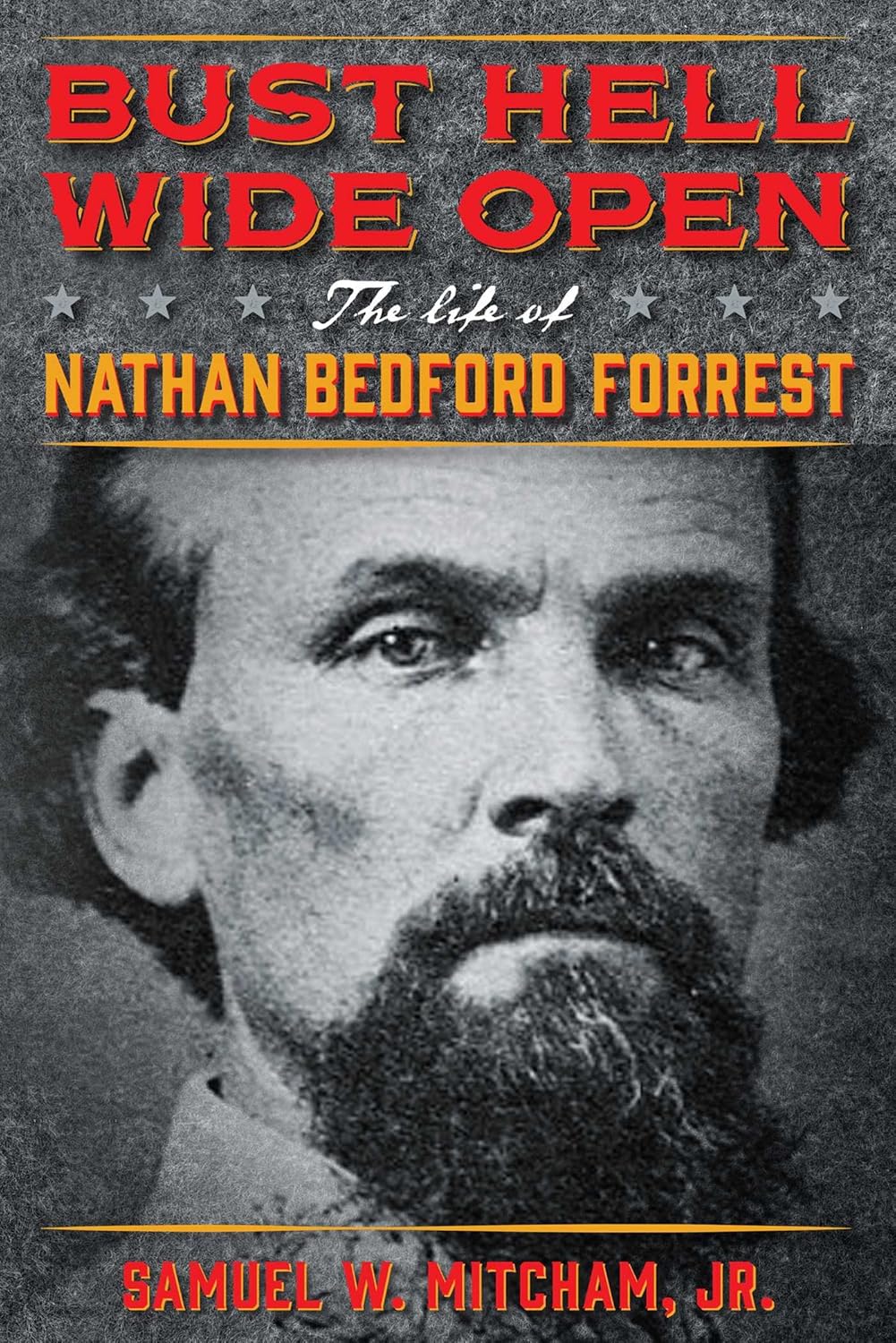
Bust Hell Wide Open: The Life of Nathan Bedford Forrest
by Samuel W. Mitcham, Jr.
Nathan Bedford Forrest was a Confederate general in the Civil War. He was a slave trader and helped found the Reconstruction-era Ku Klux Klan. Those facts can make it easy for us to dismiss him as an evil figure in history, but this biography gives a more complete picture of who he was. I would say it even over-corrects a bit and soft-peddles his flaws, but it was nevertheless very interesting. The author addresses it this way in the intro:
Now, a warning, to my liberal friends. Forrest's world view was that of a Nineteenth Century Southerner, a Confederate patriot, and a man who grew to manhood in the raw, tough, and often violent world of the antebellum American frontier. I firmly believe that it's a mistake to judge the past entirely by the standards and values of today, a practice some historians call "Presentism," in which the past is always wrong because it is not the present. I hold that we can learn a great deal from the past and from the people who populated it, people like Forrest, even though we might not want them as neighbors. (xi)

Here are my notes:
Robert E. Lee named Forrest when he was asked who was the best general in the Civil War (x), in spite of the fact that they never met. The intro references these quotes: Napoleon: “In war, men are nothing. The man is everything!” Alexander the Great: I do not fear an army of lions led by sheep, but I do fear and army of sheep led by a lion.
“Forrest’s capacity for war only seemed to be limited by the opportunities for its display.” –Gen. Joseph E. Johnston (2)
He was known as “the Wizard of the Saddle.” (4)
Born in Chapel Hill, TN, in 1821. He had a twin sister, Fannie.
“Napoleon once said that poverty is the best military school and, if so, young Forrest was very well educated.” (5) His father died, making him the man of the house at age 15. He plowed, cut wood, cared for livestock, tanned hides, made shoes, and led his siblings, in order to keep things running. This developed the skills needed to lead others.
The story of killing a panther:
In the late 1830s and 1840s, northern Mississippi remained very much an untamed wilderness. One day, Miriam Forrest and her sister Fannie were riding back to the cabin with a basket of chicks that the family's neighbor had given to them. Unfortunately, the women could not cover the nine miles before sunset. Darkness had just fallen when she reached the creek about a mile from her cabin. There, she heard the blood-chilling roar of a panther, which had smelled the chicks. Fannie urged her sister to drop the chickens but she refused. As their horses entered the water, the panther sprang from the bushes and ripped into Miriam's back and shoulder. Her horse's panicked jerks caused the panther to fall into water, and Miriam was able to make it to her cabin. She never cried out, despite her pain.
Forrest carried her into the cabin and dressed her wounds. He then removed his father's flintlock from above the fireplace and announced that he was going to kill the panther. Miriam urged him to wait until daybreak, but he refused. The panther would be gone by then. Forrest unleashed his hound dogs and headed out into the night. Sometime after midnight he treed the panther. He waited until dawn and, in the pale morning light, killed it with a single shot.
This was the frontier world Forrest grew up in, a merciless world of kill or be killed. Forrest never completely left that world -- or perhaps it would be better to say it never left him. Hard conditions breed hard men -- and Forrest became one of the hardest. (7)
(I like to read about things like this, but note the flavor of hagiography, which is all throughout the book.)
Fannie, all Forrests other sisters, and one brother died to typhoid fever in 1841. In 1842 he moved to Mississippi to join his uncle in the mercantile business. Four men wanted to kill his uncle over some dispute (10). NBF bested all four single-handedly. They shot at him, missed, and killed his uncle by accident anyway.
Two women on their way to church got their buggy stuck in a creek. NBF helped them, and that’s how he met Mary, nineteen, a cousin of Sam Houston. The second time he visited her, he proposed. (12) He had a successful business, and she eventually accepted his proposal.
He “thought Christianity was a fine religion – for women.” (13)
After his uncle Jonathan died, he expanded into slave trading. (14) After making his fortune in slave trading, he became a cotton farmer, which was less lucrative but more respected, in 1859. (18) He moved from Memphis to Mississippi. He had made over a million dollars ($30M today) selling slaves.
NBF was originally a Union man! He changed his mind when Lincoln called for the army to suppress the rebels. (20) He went to Memphis and enlisted in June 1861. His reasons involved tariffs (explained pp. 21-22). The South was less than 30% of the population but paid more than 85% of taxes in the form of tariffs.
He was made a Lt. Col., and he spent his own money to equip his men (22), even buying guns from Yankee merchants and smuggling them south in boxes labeled “potatoes.”
After capturing a Northern chaplain, he released him. “Parson, I would keep you here to preach for me if you were not needed so much more by the sinners on the other side.” (25)
A summary of his battle tactics, “the common sense tactics of the hunter and the Western pioneer,” begins on page 31. Basically, confuse the enemy, then attack with all you’ve got, and never wait for the enemy to attack you – if they are charging, “charge them, too!”
“In all, NBF had 29 horses shot out from under him, 18 fatally, during the war.” (37)
Confederate leaders (Pillow, Floyd, Buckner) wanted to surrender at Ft. Donelson. NBF told his men, “These people are talking about surrendering, and I’m going out of this place before they do, or bust hell wide open.” (41) But the “Yankees” they were supposedly surrounded by “turned out to be a line of fence posts.” NBF escaped. Buckner surrendered over 10,000 men.
A eucatastrophe: after one battle, his son Willie was missing, so he went out searching for him. He came back and found Willie alive and well in the camp, having (along with another boy) brought in 15 Yankee prisoners. (49)
At Shilow, Sherman pursued the rebels but allowed his cavalry and infantry to get separated. NBF, “lurking in the woods,” attacked and almost captured Sherman himself. This is the point where NBF gets surrounded, shot, and had to fight his way out alone. By some accounts, he pulled a Union soldier up onto his horse and used him as a human shield.
At Murfreesboro, he captured almost as many men as he commanded. He offered the Union enlisted men a deal: help drive wagons of captured supplies, and NBF would parole them, and they could go home. (60)
His brother John was paralyzed in the Mexican-American War. Union men insulted his mother, kicked his crutches out form under them. He shot 3, killing 2. Was taken prisoner but later acquitted. (67) This was a time when you could be excused for killing people because they insulted your mother!
Captain Adam “Stovepipe” Johnson once ran 2000 Indiana militiamen out of a town by mounting stovepipe to a wagon, making them think he had a canon. He only had 12 men with him at the time! (68)
NBF took slaves into battle, offering to free them if the Confederacy won. (73)
Ways NBF deceived the Union about the size of his army:
- had men beat drums and call assembly in the dark at places where there were no units
- hundreds of campfires, kept up by just one man
- exposed artillery to Union outposts from a distance, so they could parade the same guns repeatedly and make it look like they had more than they did
- “Quaker guns” - logs painted black to look like canons
- guards gave Yankee prisoners bad info, then “accidentally” let them escape
- captured telegraph offices and sent messages pretending to be from Union officers, with misleading accounts of NBF’s forces
This reminds me of The Princess Bride:
With 275 men, Forrest captured four hundred men at Trenton... The garrison commander sadly handed his sword over to Forrest, wistfully adding that it was a family relic. Forrest examined it and handed it back to him, saying that he hoped the next time he drew it, it would not be against his own people. (79)
On p. 81, he captured 1300 prisoners and paroled them. That means they went to a parole camp run by their own side, and they could not reenter combat unless there was a prisoner exchange. All on the honor system!
His horse Roderick “followed him around camp like a dog” (97). Hearing the sound of battle, Roderick would head toward the conflict. He was killed by a stray bullet, and NBF had him buried and marked the grave with a monument.
NBF proposed a strategy of raiding that would have required the Union to devote men across a larger geographic area, which might have prolonged the war. According to Grant, prolonging the war by another year would likely have changed the outcome. (125) Grant thought the exhausted North would have agreed to a separation in that case.
During a charge, NBF’s horse was shot. He jammed his finger in the bullet wound, keeping pressure on it in order to complete a charge. Afterwards, he removed his finger and the horse dropped dead. (131)
Col. Fielding Hurst was a Union colonel and extortionist. When NBF’s men captured his hometown, NBF made a point to protect Hurst’s wife and house from looting. Southern courtesy. (167) On the other side, Hurst captured one of NBF’s lieutenants and had him tortured – face skinned, nose and genitals cut off – before hanging him. (169)
The Ft. Pillow soldiers were primarily ex-slaves, attacking their former masters. (173) Forrest surrounded Ft. Pillow (April 12, 1864) and demanded surrender. Bradford refused. NBF took the fort, the Union then tried to surrender (maybe), and they were all killed in the Fort Pillow Massacre. Accounts differ – NBF said the Union soldiers fled but continued shooting and did not lower their flag, so they were not surrendering.
NBF required church attendance of his men, although he wasn’t a Christian. (195)
He spread men out to avoid over-grazing an area, which helped keep horses healthy. (195)
If the South could hold Richmond and Atlanta until the 1864 election, Lincoln was expected to lose. The war-weary North would elect a Democrat and call for peace. (198)
Frederick the Great: “He who defends everything defends nothing.” Jefferson Davis could have given up northern Mississippi and Alabama to protect Atlanta, and this would likely have saved the Confederacy. (199)
“One of his principal military axioms was, ‘Git ’em skeered and keep the skeer on!’” (208)
NBF routed Sturgis at Brice’s Crossroads even though outnumbered more than 3:1. On a hot day, he initiated battle early. Sturgis’s infantry ran about 6 miles in 107-degree weather, totally exhausted when they arrived. “In any fight, it’s the first blow that counts.” (212)
NBF to Robert E. Lee after a bad defeat at Harrisburg/Battle of Tupelo: “If I knew as much about West Point tactics as you, the Yankees would whip hell out of me every day!” (221)
He issues this general order to his men to “show fight”:
Whenever you meet the enemy, show fight, no matter how few there are of you or how many of them, show fight. If you run away, they will pursue and probably catch you. If you show fight, they will think there are more of you, and will not push you half so hard... Whenever you see a Yankee, show fight. If there ain't but one of you and a hundred of them, show fight. They'll think a heap more of you for it. (223)
Here’s a funny story where someone stood up to NBF:
It rained in sheets in Tennessee during the last week in September, as Forrest's columns struggled eastward over poor middle Tennessee roads. One evening, one of Morton's caissons got stuck and Captain Andrew McGregor of the Fourth Tennessee dismounted and tried to help the gun crew free it. They emptied the ammunition chest to lighten the load and McGregor held the torch while the men tried to push the caisson out of the ruts, but again they failed. At that moment, General Forrest rode up. He was tired, wet, cold, and angry a the slow progress of the march.
"Who has charge here?" he snapped.
"I have, sir," McGregor responded.
"Then why in hell don't you do something?" Then he unleashed a torrent of the infamous Forrest profanity.
McGregor waited until the general paused.
"I'll not be cursed out by anyone, even a superior officer!" he declared. Without further ado, he opened the lid of the ammunition chest, threw the burning torch inside, and glared at his commander.
Forrest's mouth undoubtedly fell open and his eyes got wide. From his angle of vision, he could not see that the box was empty. He expected an explosion at any second. For the only time on record, Nathan Bedford Forrest hastily turned his horse around and ran away as fast as he could. (244)
John W. Hinson was the “most successful sniper in the Civil War.” He had been neutral until Union men killed two of his sons, caught while they were hunting. (250)
This quote (really its source) surprised me, from p. 259: “Strength of numbers is the delight of the timid. The valiant in spirit glory in fighting alone.” –Mahatma Gandhi. I guess I don’t know much about Gandhi.
“Git thar furstest with the mostest.” He apparently said this a bit more eloquently (282), but the quote turned into this. I remember my college Cryptography professor using this quote! But I don’t know what for.
He was left-handed. (284)
He had 30 kills total in the war. (286)
Toward the end of the war, he wrote “a reflective letter to his son Willie” in which he “attributed his survival in battle due to the prayers of his wife [Mary] and mother.”
If I have been wicked and sinful myself, I would rejoice in my heart to see you leading the Christian life which has adorned your mother... What I desire most of you my son is never to gamble or swear... As I grow older I see the folly of these two vices, and beg that you will never engage in them ... Be honest, be truthful, in all your dealings with the world. Be cautious in the selection of your friends. Shun the society of the low and vulgar. Strive to elevate your character and to take a high and honorable position in society... Keep this letter prominently before you... should we meet no more on earth. (287)
He gave a final message to his soldiers before surrendering. “You have been good soldiers; you can be good citizens. Obey the laws, preserve your honor, the government to which you have surrendered can afford to be, and will be, magnanimous.” (289)
He could have fled to Mexico, led bands of raiders from there, and kept fighting. But he listened to the council of Major Charles Anderson and surrendered.
His horse, King Philip, didn’t know the war was over. Whenever he saw men in blue coats (Yankee tourists, Memphis police recruits), he charged them! (292)
The book describes (298) the conditions under which the KKK was initially formed. There were marauders, murder, crime, and lawlessness. A bad economy meant unemployed people with too much free time. So, some former Confederate soldiers formed the KKK as a social club, but it soon grew into a protective organization. It was formed on December 24, 1864 in Pulaski, TN. (299)
In 1865, former Confederates were not allowed to vote. Tennessee governor Brownlow, elected in 1865, called for a second war to completely exterminate “the Rebel population.” (300)
The KKK of 1866 sounds like a “law and order” society. (301) NBF intended the Klan to be a militia to fight if Brownlow’s plans were acted on. Page 302 lists other leaders like Brownlow.
While in New York for a convention, Forrest was annoyed by looky-loos who just wanted to see “the Rebel general”. An angry woman “knocked on the door of his hotel room before Forrest had gotten his boots on.” Barging in, she demanded: “Are you the Rebel General Forrest? And if so, why did you murder those wonderful colored folks at Fort Pillow? Tell me, sir! I want no evasive answer!”
He replied, “Yes, madam. I killed the men and women for my soldiers’ dinner and ate the babies myself for breakfast. Best meal I ever had.” She ran screaming from the room. (305)
In 1869, he ordered the Klan dissolved. It was no longer needed, and it was used by some as cover for their crimes.
Today’s KKK borrowed the name but is different, launched after the 1915 film “Birth of a Nation,” as a terrorist organization. NBF should not be associated with it (307).
His racial views are summarized on 307-8. They reflected his times and upbringing. He “never hated black people.” Made substantial contributions to a black Baptist church on Beale Street in Memphis. In 1867, his railroad employed blacks – mostly as laborers, some foremen, conductors, “even architects and engineers.” By 1875, he publicly said he thought “blacks should be free to enter any profession they choose without restriction” and even “have the unrestricted right to vote.” Not a common possition among Confederate generals!
In November 1875, Forrest ran into an old friend, Lt. Col. White, who had become a Christian and Baptist minister since the war. In a bank lobby, they spoke about the faith for over an hour, prayed, and Forrest decided to be baptized. He was baptized Nov. 14 at Mary’s Presbyterrian church in Memphis. (310) He credited Mary’s prayers for his conversion (314). He died less than two years later, on Oct. 29, 1877.
Vocab
- shambolic - disorderly, chaotic (298)