Antigone
October 22, 2025
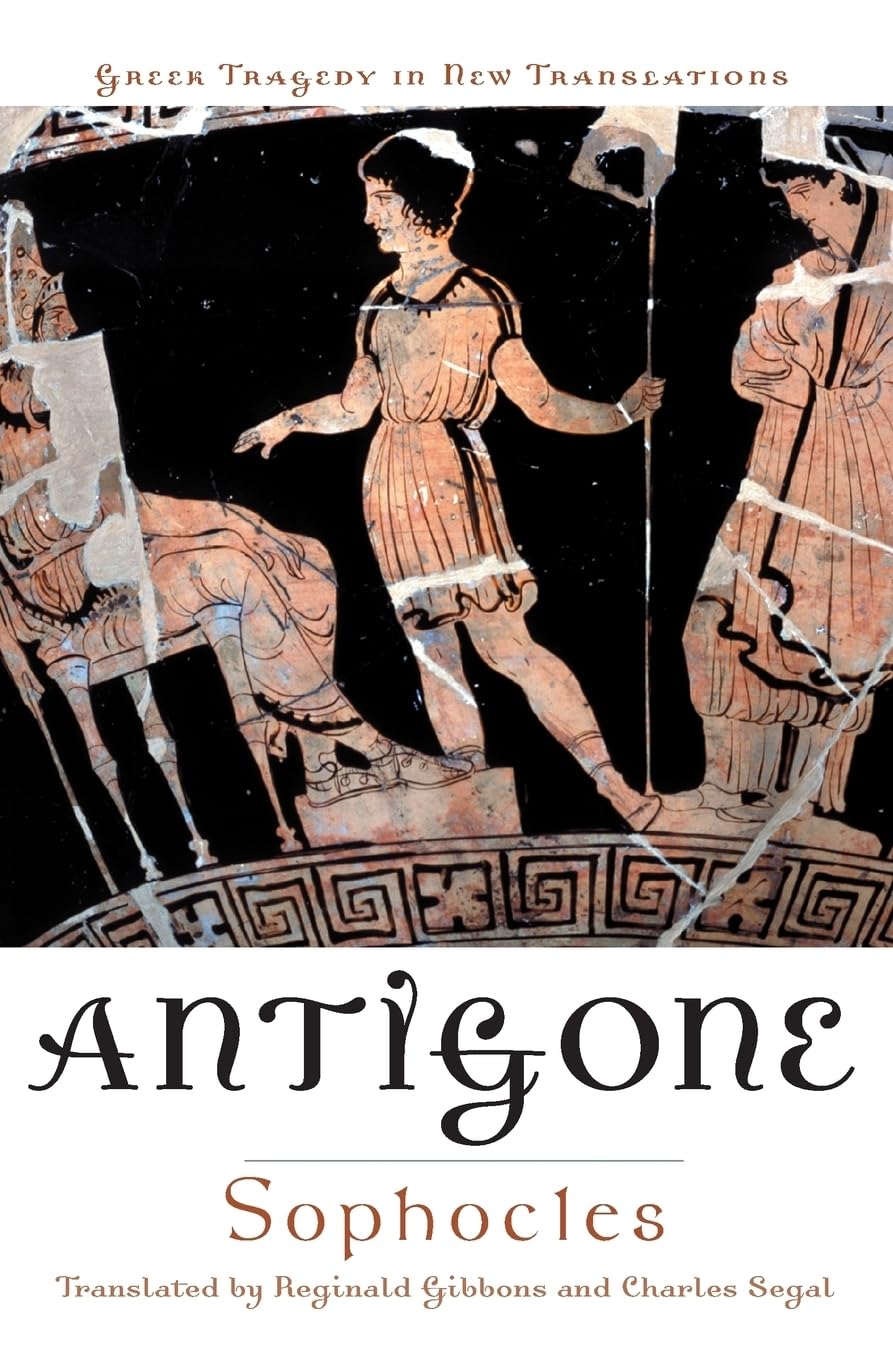
Antigone
by Sophocles
Jonah read this for a class and recommended it. (He read a different translation, this one by Fitts & Fitzgerald. I read the one by Gibbons & Segal (from the library).
Wikipedia:
Antigone appears in the three 5th century BC tragic plays written by Sophocles, known collectively as the three Theban plays. (So this is kind of like reading the third book in a trilogy – after Oedipus Rex and Oedipus at Colonus. Oedipus was Antigone’s father.)
Synopsis:
Before the story begins, Antigone’s brothers Polyneikes and Eteokles kill each other in battle. P was trying to overtake the city, and E was defending it.
The king (Antigone’s uncle, Kreon) declares that no one shall bury P or touch his body, since he was a traitor to the city. Antigone defies his order, burying P and showing respect to her brother. This may please the gods, but it infuriates Kreon, and he declares she will die, even though she is not just his niece but also engaged to his son Haimon.
Haimon tries to convince him this is a bad idea, but Kreon is stubborn. He sends her to be walled up in a cave to die there. Then a seer (Teiresias) comes to warn him that this is angering the gods. At long last, he changes his mind, and he gives P a proper burial. But when he goes to the cave to free Antigone, he finds she has already hung herself, and Haimon is there. Haimon runs himself through on a sword and dies with her in his arms. Kreon returns home to find that his wife, Euridike, has stabbed herself to death, having heard about Haimon.
Some quotes and thoughts:
“Nor would I love an enemy of my land as a close friend – knowing that this ship [the country] keeps us safe, and only when it sails upright can we choose friends for ourselves.” – Kreon (L210+)
“It was not Zeus who made that proclamation [law] to me… nor did I think your proclamation so strong that you, a mortal, could overrule the laws of the gods.” (L500) I.e., we must obey God rather than men. This is Antigone’s response to Kreon when he confronts her about burying Polyneikes.
“Does not one who, like me, lives on among so many evils, profit by dying?” Antigone is not bothered by the idea of dying – it means an escape from the evils around her. This reminds me (in a way) of Isaiah 57:1 – “The righteous are taken away to be spared from evil.”
Only one law explains the ups and downs of life: “Into the life of mortal beings comes nothing great that lies beyond the reach of ruin.” (80, L658)