A Severe Mercy
July 18, 2025
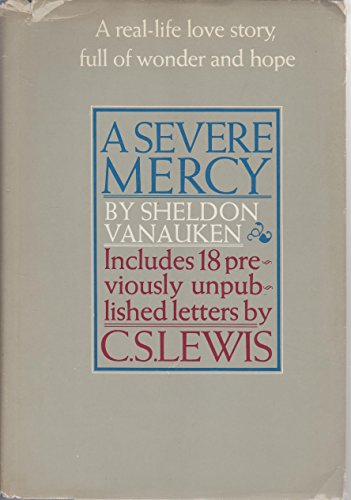
A Severe Mercy
by Sheldon Vanauken
I bought this having never heard of it, because the cover said it contained “18 previously unpublished letters by C.S. Lewis.” It was one of the best books I read this year. This is an autobiography/memoir, largely about how Sheldon Vanauken (Van) met his wife (Davy), their love and marriage as pagans, how they became friends with C.S. Lewis at Oxford, how they later converted to Christianity, and her death.
He calls the book a spiritual autobiography of a love rather than of the lovers. They refer to the wall around their love for each other as “The Shining Barrier.” (58)
My notes:
He felt “a surge of gratitude” toward his parents “just for being what they were.” (19) I know this feeling, especially as an adult.
With his wife Davy’s death came “a curious hint of consolation in one thought: that nothing could now mar the years of their love.” (20)
“[Van] and Lewis would talk deeply and drink beer and perhaps, as Lewis had written, get high.” (21) CSL got high??
“Rather suddenly, without previous reflection on the matter, it began to appear to me that heart-shaped faces were perhaps the best kind.” (25)
Their first kiss is like a scene from a movie:
Earlier I had said I would never kiss a girl unless it would really mean something. This was a bit of a challenge to Davy...
So the next time I did. But not, as she might have expected, in a scene of soft lights and music. Rather, when she proved that she was not one of the screechy girls I detested. The streets were icy. Perhaps I was driving a bit too fast. A major intersection as the lights changed against us -- and a sheet of ice. We slid helplessly into the traffic. Buses thundered down upon us. Cars all but reared up on their hind wheels to avoid us. I snapped a glance at Davy. She caught it and grinned. I grinned happily back. We came gently up against the diagonally opposite kerb. A policeman with an old-fashioned look on his face strode towards us. I leaned quickly over and kissed her. Later, the ice being broken as it were, I kissed her lots more. (26)

They made rules together. “No laying down the law by anybody, ever. Now, children. How do you, um, feel about that? There were, we agreed – even then we saw it – too many people everywhere. Tentatively we said: no children.” (32)
They rejected over-valuing possessions. Upon buying their first new car, they deliberately dented it with a hammer! (33)
They thought boys were brought up to think one way, girls another. “We therefore commenced an immense effort, which we continued over the years, to see and understand the very different points of view: it is not too much to say that I learnt to think like a woman and she like a man.” (38)
They developed these principles:
- Total sharing. If one reads a book, the other does!
- Don’t let possessions become a burden.
- Spontaneity.
- Affirm.
- Courtesy.
These are good but also intense and taken to a crazy degree. Comes across as a kind of monastic legalism in a weird way.
For use in company we had a whole range of signals that didn't depend on catching each other's eye or contorted faces. They were, in fact, mostly innocent questions, such as asking, "Did you bring those English Ovals?" And they meant such things as "This person is boring me out of my mind: do something!" or "Let's get out of here!" or "Keep your eye on the one I shall glance towards" or "The one that just spoke is lying" or "When we go, let's ask the person (or couple) I shall glance at to come with us." These and many others, some more subtle and complex, along with the appropriate responses, in all of which we were well drilled, enabled us to carry on fairly elaborate conversations with privacy in a roomful of people. (42)
They resolved that if one of them died, the other would follow. “We were pagans, not compelled by any religion, expecting only the dark.” (43)
They felt a distaste for the terms husband and wife. They were “comrade-lovers.” Yet they married, a ritual confirming their deep vows. They did this secretly, while still in school. (47)
Knowing little about sailing, they decide to live on a sailboat. Read books, take correspondence courses. “All we needed was a yacht and of course an ocean.” But they lacked money. (50)
In my view, they made an idol of their love for each other. “We build our altar, then, to love…” And they are willing to die (suicide) for it. (53)
He was stationed at Pearl Harbor in the navy and witnessed the attack while on a nearby hill.
I sometimes go on a goose chase looking for the source of a quote. Page 66 refers to “that ‘quiet disrespect of libraries’ of E.B. White’s line.” I couldn’t track this down conclusively. It may be from a 1940 poem published in Harper’s and in a book called One Man’s Meat, but I didn’t actually find it.
While at Yale, they burned in their fireplace “not coal but beautiful walnut gun-stocks – rejects from an arms factory that we could get for a song.” (66)
Davy encounters a pervert:
In the spring Davy decided one afternoon to take her book into the city park. She read peacefully, looking up now and then to watch children at play. They went away after awhile. She read on. She heard a hoarse cry somewhere behind her. It was repeated, and she twisted round to look. A man exposing himself. The loose lips smirked. Awareness of dusk and an empty park but for him swept over her. The man ran towards her. Although I had taught her some methods of defence, Davy sprang up and ran like a hare out of the park, the man pounding along behind her till she proved faster. She leaped out into the street, sobbing a little and filled with loathing, and came home. That was all -- a man whose whole being was a monstrous ego, consumed in self. It would have given me a terrible pleasure to exterminate him. Davy was able to smile at herself later that night, but she did not forget the feeling of being prey. (67)
Davy, unexpectedly convicted of sin: “The Hound of Heaven was after her, following after with unwearied page.” (68)
Van stole a sliver of wood from the Confederate ship Virginia, and they used it in building their Grey Goose. (69)
From one of the C.S. Lewis letters, I found this interesting:
If you are really a product of a materialistic universe, how is it you don't feel at home there? Do fish complain of the sea for being wet? Or if they did, would that fact itself not strongly suggest that they had not always been, or wd. not always be, purely aquatic creatures? Notice how we are perpetually surprised at Time. (How time flies! Fancy John being grown-up & married! I can hardly believe it!') In heaven's name, why? Unless, indeed, there is something in us which is not temporal. (93)
The above quote is discussed more on p. 203. Is our reaction to time a reflection of our eternal nature? “So it appeared to me. Davy and I had longed for timelessness – eternity – all of our days; and the longing… whetted my appetite for heaven.”
Van writes a letter to CSL upon his conversion (99). An emphasis on choosing. But on p. 101, he chalks that up to a lack of humility. “In reality, I suspect, it was not like that at all: I did not chose; I was chosen.”
The problem with de-mythologizers:
If Oxford consistently teaches any one thing, it is that fundamental assumptions must be verified. But not the demythologisers: When they say that prophecy must have been inserted after the event, their unverified assumption is that true phophecy cannot occur. They assume -- merely assume -- that miracles cannot happen: no proof and, by the nature of the case, no proof possible. Apart from being miraculous, the Ascension could not have happened because it contradicts modern cosmology -- heaven cannot be 'up' or out'; the assumption is that God could not have had purposes obscure to critics. They argue that something could not have been said or written when it was supposed to have been because its theology or ecclesiology is too advanced, assuming that no man could have been ahead of his times. If a New Testament event is akin to an earlier myth, it cannot have happened, on the assumption that God couldn't have intended to turn anticipatory myth into fact. Moreover, Christ's words were misunderstood by His followers and the early church though quite clear to critics. Assumption: the mind of the infinite God is not unlike that of a German critic. We had no quarrel with legitimate Biblical criticism and scholarship, only with those, like the demythologisers, who bring their unverified assumptions and philosophies to the text. (107)
CSL points out that “it is altogether healthier to find yourself being used as the answer to someone else’s prayer.” (110)
“Rereading books… was the mark of the real lover of books.” (111)
“It was we two again. All this gray magic of Oxford would fade away, but we – we should go on, we should be together, back to back if need be.” (123)
Another cinematic scene (like the first kiss), saying farewall to C.S. Lewis upon leaving Oxford:
Lewis said that he hoped Davy and I would be coming back to England soon, for we mustn't get out of touch. "At all events," he said with a cheerful grin, "we'll certainly meet again, here -- or _there_." Then it was time to go, and we drained our mugs. When we emerged on to the busy High with the traffic streaming past, we shook hands, and he said: "I shan't say goodbye. We'll meet again." Then he plunged into the traffic. I stood there watching him. When he reached the pavement on the other side, he turned round as though he knew somehow that I would still be standing there in front of the Eastgate. Then he raised his voice in a great roar that easily overcame the noise of the cars and buses. Heads turned and at least one car swerved. "Besides," he bellowed with a great grin, "Christians NEVER say goodbye!" (125)
Davy paints a scene with a high door – a “high destiny” – for Van, and a low door for herself. He comments, “that low door probably leads to a throne.” (152)
The Virginia Baptist Hospital cared for Davy for weeks before she died, and end the end they “would not take a penny” for her care (164). Unimaginable today!
After she died, “for over a year, there was no day I did not weep, and I did not find that tears cut me off from her. It was the tearless void that severed us at times.” (182)
This thought from C.S. Lewis – “what Jean would have liked” is a snare – seems right:
Forgive me for suggesting that the form 'what Jean would have liked' could come to have its dangers. The real question is what she wills now; and you may be sure her will is now one with God's. A 'sovereignty in the pluperfect subjunctive' is often a snare. The danger is that of confusing your love for her (gradually -- as the years pass) with your love for a period in your own past; and of trying to preserve the past in a way in which it can't be preserved. Death -- corruption -- resurrection is the true rhythm: not the pathetic, horrible practice of mummification. Sad you must be at present. You can't develop a false sense of a duty to cling to sadness if -- and when, for nature will not preserve any psychological state forever -- sadness begins to vanish? There is great good in bearing sorrow patiently: I don't know that there is any virtue in sorrow just as such. It is a Christian duty, as you know, for everyone to be as happy as he can. (189)
On pp. 214-15, he gives a brilliant, introspective, honest analysis of what would have happened had Davy recovered. Her death “brought me as nothing else could do to know and end my jealousy of God.” (216)
CSL on his wife Joy’s improved health, talks of the sword of Damocles “which really hangs over everyone.” (227) After she died, he wrote, “When I mourn Joy least I feel nearest to her. Passionate sorrow cuts us off from the dead.” (229)
I like this epilogue. The book had gotten intense and needed a denoumont. A beautiful book. A case of a fellow Christian with whom, like CSL, I would disagree on many points (feminism, children, etc.) but who had something valuable to share.
Vocab
- catamount - a cougar (47)
Some terms from heraldry:
“We designed and had a jeweller make grey-goose signet rings in gold like a coat-of-arms: the grey goose, fess [i.e., in a band across the middle of the shield], flying over stylized waves at the base, and above it and ahead, dexter [i.e., on the right side of the shield, from the perspective of the bearer], a tiny sapphire star.” (51) Opposite dexter is sinister, the left side of the shield.