A Scanner Darkly
June 4, 2025
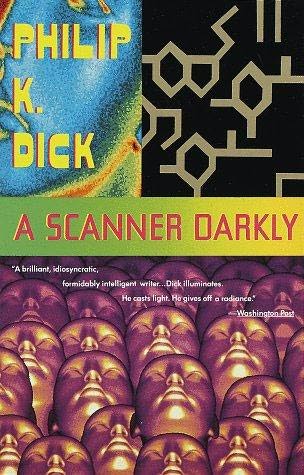
A Scanner Darkly
by Philip K. Dick
This book was published in 1977. It is about the 60s drug culture, but it’s set in 1994 with holo-scanners and scramble suits because that’s how PKD writes about his life and experiences. I think this is the best of all the PKD books and stories I’ve read – genuinely Good Literature. Here are things I noted:
Charles Freck imagines a congregation praying for all the junkies in withdrawl on “Crash Sunday.” Instead of Amen, they respond, “Yeah, yeah.” (9)
When he has a daydream: “In his head, he ran a fantasy number.” (18) This kind of lingo is used throughout to describe thoughts like they are movies or something. A memory is “doing a short rerun” (30).
Undercover cops (“narks”) don’t want their identity known even to other cops, so they wear “scramble suits” that make them appear like a smudge. “Let’s hear it for the vague blur!=” the host said loudly, and there was mass clapping. (23)
The disdain for “straights” in their fat suits, “overhappy,” calling them “nitwits” and “mental simps.” This is a form of narcisism, thinking that “normies” have no inner life, that there’s nothing special about them.
“There seemed to be nothing that contributed more to squalor than a bunch of basalt-block structures designed to lift people out of squalor.” (74)
“Their parody evil-wall-motto, to be feared and despised: If I had known it was harmless I would have killed it myself.” (94)
Here’s where I began to realize there was more to this book: In the opening scene of chapter 9, Bob and Donna are tripping on hash infused with opium. He asks can he hug her. No – you’re too ugly. He gets made, leaves, she follows. A sweet conversation about the one time a place served her alcohol even though she’s underage. Her plans to get married, move to Oregon. And Bob, slowly accepting that he’s not really part of those plans. It isn’t going to happen with Donna.
She took his hand, squeezed it, held it, and then, all at once, she let it drop.
But the actual touch of her lingered, inside his heart. That remained. In all the years of his life ahead, the long years without her, with never seeing her or hearing from her or knowing anything about her, if she was alive or happy or dead or what, that touch stayed locked within him, sealed in himself, and never went away. That one touch of her hand. (157)

“The mind of a junkie bing the music you hear on a clock radio… it sometimes sounds pretty, but it is only there to make you do something.” (159)
“I can’t any longer these days see into myself. I see only murk. Murk outside, murk inside… If the scanners see only darkly, then we are cursed… and we’ll wind up dead this way, knowing very little and getting that little fragment wrong too.” (185)
My favorite passage is on pages 186-188. Charles Freck decides to kill himself by O.D. He spends more time planning how he’ll be found than deciding to do it. When he does, the drugs he bought turn out to be hallucinagenics instead of barbituates. A demon appears, opens a scroll, and spends thousands of years reading off his sins. His conclusion: “Know your dealer.”
Barris’s book title: “Simple Ways to Smuggle Objects Into the US and out, Depending on Which Way You’re Going.”
Donna “rammed her old enemy, her ancient foe, the Coca-Cola truck, which went right on going without noticing.” Her car spun off the road, wrecked. “Now my insurance rates will go up… In this world you pay for tilting with evil in cold, hard cash.” (238)
“How’d you like to gaze at a beer can throughout eternity? It might not be so bad. There’d be nothing to fear.” (243)
What Paul says in the Bible: “faith, hope, and giving away your money.” (254)
From the author’s note: Drug use is a life style with the motto, “Be happy now because tomorrow you are dying,” but the dying begins almost at once, and the happiness is a memory. (276-7)
Vocab
- gestalt - something that is more than the sum of its parts (110)