So Anyway...
August 28, 2024
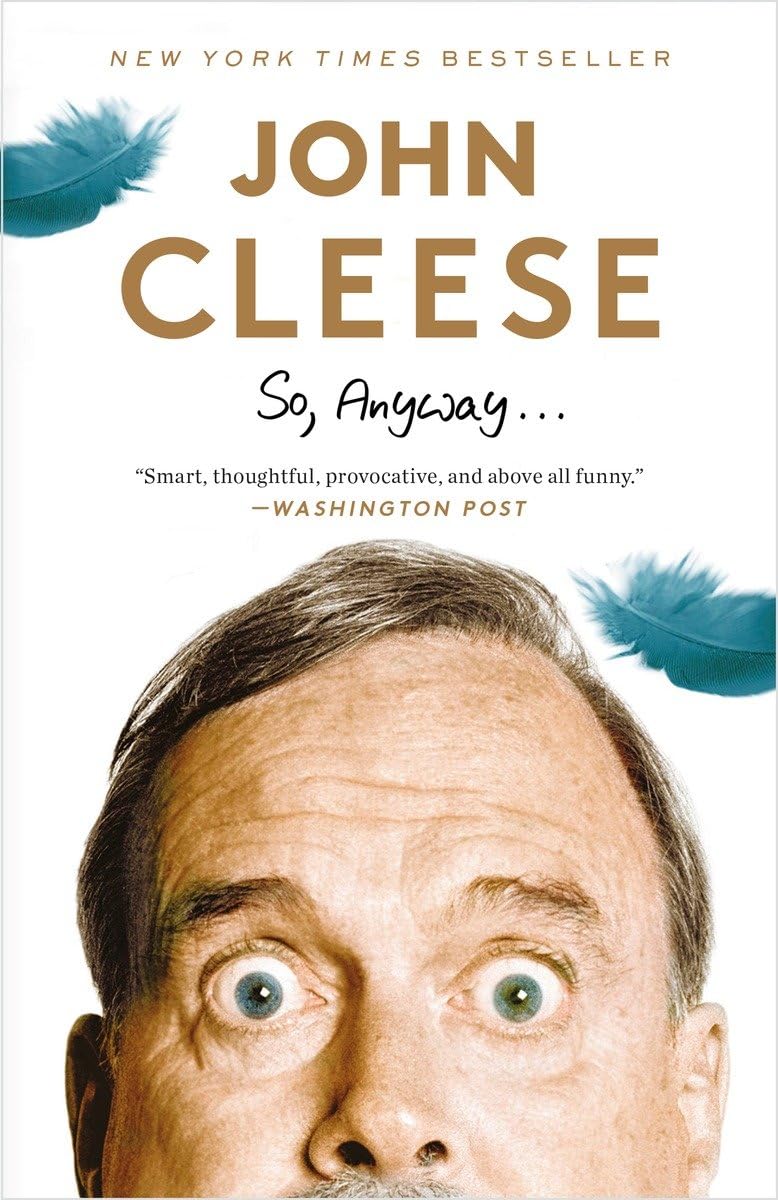
So Anyway...
by John Cleese
I was surprised this book ended when Monty Python began. Nothing in-depth about Fawlty Towers or A Fish Called Wanda, either. Very little about the other Pythons except Graham Chapman. Still, I enjoyed it. Cleese performed with the Footlights at Cambridge, was offered a job writing comedy for the BBC just as he was graduating, and went for it.
He was born Oct. 27, 1939, just a month before my dad. In Aug. of ‘40, Germany bombed his hometown of Weston Super-Mare. Why? “There was nothing in Weston that a bomb could destroy that could possibly be as valuable as the bomb that destroyed it.” (3) His father said, “The Germans bombed Weston to show that they really do have a sense of humour.” (4)
Some very funny phrases, of course. He describes himself trying to tackle in rugby, “dancing around like a disabled fairy.” (5)
His mother “experienced the cosmos as a vast, limitless booby trap.” (10) “I used to joke that she suffered from omni-phobia – you name it, she had a morbid dread of it.” (9) And “she had no information about anything that was not going to affect her life directly in the immediate future.” (9) No general knowledge.
His father sold insurance. He was known to be very honest, only selling you what you needed, so he was frequently recommended. Thus, no cold calls, but he sold more insurance than the other agents.
Dad lived at home with his parents until he was twenty-two.With the outbreak of the First World War in the late summer of 1914, he tried to sign up, but failed the medical because he couldn't read the fourth line down on the optician's chart. Later in the war the army became less picky, but before that happened he volunteered again. This time he asked the man in front of him in the queue to memorise the line he couldn't read, and to tell him what it was on the way out. The subterfuge allowed him to join the carnage in France, albeit under an assumed name; he was fed up with being teased that he was a fermented curd, so he changed the "h" to an "l." I never understood what he was hoping to achieve; I was always called "Cheese" from the moment I arrived at a school. Perhaps his regiment, the Gloucesters, lacked the imagination to make the connection.

Living in India after WWI, Cleese’s father was roommates with P.G. Wodehouse’s brother! (26) A couple of comic-geniuses-in-law.
I definitely don't recall having a fight with Terry Gilliam. May I also point out that if I had, I would almost certainly have killed him. I think the only possible explanation for the Sunday Times article—if it is true-was that Terry attacked me, but that I failed to notice he was doing so. Terry is very short, due to his bandy legs, so when he scuttles around, he stays so close to the floor that it can be difficult to see what he is up to down there. (43)
“Real anger can work in real life; it won’t work in comedy. Funny anger is ineffectual anger.” (46)
Describing Mr. Bartlett, a teacher at St. Peter’s: “This was the Edwardian gentleman’s approach to life: courtesy, grace, restraint, the careful avoidance of embarrassing others, non-intrusiveness, considerateness, kindness, modesty – nay, more than modesty, self-effacement; the very things that would disqualify one forever from employment by the Daily Mail.” (47)
There was one master who quite liked me, no doubt in part because I quite liked him. Nobody else liked him, though-perhaps because he was physically unattractive. Actually that's not true. I was being polite. He was ugly. God, was he ugly. He could have won competitions without taking his teeth out. Rather surprisingly-and endearingly—he was also a bit vain: always fussing about his hair and glancing in the mirror. It was strangely touching to see him battle on in this way against insuperable odds-rather like Quasimodo using eyeliner, or the Elephant Man wearing a toupee. (48)
Sammy’s Reaction Speed:
He must have been the oldest British teacher in captivity... When he talked about biblical events he seemed to have personal memories of them. Nobody could understand why at his age he was still on the staff: it was assumed he had something on the headmaster. He moved very carefully around the classroom like an arthritic gecko, but what was funniest about him was the slowness with which he responded to stimuli. It was as though his whole nervous system had been switched to "Proceed with care," so that his neurons moved very warily, eyeing each synapse for some time before daring to jump.
Sammy's reaction speed was best illustrated the time that a classmate named Cleave decided to hide behind the blackboard. This was a large affair in one corner of the room, which could be slid upwards after the teacher had written on it, so that it could be more easily seen at the back of the classroom. Cleave squeezed behind it before Sammy arrived, and we pulled it down to writing height so that only his legs were visible. Now, Sammy came in and, failing to notice anything unusual, walked straight to the board, pulled out a piece of chalk and started to list prophets, his writing hand never moving more than a foot or so from Cleave's nose on the other side. This kept the class beguiled for about half an hour. Finally Sammy finished and slid the board smoothly upwards to find himself standing about eighteen inches away from the motionless Cleave. What was so funny now was not that he jumped a foot in the air (higher than he had been for several decades) but that THREE SECONDS elapsed between his first seeing Cleave and his jump. In comedic terms, it was the classic "single-take," the finest I've ever seen. (62)
“His persona seemed very odd to me: It was as though he’d once seen an intellectual, and had spent the rest of his life impersonating him.” (63)
Quoting Sir Thomas Beecham: “The English may not like music, but they absolutely love the noise it makes.” (67)
“She was attractive, and in a town like Weston-super-Mare, she stood out like a matador at a Quaker meeting.” (96)
“Thurber described humor as emotional chaos remembered in tranquility.” (103)
The Rabbit Story:
Which brings me to another story that Tony Viney told me, which is very cruel. And quite hilarious, I hope ...
Once upon a time, a very kind and gentle history teacher called Tony was driving home at the end of a summer bank holiday. The traffic was even worse than he had feared, and by the time he reached Salisbury Plain the cars were bumper to bumper and moving forward at a rate of about one car's-length every other Thursday. Tony was very hot, as well as bored and sleepy, when all of a sudden he saw a rabbit. And it was not a happy bunny. In fact it was a sad and miserable little bunny, because it was in the last stages of myxomatosis (this was in the '50s, when the virus was devastating Britain's rabbit population), and it lay there, hardly breathing, its face disfigured by swelling, its eyes so puffed up it was no longer able to see, sores and tumors clearly visible all over its body, and with just hours, if not minutes, to live. And Tony, being a kind and gentle man, and an ardent animal lover to boot, was appalled to see such awful sufferting, and his heart went our to the pitable animal, so he left his car and crossed a few yards of grass until he stood by the dying creature. And seeing is nasal discharge and its swollen ears and to stangely enlarged genitals, he choked back his tears, swallowed, and vowed that very moment to put the poor, dear thing out of its misery. He reached down and picked it up by its ears, held it well away from himself, took a deep breath and karate chopped the back ofis neck -- giving it the deadly "rabbit punch" which he had read about somewhere.
Unfortunately, however, the poor creature had not read the same piece, and so the blow caused it to spring to life and start leaping about (inasmuch as a rabbit can leap about when it is being held up by its ears) with a suddenness that scared its would-be assassin out of his wits. In the normal course of events, Tony would now have dropped the rabbit and run for his life, but his determination to do the right thing by the rabbit was so great that his nerve held, and, realising that his fist karate chop had failed simply because he had not struck the dying creature firmly enough, (out of kindness) he held it up again, grasped its ears even more rightly, and let fly at it once more.
Alas! In his haste to do God's work, he had neglected to take aim properly, and so he caught the rabbit (which was, to be fair, now a moving target) with a glancing blow on the side of its head, thus spurring it to further exertions, while at the same time releasing a surprising quantity of nasal discharge on to his suit. However, the latter event was a matter of very little importance to Tony at this juncture: the question of how to terminate this remarkably resilient rabbit was now occupying his mind so totally that feelings of shame and inadequacy and self-hatred could hardly be sensed through his all-consuming panic.
How, in God's name, was he going to kill it?
Various options flashed through his mind: shooting, hanging drowning, electrocution, impalement, crucifixion, a guillotine ... something sharp! A knife? A saw? A dagger? An axe? ... A penknife! I've got one in the car! I'll cut its throat! Perfect!
He turned towards his car, and froze. Up to this moment Tony had been so focused on the poor rabbit that he had completely failed to notice the crescendoing sound of car horns and angry shouting that now suddenly enveloped him. As far as the eye could see (Salisbury Plain is famous for its flatness) motorists and their passengers, all still stuck in the traffic jam, were shouting and shaking their fists and cursing him and screaming threats. A number were opening their car doors and getting out.
For a few seconds Tony was astonished. Could all these people really believe that he was beating up this rabbit for fun? That he had left his car and pounced on the poor, unsuspecting bunny as a form of blood sport? And that he had then started using it as a punchbag, just to pass the time till the traffic started moving again? That he, kind and gentle Tony, was in fact a sadistic, vile murderous brute destined for the front page of the Daily Mail?
Well, I'm afraid that's exactly what they thought. Unfair, wasn't it?
So... what was Tony to do, in the light of this latest development? Plan A, which was to take the rabbit back to the car where he could quietly stab it to death with his Swiss Army knife, seemed too lengthy a procedure, given that people were now actually heading in his direction. He needed something a bit quicker. To his credit, he never even considered following his natural inclination, which was to throw the rabbit away and run. The creature had suffered enough already, he could not let it down. To be dying of myxomatosis, and then, in the middle of that, to be attacked so gratuitously and, after that, to be abandoned to myxomatosis again was a fate no one deserved. So Plan B was...
"Wait a moment!" thought Tony. "If it's called a rabbit punch; since rabbits can't punch, it must actually kill rabbits. Eventually. So if at first you don't succeed...
And he started hitting it again, with greater determination. The approaching mob stopped in astonishment. Was he deliberately baiting them? A howl of fury arose from them that froze Tony's blood They moved forward again.
And now he panicked.
He threw the rabbit to the ground, and jumped up and down on it.
Then he checked it was dead, shrugged, and waited to be lynched.
And at this very moment, God intervened.
He caused the traffic to begin to move.
And the mob, hearing engines starting up behind them, paused. They were faced with a stark choice. Either they could exterminate this fiend from the face of the planet, or they could regain their place in the queue. A moment of indecision, and then good sense prevailed. They hurried back to their cars, still shouting curses over their shoulders, jumped inside and drove off, in a huff.
Tony pretended to faint, and fell into a position where he could keep his eye on the traffic. He lay there motionless until all the cars that had been in sight during the murder had passed on, at which point he pretended to wake up, and then casually strolled back to his car, got in, and fainted for real.
And it was not as though this kind of thing happened to Tony now and again; such occurrences were a regular part of his day. It was as though God's Department of Practical Jokes had singled him out for special attention, along with Job. I should have become his Boswell. (103-106)
“This is a good example of one of my worst characteristics, which is, when faced with something unfamiliar, to do exactly what I am told without applying common sense.” (113)
I could see no harm in trying to turn myself into a fake English gentleman, because I had incorporated my father's view of gentlemanly behaviour. I recalled being told stories about guests at royal banquets who had picked up the "wrong" fork, whereupon the king had done likewise to avoid embarrassing them, and all the other guests had followed suit. And I was touched by this. It was nothing to do with snobbery. I read once that the journalist Auberon Waugh reproached a guest who had taken off his jacket and put it on the back of his chair, telling him it was "not gentlemanly." I thought it was not gentlemanly to have pointed this out. (121)
About David Frost:
...He was one of the few people I've known who was "pronoid."
I have borrowed this word from the late, great Rob Buckman. He explained to me that whereas a "paranoid" person believes delusionally that people hate him and are out to get him, a pronoid person believes, on no reasonable grounds whatsoever, that people like him and want to help him (I use "him" rather than "her" because the pronoid folk I am acquainted with are all male). (245)
The Rissoles:
I have one last memory of Ibiza. There was a very pleasant and competent open-air restaurant an easy walk from our house. It became our default diner. But the service was slow. Usually it didn't matter because we were happy to sit outside for hours in the balmy evenings sipping sangria, but one evening Alan Hutchison arrived late and hungry, ordered the rissoles (which were always delicious) and then sat at the table with his stomach rumbling, quivering in anticipation. Well, he quivered for a very long time; he politely asked every few minutes when his rissoles were coming, and was assured "dos minutos." After an hour or so, the quivering increased, and was supplemented by suppressed rage, of a kind I had never before ob. served in this mild-mannered man. Finally, as I was becoming worried that bits of him might start shaking loose, or that, worse still, he might kill and eat our waiter, he stood up, announced, "Right!" and strode off with great resolution into the indoor section of the restaurant. We sat, poised for the sound of shouts or blows, but... nothing. Ten minutes later, he reappeared, carrying a plate of his designated rissoles, and tucked into them. When it was safe to speak to him, I asked for details. Nobody, he informed me, had taken any notice of him when he stalked through the restaurant, nor when he arrived in the very busy kitchen. He was expecting to be challenged, so that he could air his grievance, but the various chefs ignored him. Then he saw a large plate of uncooked rissoles. He took down a frying pan, poured in some oil, added a lot of rissoles and started frying. Occasionally the other chefs glanced at him, but nobody seemed put out and so when the rissoles were cooked, he flipped them on to a plate and carried them back to his table. I loved Alan for this: he may be the only person in world history who has responded so effectively to slow service. (270)
On saying no to things, “I had to adapt Edmund Burke: The price of free time was eternal vigilance.” (318)
Re: Peter Sellers, “It is a truth universally acknowledged that the greatest impersonators often have strangely colourless personalities. Perhaps their very lack of a strong identity means they have little of themselves to get in the way when they try to assume someone else’s personality.” (339)
He booked a table at a German restaurant under the name “Mr. Hyena-Explosion.” The Germans didn’t get the joke, so they took the name very seriously (344).
He played a character who “registered the copyright of the unique make-up of every single circus clown by painting it on a real hen’s egg (this, believe me, is how it really used to be done).” (347) I looked it up, and he’s not kidding! See this article.
He talks about the origin of Monty Python. Many of the cast were working together on a show called Do Not Adjust Your Set. They pitched a new show to the head of BBC Comedy with no idea, and he ordered 13 episodes for no apparent reason (356).
Cleese had doubts while writing the Cheese Shop sketch, but Graham Chapman kept reassuring him while writing it, and he had total trust in GC’s comedic sense.
You want creative conflict. But not personal conflict.
Every episode of Flying Circus was recorded with an audience of around 300, between 8-10pm, including retakes. So, no ad-libbing – there was not enough time to experiment.
I was s