The Ingenious Gentleman Don Quixote of La Mancha
December 14, 2024
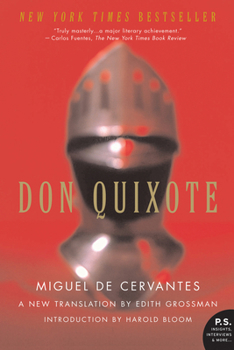
Don Quixote
by Miguel de Cervantes, tr. by Edith Grossman
Wikipedia:
It was originally published in two parts, in 1605 and 1615. Considered a founding work of Western literature, it is often said to be the first modern novel.
Cervantes, in a metafictional narrative, writes that the first few chapters were taken from “the archives of La Mancha”, and the rest were translated from an Arabic text by the Moorish historian Cide Hamete Benengeli.
My notes:
Cervantes and Shakespeare died one day apart, on April 22 and 23, 1616. (xxi) Shakespeare wrote a play, Cardenio, after reading a translation of DQ, but it has been lost.
A brief bio of Cervantes from the front matter:
[Cervantes] was the most battered of eminent writers. At the great naval battle of Lepanto, he was wounded and so at twenty-four permanently lost the use of his left hand. In 1575, he was captured by Barbary pirates and spent five years as a slave in Algiers. Ransomed in 1580, he served Spain as a spy in Portugal and Oran and then returned to Madrid, where he attempted a career as a dramatist, almost invariably failing after writing at least twenty plays. Somewhat desperately, he became a tax collector, only to be indicted and imprisoned for supposed malfeasance in 1597. A fresh imprisonment came in 1605; there is a tradition that he began to compose Don Quixote in jail. Part I, written at incredible speed, was published in 1605 [age 58]. Part II, spurred by a false continuation of Don Quixote by one Avellaneda, was published in 1615 [age 68, right before he died]. (xxv)

Rocinante : Don Quixote :: Babieca : El Cid (medieval knight from Spain) (16)
Rocinante means something like “previously, a nag.” (22)
“Quixote” = armor that covers the thigh (23)
While deciding which of DQ’s books to burn, the priest excuses some which are not about chivalry. But DQ’s niece worries that her uncle, “having been cured of the chivalric disease, will read these and want to become a shepherd… or even worse, a poet,” which is “an incurable and contagious disease. (50)
Of a book of poems: “This book needs a weeding and clearing out of certain base things contained among all its grandeurs.” (51)
One of the books is by Cervantes, who the priest says “is better versed in misfortunes than in verses.” (52) They don’t burn it but decide to lock it away and wait for Cervantes to publish its sequel.
Sancho, after getting beat up yet again, says they should stop looking for adventures, go home, and mind their own business. DQ: “How little you know, Sancho…” Two herds of sheep approach, kicking up dust. DQ says they are armies, describes them in detail. SP only hears “the bleating of lots of sheep.” (129) DQ says fear is clouding his senses. Medieval gaslighting! DQ charges the sheep, kills several, and is knocked off Rocinante when shepherds sling stones at him. DQ drinks a “balm” (from a previous chapter) to heal himself, though it always makes him vomit. While SP is examining his broken teeth, he suddenly pukes all over him, which causes SP to puke all over DQ. (131)
The licentiate Alonso Lopez, after falling from his mule and breaking his leg: “It was a great misadventure for me to run across a man who is seeking adventures.” (138)
Errant = “seeking adventure” (thus, “knight errant”). But “errancy” = being in error.
SP calls DQ “The Knight of the Sorrowful Face” (139). DQ gives credit for this appellation to “the wise man whose task it will be to write the history of my deeds,” i.e. to Cervantes! “The wise man” put this title in SP’s mind and on his tongue.
SP spends two pages telling a story about a goatherd. He has to ferry goats across a river one at a time. SP tells DQ to keep count, but DQ is impatient – “Just say he ferried them all.” DQ doesn’t keep count, and so SP stops the story abruptly. “I forgot everything I had left to say.” (145-147) This was funny, but what was the point? Just to make fun of shaggy dog storytelling? And then SP quietly takes a dump while still clinging to DQ’s leg, standing up, while DQ sits on Rocinante?! Chapter XX is weird!
“Your grace will learn the lesson… the same way I’m a Turk.” -SP (173)
The story of Cardenio (basis for the lost Shakespeare play) begins on p. 184. “Worldly possessions can do little to remedy the afflictions sent by heaven.”
“A knight errant deserves neither glory nor thanks if he goes mad for a reason. The great achievement is to lose one’s reason for no reason, and to let my lady know that if I can do this without cause, what should I not do if there were cause?” (194)
Sancho, don’t believe your lying eyes:
"By God, Señor Knight of the Sorrowful Face, but I lose my patience and can't bear some of the things your grace says; because of them I even imagine that everything you tell me about chivalry, and winning kingdoms and empires, and giving me ínsulas and granting me other favors and honors, as is the custom of knights errant, must be nothing but empty talk and lies, and all a hamburg or a humbug or whatever you call it. Because it anyone heard your grace calling a barber's basin the helmet of Mambrino without realizing the error after more than four days, what could he think but that whoever says and claims such a thing must be out ofhis mind? I have the basin in the bag, all dented, and I'm taking it along so I can fix it when I get home, and use it to trim my beard, if someday, by the grace of God, I ever find myself with my wife and children again."
"Well, Sancho, by the same oath you swore before, I swear to you," said Don Quixote, "that you have the dimmest wits that any squire in the world has or ever had. Is it possible that in all the time you have traveled with me you have not yet noticed that all things having to do with knights errant appear to be chimerical, foolish, senseless, and turned inside out? And not because they really are, but because hordes of enchanters always walk among us and alter and change everything and turn things into whatever they please, according to whether they wish to favor us or destroy us; and so, what seems to you a barber's basin seems to me the helmet of Mambrino, and will seem another thing to someone else. (195)
Sancho seems genuinely pleased when he learns who lady Dulcinea really is – a peasant girl, “sturdy as a horse,” with a bellowing voice, who makes fun of everything and isn’t “a prude.” (199)
“Although your wits are dull, your tongue often is sharp.” (200)
SP calls himself an ass, but says, “I don’t know why my mouth says ass, when you shouldn’t mention rope in the hanged man’s house.” (201)
There are occasional references to the slave trade, like this:
The only thing he regretted was the thought that the kingdom was in a country of blacks, and the people who would be given to him as vassals would all be blacks; then, in his imagination, he found a good remedy for this, saying to himself:
"What difference does it make to me if my vassals are blacks? All I have to do is put them on a ship and bring them to Spain, where I can sell them, and I'll be paid for them in cash, and with that money I'll be able to buy some title or office and live on that for the rest of my life. No flies on me! Who says I don't have the wit or ability to arrange things and sell thirty or ten thousand vassals in the wink of an eye? By God, I'll sell them all, large or small, it's all the same to me, and no matter how black they are, I'll turn them white and yellow [i.e., turn them into silver and gold]. Bring them on, then, I'm no fool!" (245)
The purpose to letters (studying, reading books) is to produce good laws. The purpose of arms (war) is peace. “Peace is the true purpose of war.” (329)
Cervantes name-drops a captain he himself once fought under. He fought in the Battle of Lepanto, Oct 7, 1571 – the definitive defeat of the Turks. (336) He references “something de Saavedra” (344), and this is a reference to himself. His “complete surname was Cervantes Saavedra.”
The one good thing about “Milesian tales” (411), which are designed to “delight and not to teach” (as opposed to moral tales): They give the author such an opportunity to show his skill in developing characters – “drawn as close as possible to the truth” – that the perfection and beauty displayed do teach as well as delight. (413-14)
Cicero: Drama should be an image of truth. (416) This chapter is an argument for art over pulp. The canon proposes an authoritarian art court that must approve any play before it can be performed. (418)
The priest: “I know from experience that mountains breed learned men and shepherds’ huts house philosophers.” The goatherd: “At least, Señor, they shelter men who have suffered greatly…” A connection between suffering and wisdom. (432)
Part 1 ends with DQ back in his bed in La Mancha, attended by his niece. Epigraphs from the graves of DQ, Sancho, Dulcinea, etc. are recorded.
In the Prologue to Part 2, we have this story comparing the difficulty of writing a book to… well, read on:
In Sevilla there was a madman who had the strangest, most comical notion that any madman ever had. What he did was to make a tube out of a reed that he sharpened at one end, and then he would catch a dog on the street, or somewhere else, hold down one of its hind legs with his foot, lift the other with his hand, fit the tube into the right place, and blow until he had made the animal as round as a ball, and then, holding it up, he would give the dog two little pats on the belly and let it go, saying to the onlookers, and there were always a good number of them:
"Now do your graces think it's an easy job to blow up a dog?" Now does your grace think it's an easy job to write a book? (456)
“Amadis of Gaul” gets mentioned a lot in this book.
Part 2, Chapter 2 has this shout-out to Part 1:
“…Last night Bartolomé Carrasco's son, who’s been studying at Salamanca, came home with his bachelor's degree, and I went to welcome him home and he told me that the history of your grace is already in books, and it's called The Ingenious Gentleman Don Quixote of La Mancha; and he says that in it they mention me, Sancho Panza, by name, and my lady Dulcinea of Toboso, and other things that happened when we were alone, so that I crossed myself in fear at how the historian who wrote them could have known about them."
"I assure you, Sancho," said Don Quixote, "that the author of our his tory must be some wise enchanter, for nothing is hidden from them if they wish to write about it." (472)
The author of Part 1 is given as Cide Hamete Berenjena (Mr. Hamid Eggplant), a Moorish name. (473)
“There is no book so bad that it doesn’t have something good in it.” (479)
“Since printed works are looked at slowly, their faults are easily seen, and the greater the fame of their authors, the more closely they are scrutinized.” (479)
“Aliquando bonus dormitat Homerus” - “from time to time, even Homer nodes” (ie, makes a misstep in his writing)
He lists examples of men desiring fame, including Caesar crossing the Rubicon and Cortez burning the ships. (506)
Sancho is not stupid, just simple. And he has been to church, and thought about the sermons. (527) When he tries to sound smart, he fails. (528)
In giving examples of things we can learn from animals, the author says that from storks we can learn about enemas. According to a footnote (529, fn 4), “Pliny claimed that the ibis could administer an enema to itself by filling its neck with water and using its long beak as a nozzle.”
Thoughts on marriage:
If a person wishes to make a lone journey, and if he is prudent, before setting out he will find reliable and peaceful companionship for his travels; then why would he not do the same for the journey that takes a lifetime, until it reaches the resting place of death, and especially if his companion will be with him in bed, at the table, everywhere, which is how a wife accompanies her husband? The companionship of one's own wife is not merchandise that, once purchased, can be returned, or exchanged, or altered; it is an irrevocable circumstance that lasts as long as one lives: it is a rope that, if put around one's neck, turns into the Gordian knot, and if the scythe of Death does not cut it, there is no way to untie it. (578)
“There are only two lineages in the world, as my grandmother used to say, and that’s the haves and the have-nots.” (589)
In ch. 22, Sancho and another guy lower Don Quixote by rope into the Cave of Montesinos. At first, when pulling him up, they think he’s no longer on the rope. When they get him back up, they say, “A very hearty welcome to your grace, Señor; we thought you were going to stay down there and start a family.” (603)
A theological point from Don Quixote: Christ commands we love our neighbor. Since “His burden is light,” it must be that He would not command us to do the impossible. Therefore, these warring villages must make peace. (640-1)
Sancho Panza knows Don Quixote is mad, but he loves him. “If I were a clever man, I would have left my master days ago. But this is my fate and this is my misfortune; I can’t help it; I have to follow him: we’re from the same village, I’ve eaten his bread, I love him dearly, he’s a grateful man, he me his donkeys, and more than anything else, I’m faithful; and so it’s impossible for anything to separate us except the man with the pick and shovel.” (678-9)
Sancho speaks in proverbs, sometimes strung together one after another:
- “Under a poor cloak, you can find a good drinker.” (682)
- “A good governor and a broken leg stay at home.” (686)
- “If you pay your debts, you don’t worry about guarantees, and it’s better to have God’s help than to get up early, and your belly leads your feet, not the other way around.” (686)
- “Just put a finger in my mouth and see if I bite or not!” (686)
DQ curses SP’s many, MANY proverbs:
“God and all his saints curse you, wretched Sancho… as I have said often, will the day ever come when I see you speak an ordinary coherent sentence without any proverbs? Señores, your highnesses should leave this fool alone, for he will grind your souls not between two but two thousand proverbs…” (686)
I think it would be fun to collect all of Sancho’s proverbs into a small book. There are SO MANY, but I didn’t start marking them (with a “P” in the margin) until I was pretty far along. After having that idea, I googled it and found the book Sancho Panza’s proverbs, and others which occur in Don Quixote, from 1892.
The “Overview Effect” is a change some astronauts experience after seeing earth from space. Earth is “a tiny, fragile ball of life,” and our conflicts are small and inconsequential. After seeing earth from the back of the flying wooden horse Clavileño (in his imagination, at least), Sancho seems to experience something similar. (728)
To summarize Don Quixote’s advice to Sancho Panza about good governing:
- fear God (to have wisdom)
- know yourself; be humble
- humble virtue > noble sin
- don’t scorn old friends and neighbors
- instruct your wife in wisdom and refinement, so you grow together
- don’t allow your wife to receive bribes so you can claim you don’t. “For everything received by the judge’s wife her husband will be accountable at the universal reckoning. (731)
- “let the tears of the poor find in you more compassion, but not more justice, than the briefs of the wealthy”
- “if you bend the staff of justice, let it be with the weight not of gifts but of mercy.”
- “if you must punish a man with deeds, do not abuse him with words.”
In ch. 43 he also gives advice on how Sancho should dress and behave. (Say “eructate,” not “belch.” Quit talking in proverbs all the time. “Be moderate in your sleeping.” (734)) Educated people introduced the word “eructate” to replace belch. Deliberately introducing a word “enriches the language, over which the common people and usage have control.” (733) And “the man who does not get up with the sun does not possess the day.” (734)
Sancho becomes governor and is suddenly like a second Solomon. I liked the second case he judged (749). Two men come in, one older and with a cane. The younger one loaned the older one 10 gold escudos, which he says were never repaid. The old man says he gave them back. Sancho has the old man take an oath to that effect, so the old man hands the younger man his can and takes the oath. Sancho figures out that the gold coins were hidden inside the cane!
On p. 844, they stay at an inn where you can order anything you like. But everything Sancho orders, they’re out of. Like the cheese shop sketch.
Idiom: Sancho leaves the innkeeper “looking like an X” – i.e., staggering drunk, as the legs of a stumbling drunkard catching his balance look like an X. (847)
There’s a reference to “second sleep” – “Don Quixote fulfilled his obligations to nature by sleeping his first sleep” (the sleep before midnight, according to the footnote), “but not giving way to his second.” It says Sancho always slept through the night, “provning he had a strong constitution and few cares.” (902)
Post tenebras spero lucem - The motto of printer Juan de la Cuesta, this phrase “appears on the frontispeace of the earliest editions of Don Quixote.” It means, “After the darkness, I hope for the light.”
Sancho on sleep: “I only understand that while I’m sleeping I have no fear, or hope, or trouble, or glory; blessed be whoever invented sleep, the mantle that covers all human thought.” (903)
This reference on 910: “Humble yourself, proud Nimrod.” Nimrod is famous here not just as a mighty hunter but one “in the face of the Lord” (proud).
Don Quixote keeps asking questions while Sancho wants to go to sleep, and I can relate to Sancho here. He’s pumpkining. “I beg your grace to let me sleep and not ask me anything else, unless you want me to throw myself out a window.” (913)
DQ “thought with sounder judgement about everything” after being defeated. (922)
He comes to his senses on his deathbed, renouncing reading all those books of chivalry. Goes by his real name, Alonso Quixano. (935)
Back Matter pp. 4, 6: Edith Grossman got into translation because she wanted to smoke while she worked, and translating was something she could do from home. They wouldn’t let her smoke at the library.