Children of Time
December 19, 2024
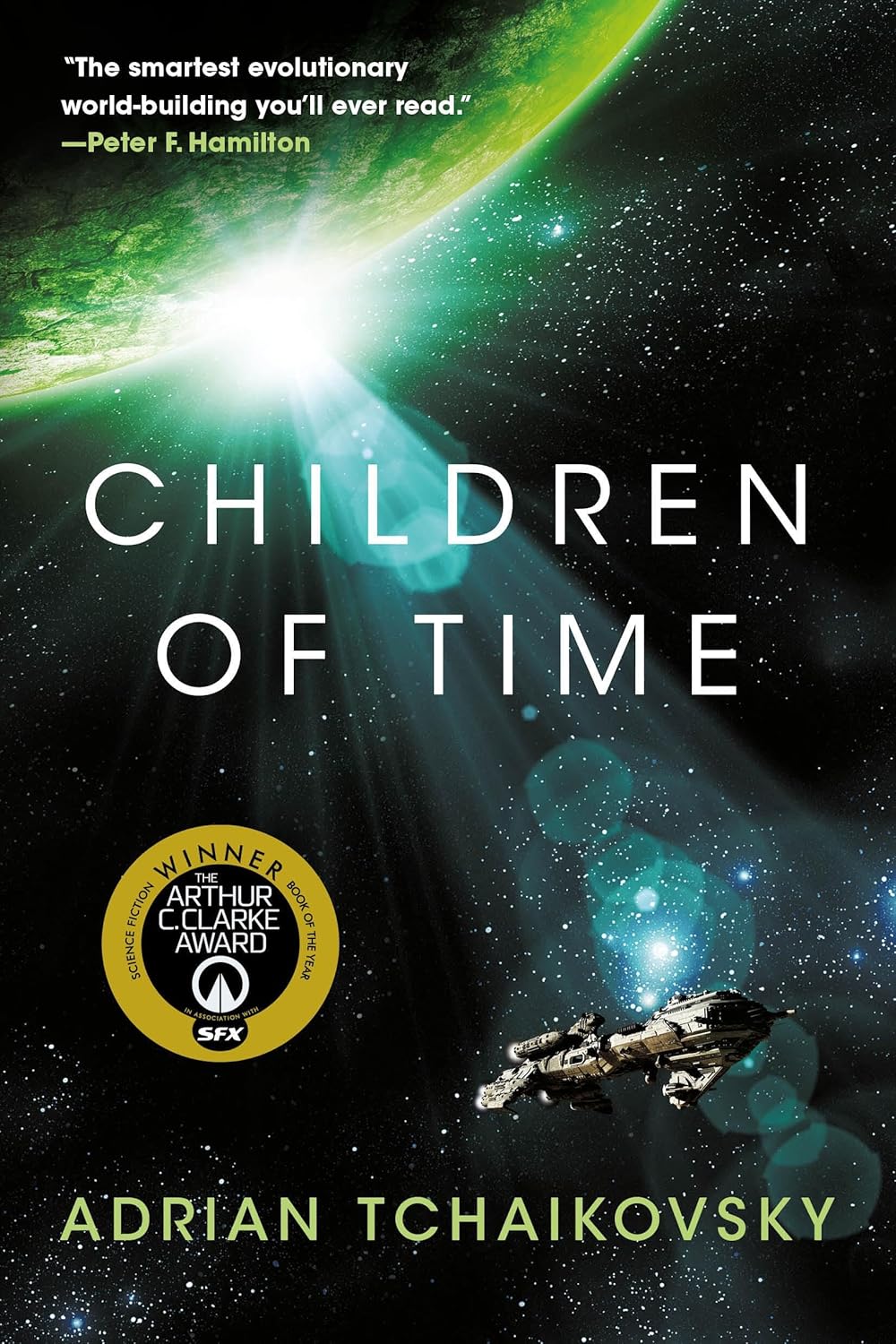
Children of Time
by Adrian Tchaikovsky
I have seen this book recommended in many places (e.g., in this list, and in this tweet from Ivan Kirigin). It just keeps cropping up, so I gave it a try.
Here’s a typical review: “A truly epic evolutionary science fiction story about animal uplift that feels very well researched. Tchaikovsky manages to perfectly immerse the reader in a radically different mindset.”
While I enjoyed the book, I think it’s overrated. It is not truly epic. It does not feel that well researched. The “radically different mindset” feels pretty much human to read about. I think it is a solid book, well written, with a much better ending than I was expecting, just not a masterpiece.
Plot synopsis (spoilers!)
Humans want to start a new planet by dumping monkeys on it, giving the monkeys a virus that will help them evolve faster. But a counterfaction ruins those plans and the monkeys all die. Meanwhile, spiders on the planet receive the virus and begin evolving. Alternating chapters deal with the progress of these spiders over thousands of years. Jumping ahead, humans have to abandon Earth in ark ships looking for a new home. The non-spider chapters are about The Gilgamesh and the humans on board.
The humans get to the spider planet near the beginning of the story, but they are run off by the semi-insane ancient scientist Avrana Kern, who doesn’t understand that the monkeys are gone. She thinks her monkeys are going to rule the planet, and she doesn’t want some dumb humans ruining the experiment. I thought the humans would just land on the planet and fight off the evil spiders to preserve humanity, but the book took a different path that was much more interesting in the end.
After Kern runs them off, the humans travel to other places with no success, and they eventually return to fight Kern and the spiders in a last ditch effort to save humanity. By this point, the spiders are fully sentient and even space-faring.
Notes
Notes taken while reading:
Holsten is a classicist who is on The Gilgamesh because of his knowledge of ancient humanity (Kern’s people) and their language (Imperial C). Deciphering some of their language, he thinks of it as “the formal, antique tongue of a vanished age of wonder and plenty, and an appalling capacity for destruction.” (39)
“Guyen [the captain] was glowering at Holsten as though his fierce regard could somehow inspire the classicist to greater efforts of antiquarianism.” (87)
“The blind watchmaker has been busy.” (105) I found this line annoying. The “blind watchmaker” refers to evolution (and the Dawkins book), but the evolution in this story is not an unguided process. A major plot point is that the virus is guiding the evolution of the spiders, and the virus has a creator (Kern). The book doesn’t really address God, but the spiders understand that they were created (or guided) by Kern’s virus, and they wouldn’t be who they are without her. All it takes is taking one more step back to see that the same logic should apply to Kern (or to all humans). What gives us intelligence, wisdom, love, etc.?
Similarly, “the intrusion of this signal [Kern’s ship sending a steady radio message of mathematical facts which the spiders detect] … is something demonstrably from beyond.” (133) We live in a universe absolutely bursting with mathematical information in its design at every level, down to physical laws. The spiders can tell that this signal is from a higher intelligence – why can’t we? Even the author doesn’t seem to notice this.
The spiders see “the Messenger” (Kern’s ship) cross the sky and detect its signal via a crystal. (157) Kern, creating this world, set up things to be discovered. She knows the monkeys (well, spiders now) will eventually learn how to receive a radio signal, so she created a signal for them to receive, and one simple enough that they will understand it. God has done the same thing with our universe, but He is called a “blind watchmaker.” Does the author think the universe is random and meaningless, or not? Seems like he is trying to have it both ways.
“Who would have any use for a large group fo males?” (153) The author is a girlboss. Kern (a woman) is the leader of the initial project. The spider leaders are almost all female, but with masculine traits (size, fighting). The chief engineer on The Gilgamesh (Isa Lain) is a woman.
Kern has forgotten her own history. She has “memories of times when she once remembered.” (480) This is relateable – like when I start to tell a story and realize I don’t remember any of the details.
Kern says the meaning of life is to survive, grow, prosper, and seek to understand. (482) This is what she tells the spiders once they can talk to her over radio. But being able to understand is not guaranteed apart from a benevolent creator. And she makes no mention of morality.
“What is it like to be you?” A question all historians have but can never ask. (503)
Spiders are made for a life in space – they always have a tether. (515)
The author was smart to keep spider names consistent throughout thousands of years of evolution. Every spider chapter had a Portia, a Bianca, a Fabian, etc. This is much easier to keep track of, and it makes me care about them more. Not an obvious writing choice.
He shows you both sides. The spiders are not the bad guys. Their planet is being invaded by technologically superior aliens! And the humans are not bad, either. They are just trying to save their species. He puts it in the context of The Prisoner’s Delimma. The prisoners can’t communicate, so they can’t know what the other one is going to do and must make a decision. Usually this is because the prisoners are kept separate, but in this story it’s just because of a language/species barrier.
The Ending
The point of the story: “Life is not perfect, individuals will always be flawed, but empathy – the sheer inability to see those around them as anything other than people, too – conquers all, in the end.” (598)
You think the spiders are poisoning the humans on the Gilgamesh with a biological weapon. Instead, they have bet everything on being able to impart a portion of Kern’s nanovirus that will cause the humans to see the spiders as “like us.” Then understanding can occur. In the last 10-20 pages of the book, the entire course of events turns from the Prisoder’s Delimma worst case to a best case scenario where the humans and spiders live in peace. It is a eucatastrophe, a sudden, happy resolution. This really makes the book satisfying, and I suspect it is the reason people praise the book so highly.
Words I didn’t know
idiolectic = a language variant used by a single person (493)
autolysis = the destruction of an organisms cells by enzymes produced by the organism, i.e., self-destruction (520)