Reflections on the Psalms
August 30, 2023
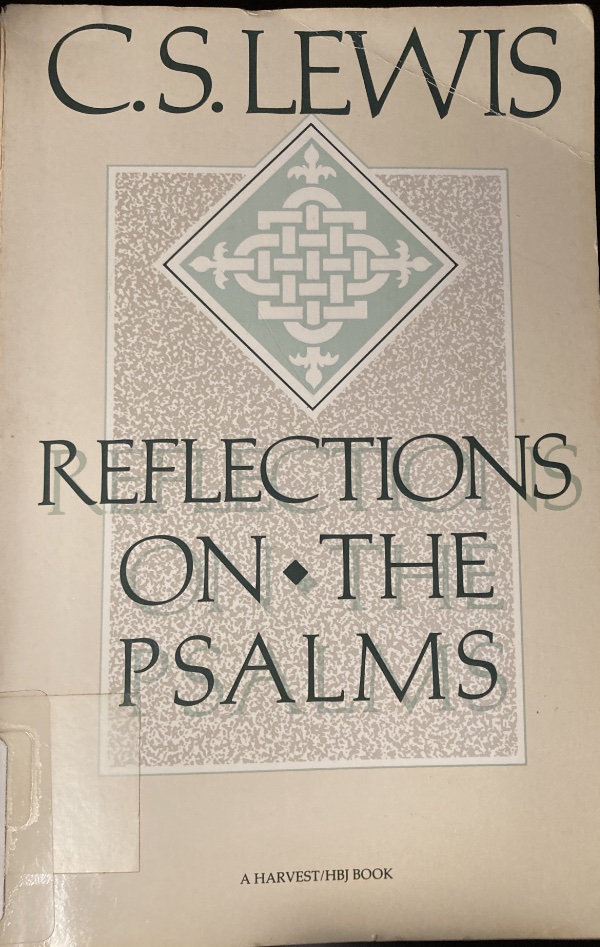
Reflections on the Psalms
by C. S. Lewis
Having just heard an excellent presentation by Pastor Bryan Wolfmueller on the Psalms (at Higher Things 2023 in San Antonio), I was really looking forward to this book. I’ve gotten a lot out of some of Lewis’s theological writing (especially Mere Christianity), but not this one. Overall, I was appalled and disappointed by it.
In case one of my children picks this book off the shelf someday, I wrote this in the front:
If you are considering reading this, reconsider. Or skip to page 139, and simply read the Psalms. CSL’s view of Scripture is that it “contains” (not simply “is”) God’s Word, and this muddies everything. (See p. 111, if you must, where he explains this.)
Yet, he is a brother, and when he writes of God’s grace and forgiveness in Christ, he is sincere. (He has written of this much better elsewhere.) It testifies to God’s grace that He would save someone who holds such a liberal, Swiss cheese view of Scripture.
That summarizes my view of the book. Below are some notes I took while reading it.
This is not an “apologetic work,” he says (7). “A man can’t be always defending the truth; there must be a time to feed on it.” I’ve heard this called reading the Scriptures “devotionally.” Believing they are God’s Word for us, we can read and simply receive what they say. There are times to parse the grammar and dig into the original languages, but if you do that forever, you may starve yourself of some of their gifts.
Art: “The principle of art has been defined by someone as ’the same in the other’” (4). Theme and variation, symmetry, parallels, patterns.
Poetry: “For poetry too is a little incarnation, giving body to had been before invisible and inaudible.” (5)
He translates “judges” in the OT as “champions,” which makes sense to me.
He writes as if the Psalmists were of a different faith than we are: “I think there are very good reasons for regarding the Christian picture of God’s judgement as far more profound and far safer for our souls than the Jewish.” (12) Later, the Psalmists, “were not Christians…” (26)
The Gospel is still in here: “We must all pin our hopes on the mercy of God and the work of Christ, not on our own goodness.” (13)
He writes of being “sensitive” as a form of “domestic tyranny” (14). We pretend to be sensitive when the real problem is our “thwarted self-will.”
“…if we still believe (as I do) that all Holy Scripture is in some sense – though not all parts of it in the same sense – the word of God.” (19) I detected a problem here, and later reading bore it out. In spite of what he says here, he writes about some of the Psalms as if they are NOT the word of God. On the very next page (20) he calls one verse “devilish,” and on 21 calls a passage “diabolical.” It is fine to be puzzled by these passages. They puzzle me as well. It is not fine to oppose the word of God by calling it devilish. This is like the Pharisees saying of Jesus, “He has a demon.”
About forgiving others: “We forgive, we mortify our resentment; a week later, some chain of thought carries us back to the original offence and we discover the old resentment blazing away as if nothing had been done about it at all. We need to forgive our brother seventy times seven not only for the 490 offences but for one offence.” (25)
CSL sees “cursing” Psalms (109, 137:9, 139:19) as “devilish.” The writer was sinning when expressing these thoughts, and their main use is in showing us our depravity. In what “sense” (p. 19) is he viewing these as the word of God? If God is the writer, then God was sinning – no!
“Where we find a difficulty we may always expect that a discovery awaits us. Where there is cover we hope for game.” (28) The difficulty he’s exploring is that he claims Pagan writers seem to lack the vitriol of the Psalms. (If true, maybe this reflects the Lord’s wrath over sin.) “If the Jews cursed more bitterly than the Pagans this was, I think, at least in part because they took right and wrong more seriously.” (30) Their indignation may be a sign of having a sense of moral fairness.
He rightly applies the second commandment to adding “Thus saith the Lord” to your own opinions. (31)
Re: eternal life in the OT, CSL thinks God did not reveal heaven and hell to Jews, because they would’ve made it the center of their religion (36). This is wrong. Consider:
- Job 19:25-27, I know that my Redeemer lives, I will see Him with my own eyes
- Isaiah 26:19, Your dead will live. Their bodies will rise.
- Daniel 12:1-3
- Psalm 49, God will redeem the righteous from Sheol and take them to Himself.
- Psalm 73:24
- Psalm 16:10
- Job 14:1-15
- …
Barfield, Baxter, CSL all write of an older mind that drew fewer lines between things. The acts of worship and feelings of being in God’s presence were indistinguishable to the Psalmist. “I suspect the poet of that Psalm (Ps 27) drew no distinction between ‘beholding the fair beauty of the Lord’ and the acts of worship themselves.” (48)
All truths come from God. Therefore, because Akhenaten was a monotheist (truth), “we may well hope that he was accepted and blessed by God…” (86) Is monotheism the criteria for attaining heaven, then? Even religions that explicitly reject Christ? This does not stand up under any scrutiny at all.
“I think we delight to praise what we enjoy because the praise not merely expresses but completes the enjoyment.” (95)
On p. 97, he refers to “the element of bargaining in the Psalms” (I’m not going to reread this section to remember what he meant) as a “silly dash of Paganism.” Referring to God’s word as paganism is indefensible for a Christian. On p. 19 he said all Scripture is “in some sense” God’s word, but he regularly writes of it as if it were not.
Pages 111-114 (and on) express his view of the inspiration of Scripture. A few good things in this passage, but he’s way off. I do like this: “But of course these conjectures as to why God does what He does are probably of no more value than my dog’s ideas of what I am up to when I sit and read.” (115)
Re: evolution, “what difficulties I have with evolution are not religious”. (115)
Christ, a man, is seated at the right hand of the Father, interceding for us. “And it is this, I believe, that most modern Christians need to be reminded of. It seems to me that I seldom meet any strong or exultant sense of the continued, never-to-be-abandoned, Humanity of Christ in glory, in eternity. We stress the Humanity too exclusively at Christmas, and the Deity too exclusively after the Resurrection; almost as if Christ once became a man and then presently reverted to being simply God. We think of the Resurrection and Ascension (rightly) as great acts of God; less often as the triumph of Man. The ancient interpretation of Psalm 8, however arrived at, is a cheering corrective.” (134)
“A thousand years are as one day” and “one day is as a thousand years.” “As nothing outlasts God, so nothing slips away from Him into the past.” (137)