Poetic Diction
May 6, 2023
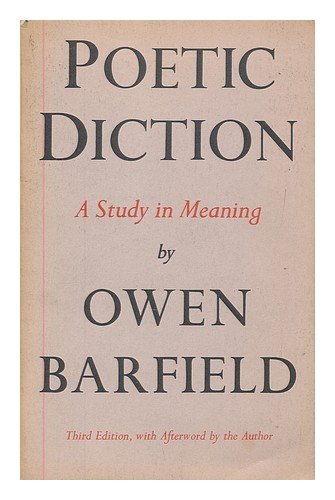
Poetic Diction
by Owen Barfield
Below are my barely edited, raw notes from reading Poetic Diction. Some of the better stuff is toward the bottom!
“No poet can be the creator of all the meaning in his poem,” since he must work with words, which “owe their meaning to the generations of human beings who have previously used them.” (50)
Appreciating poetry comes at the moment of a “felt change of consciousness.” Once the change occurs, we are no longer concerned with diction – the words have served their purpose. These changes are rare; “men are habitually insensible to beauty.” (52)
A thought experiment: Helen Keller in reverse. Losing all language, one would lose recognition and meaning in what is observed. Gaining language is thus an “expansion of consciousness.” Poetic experience does this. (56)
Coleridge: Poetry is “the best words in the best order.” (58)
OB’s goal seems to be finding principles for evaluating poetry that transcend “expressions of personal taste.” (58)
The essence of poetry is metaphorical language, the marking of relations of things. (67)
“the gradual murder of the Muse by Reason” (68)
Fallacy of progress. Ancient poetry (The Odyssey, Beowulf) is better. (71)
A language with fewer words requires more metaphor, thus is more poetic. I think this could be the opposite of scientific language, in which all things are given a precise term but without beauty (or at least, beauty is not a goal in science). The beauty is in the comparisons. (74)
OB thinks the concept of root words arose after much time. More complex words “divided.” So these words are not, historically speaking, “roots.” But I see in them the design of language. (82)
Another writer, Max Müller, writes of a “metaphorical period - a wonderful age when a race of anonymous and mighty poets took hold of a bald inventory and saturated it with poetic values.” I call this The Poet of the Gaps theory, and OB calls it absurd and untenable. (84)
OB’s theory is that, long ago, words had more meaning. Metaphor was not needed, because anything you might say with a metaphor was already emboddied in the word itself. For example, we might use “sleep” as a metaphor for death, but in this ancient age, sleep would have meant both sleep and death. The old poets did not divide a word’s concrete and abstract meanings. Looking at an object, they saw all that it symbolizes, its uses, its origin, construction, history, …
He mentions primitive man in a few places (e.g., 86), and I don’t know what he’s getting at. It seems he thinks that a grunting Neanderthal would be “resounding with all manner of meaning” which he could not communicate.
I do appreciate the idea that “we [modern men], in the development of consciousness, have lost the power to see [with direct perception]. Our sophistication, like Odin’s, has cost us an eye.” (87) By “consciousness,” OB does not mean awareness of one’s surroundings, but I don’t really know what he does mean.
Why does older poetry “cause wisdom” moreso than modern? OB’s theory: Older poets did not divide a word’s concrete and abstract meanings. This division came later, and reading Homer (for example) leads us back “to experience the original unity.” (86)
A good name for this kind of banality -- the fruit, as it is, of projecting post-logical thoughts back into a pre-logical age -- would perhaps be 'Logomorphism'. Whatever we call it, there is no denying that it is at present extraordinarily widespread, being indeed taken for granted in all the most reputable circles. Imagination, history, bare common sense - these, it seems, are as nothing beside the paramount necessity that the great Mumbo Jumbo, the patent, double-million magnifying Inductive Method, should be allowed to continue contemplating its own ideal reflection -a golden age in which every man was his own Newton, in a world dropping with apples. Only when poesy, who is herself alive, looks backward, does she see at a glance how much younger is the Tree of Knowledge than the Tree of Life! (90)

On the one hand, he argues that poetic wisdom is older than people suppose. On the other, he calls these old poets “pre-logical,” and implies (at the end of the quote) that they lacked knownledge. Is it just that “pre-logical” reads like an insult to my Enlightenment-tuned ears? “Pre-logical” could mean before the time when we so divided the meanings of words scientifically that we severely wounded the poetry inherrent in life.
If OB really thinks the old poets lack knowledge and logic, it seems like he’s making the same mistake he’s been pointing out. As you go back in time, you find more wisdom, yet the people furthest back are the least wise for some reason? Sure, they don’t know all the facts we do. Perhaps they knew better ones. On what grounds can we call then “pre-logical?” I get the sense that he means something different by consciousness, logic, and even meaning, so I don’t want to take the argument too far and miss his point.
“Mythology is the ghost of concrete meaning.” (92) Myths capture the ancient time when “connections between discrete phenomena” were perceived as reality, not metaphor. Poets try to revive this.
Emerson: “Man is an analogist, and studies relations in all objects.”
They (OB and now Emerson) can’t get away from the idea of cave men, Neanderthals, savages. Yet they perceive them as more poetic. Did they think the savages were knowingly poetic, or that our glowing brains see their dumb lives in a poetic light? Typical Enlightenment hubris, which I expect from Emerson.
The “rational” and “poetic” principles are like two buckets in a well. For one to rise, the other must descend. (94)
There is a certain half-spurious element in the appreciation of poetry, with which everyone will be familiar, when one takes delight, not only in what is said and in the way it is said, but in a sense of difficulties overcome -- of an obstreperous medium having been masterfully subdued. It is a kind of architectural pleasure. One feels that the poet is working in solid masses, not in something fluid. One is reminded by one's very admiration that 'words are stubborn things'. (96)
Fluid vs. architectural poetry. Greek is looser, less rigidly structured, more alive than Latin. Homer writes of Hephaestus actually fashioning “the shield”; Virgil speaks as a spectator, examining the finished product. (96-8)
On page 102, he gives a pretty good summary of his case so far:
For it has been shown that poetic values abound, as meaning, in the early stages of those languages with which we are familiar; this meaning has then been traced back to its source in the theocratic, 'myth-thinking' period, and it has been shown that the myths, which represent the earliest meanings, were not the arbitrary creations of 'poets', but the natural expression of man's being and consciousness at the time. These primary 'meanings' were given, as it were, by Nature, but the very condition of their being given was that they could not at the same time be apprehended in full consciousness; they could not be known, but only experienced, or lived. At this time, therefore, individuals cannot be said to have been responsible for the production of poetic values. Not man was creating, but the gods -- or, in psychological jargon, his 'unconscious'. But with the development of consciousness, as this 'given' poetic meaning decreases more and more, the individual poet gradually steps into his own. In place of the simple, given meaning, we find the metaphor -- a real creation of the individual -- though, in so far as it is true, it is only re-creating, registering as thought, one of those eternal facts which may already have been experienced in perception.
So in earlier days, man was experiencing meaning but could not know it. Man was not, in some sense, “conscious.” He’s trying to present a trade-off. I have no problem with the idea that something has been lost since these ancient times, but it is harder to believe that we have gained a knowledge of ourselves that the ancients lacked.
Like someone who’s funny without meaning to be, the old poets just spouted profound poetry without realizing it? Why couldn’t they also have known what they were doing? But then we could not feel superior to them.
But Shelley agrees:
'In the infancy of the world, neither poets themselves nor their auditors are fully aware of the excellence of poetry: for it acts in a divine and unapprehended manner, beyond and above consciousness; and it is reserved for future generations to contemplate and measure the mighty cause and effect in all the strength and splendour of their union.' --A Defence of Poetry (105)
OB claims that “since Homer’s day, poetry as inner experience has increased.” (105) How on earth can you know that?? He goes on: “The light of consciousness… is not to be compared with such fitful aesthetic gleams as must indeed have flared up now and again amid the host of grosser pleasures preoccupying the dim self-consciousness of the poet’s (probably half-intoxicated) audience.” I take this to mean something like, “The greatest poets in history were half-drunk Neanderthals who didn’t know what they were doing.”
In math and science, there are certain “thought technologies” (e.g., certain notations, the periodic table, etc) which allow us to see farther than our ancestors. Maybe there are similar aspects to poetry?
Writing and editing are different skills. “There is a mood of creation and a mood of appreciation.” (108) He claims people used to be slower at switching between these, and now we are faster at it. Perhaps eventually this will “increase to infinity.
When OB talks of a state of “diminished self-consciousness,” it fits well with our concept of “the flow state.” (107)
The Modern Man: “The man of today, overburdened with self-consciousness, lonely, insulated from Reality by, his shadowy, abstract thoughts, and ever on the verge of the awful maelstrom of his own fantastic dreams, has among his other compensations these lovely ancestral words, embalming the souls of many poets dead and gone and the souls of many common men.” (126)
Poets create words with expansive meaning. Logicians reduce, define, and categorize. (131)
Like CS Lewis’s “dangerous since” (in Studies in Words), without participating in “Greek consciousness,” inhabiting the ancient poet’s mind, you’ll miss his meaning. Ancient meanings may only be expressable in metaphor. For this reason, poetic understanding is important to The Great Conversation.
One of the most striking examples of this truth is the interpretation of Greek philosophy by modern Europeans. Such an one can read Plato and Aristotle through from end to end, he can even write books expounding their philosophy, and all without understanding a single sentence. Unless he has enough imagination, and enough power of detachment from the established meanings or thought-forms of his own civilization, to enable him to grasp the meanings of the fundamental terms — unless, in fact, he has the power not only of thinking, but of unthinking - he will simply re-interpret everything they say in terms of subsequent thought. If he merely seeks to deduce the meaning of words like äpxn, Aóyos, yiyvonaL, Múxn, Súvages from the general context, if he cannot rather feel the way in which they came into being out of the essential nature of the Greek consciousness as a whole, he may read pages and pages of Greek letterpress, and enjoy them, but he will know no more than the shadow of Greek meaning. One could add many other words, but it would take us too far afield. Spengler is excellent on the untranslateableness of these ‘root-words’, as he calls them, and in insisting on the consequently unbridgeable gap between the souls of any two great cultures. (133)
He comes back to this at the end, on page 172: “Outside the purest abstractions and technicalities, no two languages can ever say quite the same thing.”
Language appears historically “as an endless process of metaphor transforming itself into meaning.” (140)
You can have poetic prose… or prosaic verse. (145)
Is it possible that the human experience of consciousness has deteriorated in some big way? That my experience is to the ancients’ as metaphor is to meaning? Poetry is natural; prose comes from divorcing consciousness from Nature. (147)
We (modern, prosaic) are “disgusted” by inverted word orders that our “immediate ancestors” used. He gives this example: “The wise want power; the powerful goodness want.” (148)
“Poetic pleasure” is “the stir of aesthetic imagination.” (152)
“The language of the age is never the language of poetry.” Poetic diction necessarily harkens to an earlier epoch. It has “an archaic flavor.”
“Charles Lamb, himself a minor poet, when solemnly told that he must ‘write for the age’, is said to have replied: ‘Confound the age! I will write for antiquity!’” (159)
Poets don’t have to be hippies.
There is, indeed, a certain simplicity and sobriety about the activity of men who expend more energy upon creation than upon appreciation. If they are poets, they do not require to wear their hair long or to neglect their accounts in order to remind themselves of the fact. They are what they are. The difference was well put by Wordsworth:
The earliest poets of all nations generally wrote from passion excited by real events; they wrote naturally, and as men: feeling powerfully as they did, their language was daring, and figurative. In succeeding times, Poets, and Men ambitious of the fame of Poets, perceiving the influence of such language, and desirous of producing the same effect without being animated by the same passion, set themselves to a mechanical adoption of these figures of speech, and made use of them, sometimes with propriety, but much more frequently applied them to feelings and thoughts with which they had no natural connection whatsoever. (160)
“Poets… are apt to lose touch with the language spoken by their fellow men.” If you’re talking with someone, and they sound archaic and pretentious, maybe they’re just a poet! (164)
On posthumous fame:
Thus, it so often comes about that the fame of great poets is posthumous only. They have, as Shelley said, to create the taste by which they are appreciated; and by the time they have done so, the choice of words, the new meaning and manner of speech which they have brought in must, by the nature of things, be itself growing heavier and heavier, hanging like a millstone of authority round the neck of free expression. We have but to substitute dogma for literature, and we find the same endless antagonism between prophet and priest. How shall the hard rind not hate and detest the unembodied life that is cracking it from within? How shall the mother not feel pain? (167)
Poets can make poor critics, since their own creativity can fill in the gaps in a piece of poor art. But the uncreative sees only facts, results. Non-creative critics can’t interpret; they are collectors only. (169)
“Moreover, this outlandishness is, as we have seen, the part of poetry with which the actual pleasure of appreciation–the old, authentic thrill, which is so strong that it binds some men to their libraries for a lifetime, and actually hinders them from increasing knowledge – is most closely connected. This is that ’element of strangeness in all beauty’ which has been remarked in one way or another by so many critics. Alike in the greatest poetry and in the least, if pleasure is to arise, it must be there.” (171)
Like with the Athenians always wanting to hear something new (or “strange”), seeking the novel can become an obsession that hinders one from increasing in knowledge. This is a danger for me!