Of Other Worlds
January 14, 2023
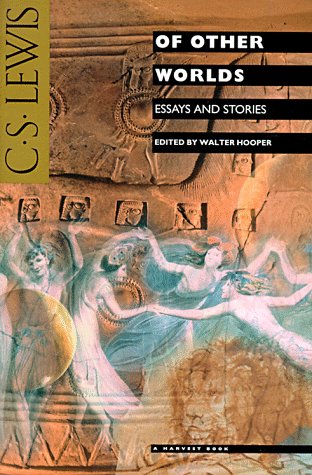
Of Other Worlds
by C. S. Lewis
This collection of essays, short stories, and unfinished chapters was published a couple of years after C. S. Lewis died.
Preface
You can't get a cup of tea large enough or a book long enough to suit me. (v)

As a kid, when he began writing, he tried to write “grown-up” books. “When I began writing stories… I tried to put off all the things I really wanted to write about till at least the second page. It woudn’t be like a grown-up book if it became interesting at once.” (vii)
On Stories
Excitement is not the only thing to enjoy in a story-centric book. There’s also atmosphere, country, weather. He dislikes The Three Musketeers because, “When they cross to London, there is no feeling that London differs from Paris.” (7) I haven’t read T3M, but this is basically true of Paris vs. Rome in Monte Cristo, so I can see what he means.
Compare to The 22 Murders of Madison May (which I just finished); there is no real difference between Madison and Felicity (two main characters), or even between Clay (the psycho killer) and Gavin (the kind boyfriend). They are all twenty-somethings in good health, capable vessels for the plot.
Of course, everyone loves T3M because it’s so exciting. Lewis is looking for more. About stories of Indians, he says:
Dangers, of course, there must be: How else can you keep a story going? But they must be Redskin dangers. The 'Redskinnery' was what really mattered... I wanted not the momentary suspense but that whole world to which it belonged -- the snow and the snow-shoes, beavers and canoes, war-paths and wigwams, and Hiawatha names. (4-5)
Excitement won’t due to replace atmosphere. In the movie adaptation of King Solomon’s Mines, the threat of the characters starving to death trapped in the mines is replaced by a volcano and an earthquake. Surely that’s more exciting, but you lose “the hushing spell of the imagination” that comes from contemplating such a fate. Instead, you get “a rapid flutter of nerves.”
And here is one of his great analogies. Talking about The Three Musketeers, he writes,
If a man sensitive to Romance likes least that Romance which is, by common consent, the most "exciting" of all, then if follows that "excitement" is not the only pleasure to be got out of Romance. If a man loves wine yet hates one of the strongest wines, then surely the sole source of pleasure in wine cannot be the alcohol?
He drops analogies like that at the end of a paragraph often. It’s a signature style and really hammers home some of his points well.
Kinds of fear (from page 8, reformated):
Even in real life different kinds of danger produce different kinds of fear. There may come a point at which fear is so great that such distinctions vanish, but that is another matter.
- There is a fear which is twin sister to awe, such as a man in war-time feels when he first comes within sound of the guns;
- there is a fear which is twin sister to disgust, such as a man feels on finding a snake or scorpion in his bed-room.
- There are taut, quivering fears (for one split second hardly distinguishable from a kind of pleasurable thrill) that a man may feel on a dangerous horse or a dangerous sea; and again, dead, squashed, fattened, numbing fears, as when we think we have cancer or cholera.
- There are also fears which are not of danger at all: like the fear of some large and hideous, though innocuous, insect or the fear of a ghost.
All this, even in real life. But in imagination, where the fear does not rise to abject terror and is not discharged in action, the qualitative difference is much stronger.
Redskins, Pirates, Giants. These are all archetypes.
About the toad in The Wind in the Willows, he writes that it was a very deliberate choice of animal. The toad’s face “has a grotesque resemblance to a certain kind of human face – a rather apoplectic face with a fatuous grin on it.” We see in the creature a certain aspect of humanity, but we are able to see it in its most humorous, “pardonable form.”
“And we bring back the wealth of the Indies; we have henceforth more amusement in, and kindness towards, a certain kind of vanity in real life.” (14)
I experienced this recently when I had to have meetings with a certain lawyer. He was long-winded, rambling, and would go off on excursions into areas of the law that had little to do with the topic at hand (a useful trait when you’re charging by the hour). But it occurred to me that he was like a Dickens character, and seeing him that way made me view him in a good humour rather than be irritated with him.
Another great analogy here (do they always involve food?):
It is usual to speak in a playfully apologetic tone about one's adult enjoyment of what are called "children's books". I think the convention a silly one. No book is really worth reading at the age of ten which is not equally (and often far more) worth reading at the age of fifty except, of course, books of information. The only imaginative works we ought to grow out of are those which it would have been better not to have read at all. A mature palate will probably not much care for crème de menthe: but it ought still to enjoy bread and butter and honey. (15)
I notice that CSL likes explaining to stuffy academics the hidden importance of popular art. These days, I think too much importance may be placed on pop art. He lived in a world that valued the classics too snobbishly; now, the snobs own NFTs of cartoon apes.
“There is death in the camera.” Because cinema tends to replace atmosphere with excitement (see the King Solomon’s Mines example above), replacing written fiction with cinema is a tragic trend. Of course, look how much further things have gone – reading has been replaced by not just movies, which can still be well done as an art form, but by TikToks and memes that require no attention span and offer zero atmosphere.
This quote got me: “An unliterary man may be defined as one who reads books only once.” (17) The theme of re-reading good books keeps coming up for me. We are ships of Theseus; we can’t read the same book twice, even when we read the same book twice. But I like trying new things so much, I rarely reread anything.
Neither story nor real life successfully capture a state of being, whatever it may be. But story can “entangle it in the net for several chapters,” so we can examine and enjoy it.
Three Ways of Writing for Children
Another great analogy here:
A children's story which is enjoyed only by children is a bad children's story. The good ones last. A waltz which you can like only when you are waltzing is a bad waltz. (24)
Some reasons that the children’s fantasy genre was good for CSL: You have to focus on what was done and said; can’t have too much exposition. And you must keep it short.
A famous quote: “When I was ten, I read fairy tales in secret and would have been ashamed if I had been found doing so. Now that I am fifty, I read them openly. When I became a man I put away childish things, including the fear of childishness and the desire to be very grown up.” (25)
This was funny:
Once in a hotel dining-room I said, rather too loudly, "I loathe prunes." "So do I," came an unexpected six-voice from another table. Sympathy was instantaneous. Neither of us thought it funny. We both knew that prunes are far too nasty to be funny. That is the proper meeting between man and child as independent personalities. (34)
Sometimes Fairy Stories May Say Best What’s To Be Said
The idea for Narnia originated with an image:
Some people seem to think that I began by asking myself how I could say something about Christianity to children; then fixed on the fairy tale as an instrument; then collected information about child-psychology and decided what age group I'd write for; then drew up a list of basic Christian truths and hammered out 'allegories' to embody them. This is all pure moonshine. I couldn't write in that way at all. Everything began with images; a faun carrying an umbrella, a queen on a sledge, a magnificent lion. At first there wasn't even anything Christian about them; that element pushed itself in of its own accord. It was part of the bubbling. (36)
On Criticism
Reviewers should be unbiased (45), but editors want some drama and conflict, so they often try to get reviewers who have an axe to grind with the book they are reviewing. More often, they don’t even read what they are reviewing (not doing “the Prep”, 46). CSL views them compassionately nonetheless:
Let no one try to make a living by becoming a reviewer except as a last resource. This fatal ignorance of the text is not always the fruit of laziness or malice. It may be mere defeat by an intolerable burden. To live night and day with that hopeless mountain of new books (mostly uncongenial) piling up on your desk, to be compelled to say something where you have nothing to say, to be always behind-hand -- indeed much is to be excused to one so enslaved.
Before reading that paragraph, I thought of “book reviewer” as kind of a dream job. But the “mostly uncongenial” comment hit me: Sure, you get to read books for a living, but you don’t get to choose which ones.
Reviewers must work hard not to write imagined histories of a book’s origins. (55) You don’t know. You can only fairly criticize the book on its merits. People get the origins of Narnia and LOTR wrong all the time.
On Science Fiction
The stranger the events you’re writing about, the more ordinary your characters should be. (64) An Everyman.
Criticizing a form you dislike is dangerous. It must be tried by its own rules. I can imagine having trouble fairly reviewing a rap album, for example. I recognize the subtleties exist in the genre which I would be completely missing.
He breaks down a few types of sci-fi:
- Other Genres in Space: Written by “Displaced Persons,” authors who would rather be writing mysteries, romances, etc. but are moved by market forces to write sci-fi.
- Engineering Stories: How might we actually see the ocean floor (Verne), visit the moon, etc.
- Eschatalogical: About the ultimate destiny of our species. HG Wells’ Time Machine.
- The Intellect at Play: Lewis’s favorite. Flatland. Some impossible postulate is granted to get the story going, then seen to its conclusion.
*** Those who condemn science fiction as “escapism” wish to keep men imprisoned in current events and conflicts. He gives the example of travelers on a ship, where there is some conflict they are all discussing, and one man goes up on deck for a few minutes of fresh air. He is condemned for running from the problem, but a few minutes on deck might give him a broader perspective, and this is what sci-fi attempts to do. Those who condemn it are concerned with “escape” because they are jailors! (67)
Reply to Haldane
He says scientism (76), a kind of worship of science, is uncommon among real scientists. I wonder if this is still true. Possibly.
Aristotle: “Men do not become tyrants in order to keep warm.” (76) Meaning, if you banish one evil, another will take its place.
On theocracy:
I am a democrat because I believe that no man or group of men is good enough to be trusted with uncontrolled power over others. And the higher the pretentions of such power, the more dangerous I think it both to the rulers and to the subjects. Hence Theocracy is the worst of all governments. If we must have a tyrant a robber baron is far better than an inquisitor. The baron's cruelty may sometimes sleep, his cupidity at some point be sated; and since he dimly knows he is doing wrong he may possibly repent. But the inquisitor who mistakes his own cruelty and lust of power and fear for the voice of Heaven will torment us infinitely because he torments us with the approval of his own conscience and his better impulses appear to him as temptations. And since Theocracy is the worst, the nearer any government approaches to Theocracy the worse it will be. A metaphysic, held by the rulers with the force of a religion, is a bad sign. It forbids them, like the inquisitor, to admit any grain of truth or good in their opponents...
A good description of Wokeism, which really is akin to Theocracy. It certainly comes with inquisitors!
Unreal Estates
This is not an essay but the transcript of a conversation between CSL and two other authors, Amis and Aldiss.
Perelandra started with an image of floating islands. (87) Aldiss says, “I would have thought you constructed Perelandra for the didactic purpose.” “Yes, everyone thinks that,” Lewis replies. “They are quite wrong.”
In early sci-fi, Lewis says, the assumption is that the human race is in the right (91). He contributed to changing that. (Now we are in the other ditch. E.g., in Avatar.)
Lord of the Flies has “the best island in fiction.” But Golding writes almost too well, with “hallucinatory vividness.”
Critics don’t only use literary criticism to interpret Scripture, but they also choose new texts to treat as Scripture and dissect:
Matthew Arnold made the horrible prophecy that literature would increasingly replace religion. It has, and it's taken on all the features of bitter persecution, great intolerance, and traffic in relics. All literature becomes a sacred text. A sacred text is always exposed to the most monstrous exegesis; hence we have the spectacle of some wretched scholar taking a pure divertissement written in the seventeenth century and getting the most profound ambiguities and social criticisms out of it, which of course aren't there at all. ... It's the discovery of the mare's nest by the pursuit of the red herring. (Laughter.) This is going to go on long after my lifetime; you may be able to see the end of it, I shan't. (93)
In the middle of a comment, Lewis: “Are you looking for an ashtray? Use the carpet.” Amis: “Actually, I was looking for the Scotch.” They are having FOLD but indoors.
And at the end of the conversation, he loans his copy of Flatland to Amis:
“Look, you want to borrow Abbott’s Flatland, don’t you? I must go to dinner I’m afraid. (Hands over Flatland.) The original manuscript of the Iliad could not be more precious. It’s only the ungodly who borroweth and payeth not again.”
The Shoddy Lands
The last 50 pages or so are fiction. I won’t write much about these. The Shoddy Lands shows you inside a vain woman named Peggy’s mind. The only things that aren’t “shoddy” (dull, blurry, etc) are clothes, jewelry, men’s faces, things she cares about. She looks at her naked self in the mirror, and the narrator is grossed out by her tan lines. The narrator has been kind of a jerk, but after seeing this he wonders what people would see if they enters his own mind.
Ministering Angels
Some women are sent to Mars as consorts for the astronauts there. But they are unattractive and annoying. If I understood it, one of them is going to be saved through conversations with a Christian astronaut called “the Monk,” although it’s not perfectly clear. Mostly, I can now imagine CSL wearing a “No Fat Chicks” t-shirt.
Forms of Things Unknown
Because the name “Moondusa” would have given away the ending.
After Ten Years
This was pretty good. There’s a twist at the end of the first chapter that I wouldn’t want to give away – it is worth reading. But he was working on it when he died, so we only get 4 complete chapters and a fifth that was in progress.