The Medieval Mind of C. S. Lewis
July 4, 2023
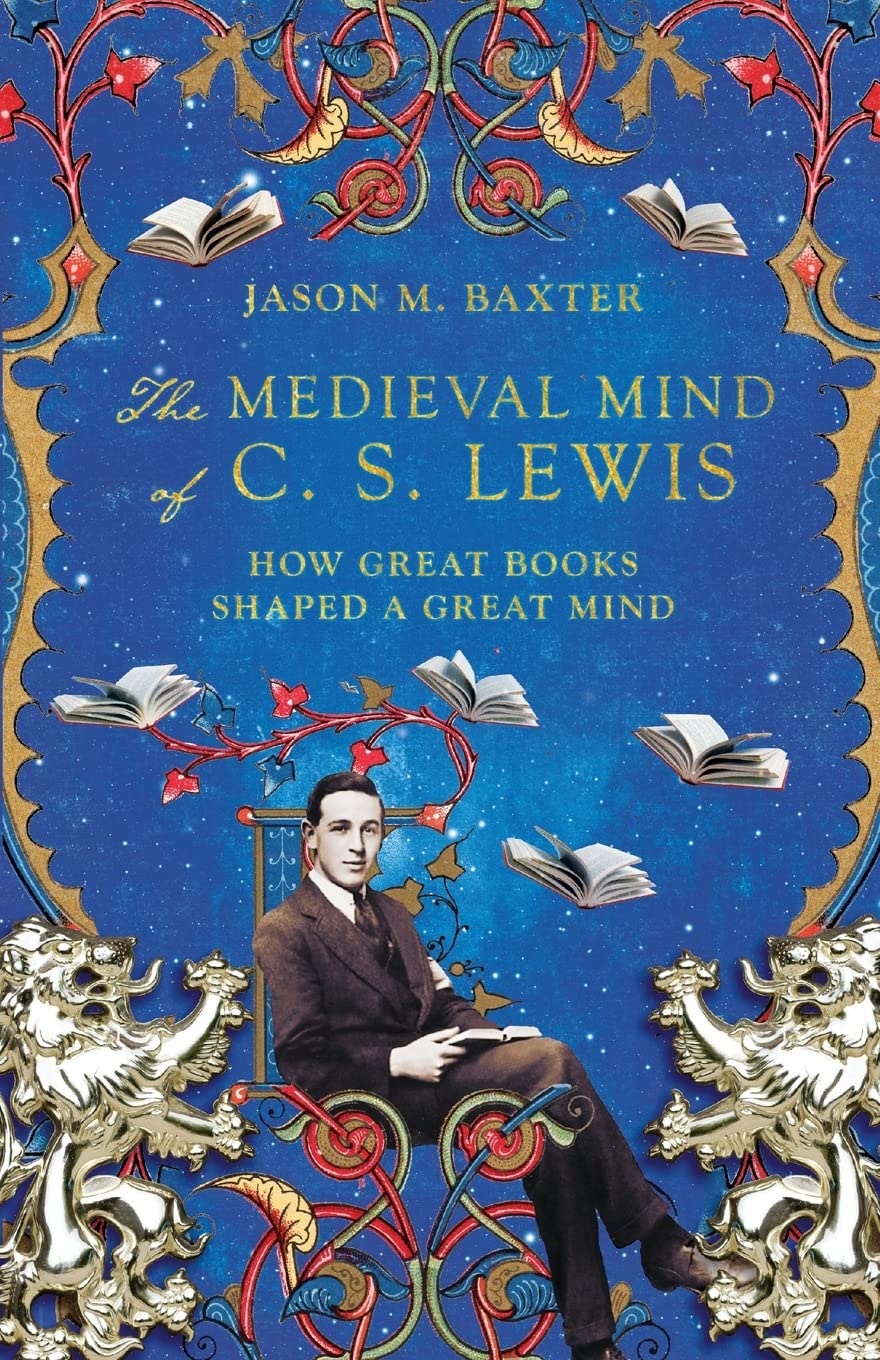
The Medieval Mind of C. S. Lewis
by Jason M. Baxter
This is a dump of my notes without much analysis. Basically, medieval people may have conceived of reality differently than we do, less mechanistically, more as an orderly (designed) system. Their intellectual experience was different from ours in ways that are hard to recapture, but CSL seems to have captured them to a degree, and loved their way of thinking in contrast with the modern ways. Like Boethius (“last of the Romans and the first of the Scholastics”), he provides a valuable bridge between periods of human existence.
It was this professorial Lewis who in a 1955 letter lamented that modern renderings of old poems made up a "dark conspiracy ... to convince the modern barbarian that the poetry of the past was, in its own day, just as mean, colloquial, and ugly as our own." (4)

The medieval mind: “the tranquil, indefatigueable, exultant energy of a passionately logical mind ordering a huge mass of heterogenous details into unity.” (19) They saw order in the universe.
“Not even the blowing winds are random.” -Boethius (24)
This book calls the time from Plato to the 17th century “the Long Middle Ages.” These people were more alike than 17th century people are to us. (8)
The beauty is in the orderly heavens. We are the anthropoperipheral, “creatures of the Margins.” (27)
Calcidius wrote that the soul is “fashioned after the same pattern as the celestial bodies” and feels a connection to them. The order of our temporal world aligns with the order of the heavens, and “time is an image of eternity.” (27) Scientists today say “we are stardust,” but their sense of wonder is fake, a parody of the medieval mind. They insult their creator, adding the unspoken, “we are nothing but stardust.”
Boethius distinguished perpetuity (things going on and on in sequence) from eternity (the “timeless fruition of illimitable life”). “The world of time is a veil, behind which stands eternity.” (28) CSL = The British Boethius.
Looking along the beam (e.g. in fiction) vs. looking at it (in non-fiction, philosophical writing). “Leaning into a literary experience” vs. “analyzing structures.” With old books, you study structure and language like you study a map. The goal is still “to leave the map behind.” (42)
What’s the point of reading?:
Almost twenty years earlier, he had answered this by arguing that the well-read individual has a special share of prudence: a "man who has lived in many places is not likely to be deceived by the local errors of his native village: the scholar has lived in many times and is therefore in some degree immune from the great cataract of nonsense that pours from the press and the microphone of his own age." But in An Experiment in Criticism, rather than describing it in negative terms (that is, arguing that learning makes us less likely to be deceived), he describes historical knowledge-especially as experienced through literature- in the positive terms of an "extension of our being:Those of us who have been true readers all our life seldom fully realise the enormous extension of our being which we owe to authors. We realise it best when we talk with an unliterary friend. He may be full of goodness and good sense but he inhabits a tiny world. In it, we should be suffocated. The man who is contented to be only himself, and therefore less a self, is in prison. My own eyes are not enough for me, I will see through those of others.Reality, even seen through the eyes of many, is not enough. I will see what others have invented. Even the eyes of all humanity are not enough. I regret that the brutes cannot write books. Very gladly would I learn what face things present to a mouse or a bee; more gladly still would I perceive the olfactory world charged with all the information and emotion it carries for a dog. (44)
CSL loved atmosphere more than plot. Smells. Weather.
Medieval writers retold old stories, expanding, editing, embellishing. Like CSL “festooning” Scriptural passages in prayer. Dante, in Purgatorio canto 11, has penitent sinners embellishing the Lord’s prayer. (53)
hylozoistism - the doctrine that all matter has life
Re: cars
The truest and most horrible claim made for modern transport is that it "annihilates space." It does. It annihilates one of the most glorious gifts we have been given. It is a vile inflation which lowers the value of distance, so that a modern boy travels a hundred miles with less sense of liberation and pilgrimage and adventure than his grandfather got from traveling ten.' (56)
Re: the news
In a second passage in Surprised by Joy Lewis targets newspaper reading, mocking the falsity of the desire to be up to date, which he labeled an "appalling waste of time and spirit." Those who do read the newspaper acquire "an incurable taste for vulgarity and sensationalism and the fatal habit of fluttering from paragraph to paragraph to learn how an actress has been divorced in California, a train derailed in France, and quadruplets born in New Zealand."
“The modern world took the magician’s bargain: Give up our soul, get power in return.” (63)
“In modernity, human beings prefer to describe rocks as falling in obedience to a law, whereas medieval people spoke of the rock as desiring, longing to return to its natural place, like a pigeon flying back to its nest by a homing instinct.” (65)
The modern world’s “evil enchantment” is this condition: the mechanized world picture has become “so obvious, such a part of the structures of our mind, that we cannot remember, or even imagine, an alternative.” (73) Lewis saw the “tendency to view the world as a machine” as a defining characteristic separating moderns from any other historical period. (59) The hylozoistic, life-infused universe of the Long Middle Ages had desire, intelligense, sympathies. But this “yielded to the inanimate world of mechanistic structures and mathematized qualities.” (59)
Re: medieval authors (Chaucer, Layamon, …) essentially copying old works, rewriting/jazzing up passages (imitatio - p. 47), see also T.S. Eliot: “Imature poets imitate; mature poets steal; bad poets deface what they take, and good poets make it into something better, or at least something different.” (from The Sacred Wood)
“Just sentiments” include piety, reverence, justice, wonder.
Re: the evil enchantment of modernity
The two-dimensional figure doubts dimensions he cannot perceive; the witch tries to make the Narnians doubt that there even is an over. world; modernity casts a spell that makes those secret longings for a far-off country seem like mere emotions without a proper referent. Spiritual longing seems out of place in the modern world. (76)
“Praeparatio Evangelica” - In history, the pagan world unwittingly prepared the way for Christ. In his essay “Religion Without Dogma?”, Lewis writes that pagan religious rituals might be a “praeparatio” in which God hints at some central Truth. I do not think of it this way, but rather that pagan rituals come from Satan perverting religion. And yet, what he means for evil, God uses for good, so maybe Lewis is on to something.
“entelechy” - Aristotle’s term for a thing fully realized, complete. (like teleios?)
C. S. Lewis loved to take up and defend the most recalcitrant of old beliefs, especially when they had been obvious to everyone in the premodern world and have only become dubious to us. (124)
“Psychological individualism” is peculiarly modern, a sense of intellectual privacy. We think this is our most authentic self, and we protect/veil it even from God. A truer self exists and is revealed when we unveil before God - “deep conversion.” (But I’m leary of there being stages of conversion…) And this unveiling is not of our own will, as CSL says - “only God can” cause it. (133) Unveiling is what we do in prayer. (139)
Finally, here’s a quote I read in… Tim Ferriss’s email newsletter, maybe? It’s from Joseph Weizenbaum, author of the book Computer Power and Human Reason, which I read a couple of years ago.
“No wonder that men who live day in and day out with such machines and become dependent on them begin to believe that men are merely machines. They are reflecting what they themselves have become.” (from On the Impact of Computer and Society) Modern man conceives of humanity using computers as metaphores. Our brain is our CPU, etc. The medieval mind saw something deeper in humanity, and we now have trouble reattaining that conception.