The Intuitionist
July 13, 2023
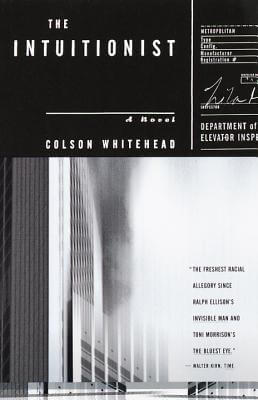
The Intuitionist
by Colson Whitehead
Lila Mae Watson is a black elevator inspector in a 1950s noir version of New York City, or maybe Chicago (I don’t think it ever says). There are two approaches to inspecting an elevator. Empiricists examine the mechanical workings of the elevator and note their findings. Intuitionists stand near the elevator, maybe put a hand on it, and they feel what’s wrong with the elevator.
Lila Mae is an Intuitionist. In reading about this book, several people noted how the Empiricist/Intuitionist thing is a metaphor for racism, and I really did not get that. There is plenty of racism in the book, but it’s dealt with directly, not as a subtext. However, near the very end of the book (239), there’s this: “They [Empiricists] look at the skin of things… White people’s reality is built on what things appear to be – that’s the business of Empiricism.” So maybe it is a metaphor for investigating what’s below the surface of a person (or elevator). But calling superficiality “white people’s reality” is pretty racist itself, in my opinion.
The basic plot, for my own future reference, goes something like this: An elevator at the Fanny Briggs building comes crashing to the ground. No one was in it. LMW (who has a perfect record as an inspector) inspected it recently, and this should never ever happen since there are so many safety mechanisms, so she believes it was tampered with.
An election is coming up for the president of the inspectors’ guild. Chancre (current president) is using the accident to question/attack Intuitionism, since he and his cronies are all Empiricists. So she suspects Chancre. (Chancre feels like an “evil conservative,” although some of the details of that no longer ring true. He controls the media, businesses, unions…)
But LMW is also a suspect. Thugs search her apartment, but it turns out they are looking for blueprints to a “black box,” a perfect elevator, designed by James Fulton. Fulton is the author of two volumes on Theoretical Elevators and is the father of Intuitionism.
LMW moves in to a room at the headquarters of the Intuitionist movement, at a college campus. They shelter her, but she keeps investigating, goes undercover as a server at one of Chancre’s fundraising events (“The Funicular Follies” – I had to look it up. Funicular means “operating by cable with ascending and descending cars”), meets Fulton’s nephew Natchez (except he’s really another thug, playing a part). Natchez sabotages an elevator at the Follies, resulting in Chancre breaking his leg. LMW learns that Fulton was half black but passed for white.
Blah blah blah. It combines the feeling of a detective story and a Thomas Pynchon novel. In the end, she visits the Fanny Briggs building to try to intuit what happened with the free-falling elevator, and she learns that it really was an accident. Fulton invented Intuitionism as a joke, then came to believe it, and he really did write up plans for the black box, in the form of a third volume of Theoretical Elevators. LMW obtains the only copy of that manuscript. She leaks it to the world a bit at a time, preparing people for the world to come.
There are lots of great sentences in this book. I marked a few:
“In person he is too flesh, a handful of raw meat. Dogs have been known to follow him, optimistic.” (113)
When Pompey (a black male elevator inspector) pinches the shoulders of his two sons: “In unison their heads incline toward his hands, a common response to shoulder pinching, Lila Mae has noticed, instinct ushered in aeons ago by the opposable thumb of some slope-browed hominid patriarch.” (191)
“He seems out of breath from his mental strain, definitely out of shape physically: the buttons of his dark blue uniform allude to an ongoing border dispute with his soft belly.” (199)