The Great War and Modern Memory
December 27, 2023
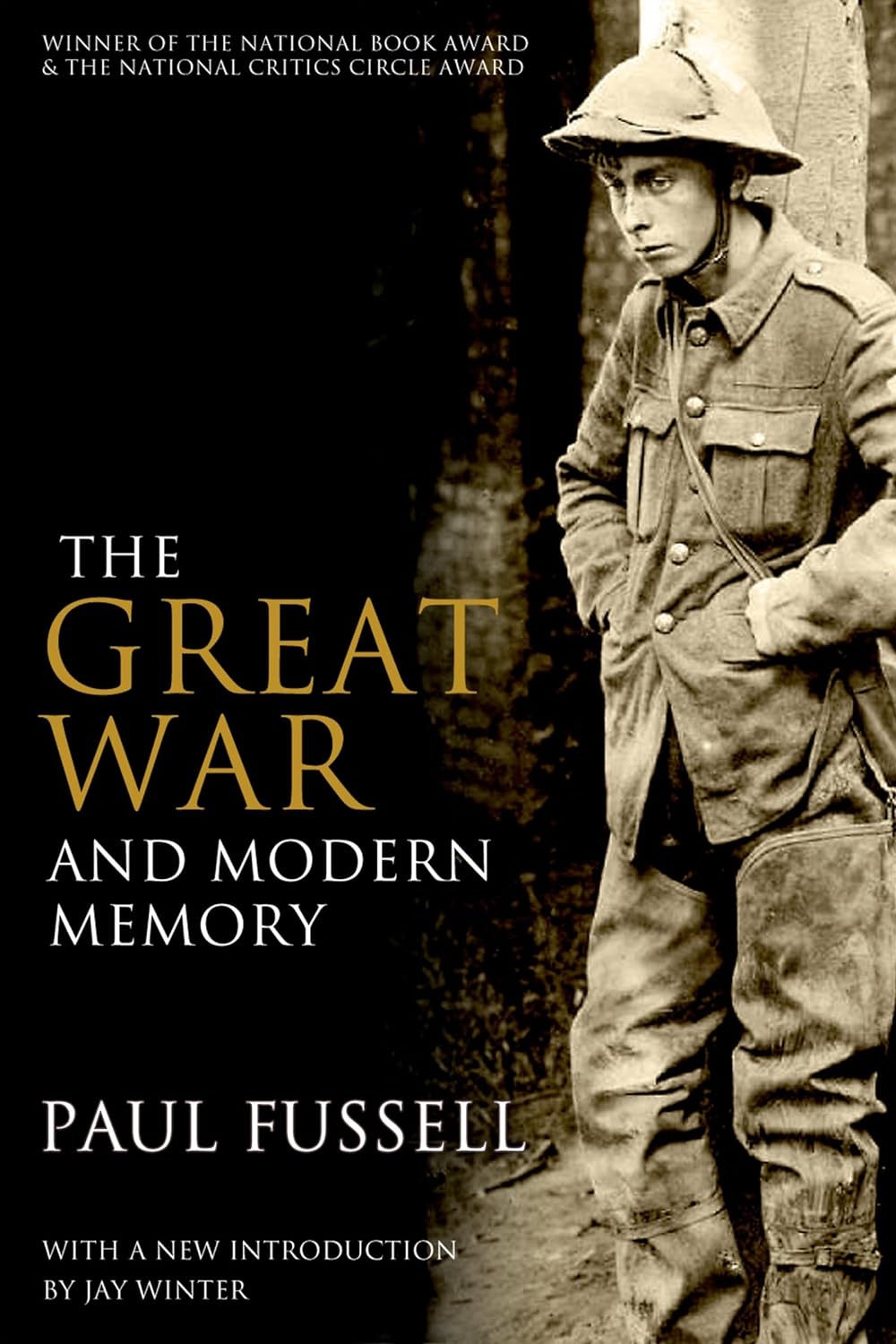
The Great War and Modern Memory
by Paul Fussell
Here are my pretty raw notes, mostly just excerpts, from the book.
What is this book
“This book is about the British experience on the western front from 1914 to 1918 and some of the literary means by which is has been remembered, conventionalized, and mythologized.” The author examines how “life feeds materials to literature while literature returns the favor by conferring forms upon life.” (Preface, xv) (Having just finished this, I can see how this related to the literary critical theories of Northrop Frye, which come up late in the book.)
Gas weapon
“The German use of gas was thought an atrocity by the ignorant, who did not know that gas is the least inhumane of modern weapons. It’s bad press was the result of its novelty. It was novel and therefore labeled an atrocity by a world which condones abuses but detests innovations.” (11) Some of this is quoting Liddell Hart, who said that gas “achieved effects without causing as many fatalities and permanent disabilities as high explosives.”
Haig
Douglas Haig “was stubborn, self-righteous, inflexible, intolerant–especially of the French–and quite humorless. And he was provincial: at his French headquarters he insisted on attending a Church of Scotland service every Sunday.” (12) I do not consider it bullheaded to want to attend your own church!
“His [Haig’s] want of imagination and innocence of artistic culture have seemed to provide the model for Great Men ever since.” (12) Ha!
The disaster at Somme had many causes. Lack of imagination that the Germans would be so well dug in. The British class system - less trained soldiers were assumed to be stupid and not given more complex orders that might have worked better. And finally, the “total lack of surprise. There was a hopeless absence of cleverness about the whole thing, entirely characteristic of its author [Haig].” (14)
Loss of innocence, a new cynicism
“Even in the quietest times, some 7000 British men and officers were killed and wounded daily, just as a matter of course. ‘Wastage,’ the Staff called it.” (44)
You get the strong impression of the entire world losing some of its innocence in the Great War. Certain cynical observations simply couldn’t have been made before the war. “Everyone knew what Glory was, and what Honor meant. It was not until eleven years after the war that Hemingway could declare in A Farewell to Arms that ‘abstract words such as glory, honor, courage, or hallow were obscene beside the concrete names of villages, numbers of roads, the names of rivers, the numbers of regiments and dates.’ In the summer of 1914 no one would have understood what earth he was talking about.” (24)
As the war approached, the unsuspecting were worried about other things - a civil war in Ulster. (26) “For as in the days that were before the flood they were eating and drinking, marrying and giving in marriage…” (Matthew 24:38)
“What could remain of confidence in Divine assistance once it was known what Haig wrote his wife just before the attack: ‘I feel that every step in my plan has been taken with the Divine help’?” (31) (The thing to doubt is not Divine assistance but the feeling that you know how God will act.)
Irony
He writes about “irony-assisted recall” (32). A soldier comes across a group of soldiers about to cross a road that the Germans regularly shelled. He warns them, but “of course they was not in charge, so up they want and the result was they all got blown up.” (33) It could have been easily avoided, if only they had been able to take his advice and attack a different way. Situations like this stay with you forever; the irony makes them easy to recall.
“I am saying that there seems to be one dominating form of modern understanding that it is essentially ironic; and that it originates largely in the application of mind and memory to the events of the Great War.” (38)
This idea that irony became widespread via the war is interesting. It connects to something from Every Love Story Is a Ghost Story (the DFW biography), page 156. It says that irony took over postmodern fiction but “got dangerous when it became a habit.” (What are the dangers?)
A case where you see better with less light
When he was touring the Somme battlefields in 1920, observing them in all lights, Stephen Graham found that full light did not properly illuminate them. "Sunlight and noonday," he says, "do not always show us truth." They suggest too insistently things like vitality and ecstasy and the soaring consciousness of complete life. "Only in the grey light of afternoon and evening, and looking with the empty eye-socket of night-darkness can one easily apprehend what is spread out here-the last landscape of tens of thousands who lie dead." (69)

A soldier’s wife was sending him good cigars from home. To prevent them being pilfered, he told his wife to have them sent in an unmarked box, and to add labels that read, “Army Temperance Society - Publication Series 9.” (72)
“War as the continued experience of twentieth-century man.” (81) Not just 20th c. man! Wars and rumors of wars. “The drift of modern history domesticates the fantastic and normalizes the unspeakable. And the catastrophe that begins it is the Great War.”
The national memory
The obvious gap “between the leaders and the led,” the “blatant display of privilege” would “survive in the national memory for the next half century.” (91) What will survive in the national memory about our time? Distrust of science, maybe.
Revisit the past and give the modern world the slip
Siegfried Sassoon spent the latter half of his life “plowing and re-plowing the earlier half” in a “craving to revisit the past and give the modern world the slip.” (101) Relatable.
Antifa
A quote from George Orwell’s “Inside the Whale”:
The thing that, to me, was truly frightening about the war in Spain was not such violence as I witnessed, nor even the party feuds behind the lines, but the immediate reappearance in left-wing circles of the mental atmosphere of the Great War. The very people who for twenty years had sniggered over their own superiority to war hysteria were the ones who rushed straight back into the mental slum of 1915. AH the familiar wartime idiocies, spy-hunting, orthodoxy-sniffing (Sniff, sniff, Are you a good anti-Fascist?), the retailing of incredible atrocity stories, came back into vogue as though the intervening years had never happened. (118)
“Sniff, sniff, Are you a good anti-Fascist?” sounds remarkably modern for a sentence written in 1940!
Inverse skepticism
Among the troops, “the prevailing opinion in the trenches was that anything might be true, except what was printed.” (124)
Soli Menti Gloria
According to a certain British colonel: “I have a mystical power. Nothing will ever hit me as long as I keep that power which comes from faith. It is a question of absolute belief in the domination of mind over matter. I go through any barrage unscathed because my will is strong enough to turn aside explosive shells and machine-gun bullets. As matter they must obey my intelligence. They are powerless to resist the mind of a man in touch with the Universal Spirit…” (135)
Horrible Thankfulness
Bringing in wounded, [poet Charles] Sorley observes in himself and his fellows “the horrible thankfulness when one sees that the next man is dead: ‘We won’t have to carry him in under fire, thank God; dragging will do.” And he notes “the relief that the thing has ceased to groan: that the bullet or bomb that made the man an animal has now made the animal a corpse.”
Triads, Mythical and Practical
Life imitating art. Just as stories often employ a rule of three, so did military life. “What we must consider now is the relation between this practical, ad hoc, empirical principle of three in military procedure and the magical or mystical threes of myth, epic, drama, ritual, romance, folklore, prophecy, and religion. In the prevailing atmosphere of anxiety, the military threes take on a quality of the mythical or prophetic.” (137)
“Observing that Shakespeare’s plays generally exhibit distinct beginnings, middles, and ends, Maurice Charney finds that in such traditional drama ’there is an implicit assumption that human experience, which supplies the plots for plays, also has beginnings, middles, and ends, and is causative, rational, pro-gressive, and triadic in structure.’ Traditional in pre-romantic thought-which would extend from 1789 all the way back to the fifth or sixth millennium B.C.—is the understanding of human life as meaningfully tripartite: each of the three stages, youth, maturity, and old age, imposes unique, untransferable duties, and each offers unique privileges and pleasures.” (138)
C.S. Lewis discovering books right before WWI
C. S. Lewis was only sixteen when the war began, but by 1917 he was nineteen and ready to go in. Just before he left he did a vast amount of reading, discovering books for the first, ecstatic time. “My great author at this period,” he writes, “was William Morris… In [his friend] Arthur’s bookcase, I found The Well at the World’s End. I looked—read chapter headings— dipped-and next day I went off into town to buy a copy of my own.” (147)
Pilgrim's Progress
All the journeying in PP “promises a meaning to be revealed at the end.” (153) Those in the war, influenced by such stories, expected the war to have an obvious purpose, at least in hindsight. The lack of one left them cynical.
Unparalleled Literariness
He describes the “unparalleled literariness of all ranks who fought the Great War.” (169) They carried The Oxford Book of English Verse in their haversacks.
By 1914, it was possible for soldiers to be not merely literate but vigorously literary, for the Great War occurred at a special historical moment when two "liberal" forces were powerfully coinciding in England. On the one hand, the belief in the educative powers of classical and English literature was still extremely strong. On the other, the appeal of popular education and "self-improvement" was at its peak, and such education was still conceived largely in humanistic terms. (170)
The postal system and the nearness of the front to civilization meant that getting new books was fairly easy.
The efficiency of the postal service made books as common at the front as parcels from Fortnum and Mason's, and the prevailing boredom of the static tactical situation, together with the universal commitment to the ideal of cultural self-improvement, assured that they were read as in no other war. No book was too outré: in fact, the gross inappropriateness of certain books was part of their value. At Ypres, Geoffrey Keynes pored over Courtney and Smith's Bibliography of Samuel Johnson (Oxford, 1915). and in Macedonia R. W. Chapman edited Boswell's Journal of a Tour to the Hebrides and Johnson's Journey to the Western Islands of Scotland during idle moments at his artillery position. (175)
And in the midst of war, it was comforting to read pre-war writings. “Eighteenth-century writing was popular… It offered an oasis of reasonableness and normality, a place one could crawl into for a few moments respite from the sights, sounds, and smells of the twentieth century.” (175) This is something I currently experience when reading 20th-century lit.
Trench Poets, by Edgell Rickword
A poem packed with literary allusions, about reading poetry to a corpse of a friend:
(See https://www.poetryfoundation.org/poems/57422/trench-poets)
I knew a man, he was my chum,
but he grew blacker every day,
and would not brush the flies away,
nor blanch however fierce the hum
of passing shells; I used to read,
to rouse him, random things from Donne—
like “Get with child a mandrake-root.”
But you can tell he was far gone,
for he lay gaping, mackerel-eyed,
and stiff, and senseless as a post
even when that old poet cried
“I long to talk with some old lover’s ghost.”
I tried the Elegies one day,
But he, because he heard me say:
“What needst thou have no more covering than a man?”
grinned nastily, and so I knew
the worms had got his brains at last.
There was one thing that I might do
to starve the worms; I racked my head
for healthy things and quoted Maud.
His grin got worse and I could see
he sneered at passion’s purity.
He stank so badly, though we were great chums
I had to leave him; then rats ate his thumbs.
People don't like to hear the truth about war
Simpson speculates about the reason infantry soldiers so seldom render their experiences in language: “To a foot-soldier, war is almost entirely physical. That is why some men, when they think about war, fall silent. Language seems to falsify physical life and to betray those who have experienced it absolutely—-the dead.” But that can’t be right. The real reason is that soldiers have discovered that no one is very interested in the bad news they have to report. What listener wants to be torn and shaken when he doesn’t have to be? We have made unspeakable mean indescribable: it really means nasty. (184)
The good thing about being illiterate
Writing of a certain unlearned fireman named Ned:
Because of his illiteracy he was the only man in the station who told the truth about his fire-fighting experiences. The others had almost completely substituted descriptions which they read in the newspapers or heard on the wireless for their own impressions. "Cor mate, at the docks it was a bleeding inferno," or "Just then Jerry let hell loose on us," were the formulae into which experiences such as wading through streams of molten sugar, or being stung by a storm of sparks from burning pepper, or inundated with boiling tea at the dock fires, had been reduced. But Ned had read no accounts of his experiences and so he could describe them vividly. (188)
Most of these men can’t write plainly about their experience. They lean on their literary past, but doing this gives the impression that this war is like past wars.
British grandiosity: Americans have “the unknown soldier,” but brits have “the unknown warrior.” (190)
Euphemisms in reporting
I noticed a limited selection of euphemistic adjectives, such as 'sharp, "brisk'; e.g., 'the enemy was ejected after brisk fighting'; 'there was sharp retaliation, and the like." He learned later that sharp or brisk had quite precise meanings: they meant that about fifty per cent of a company had been killed or wounded in a raid. (191)
Affectionate use of the word "old"
J.B. Priestley has remembered the tendency of the troops to use old to indicate half-affectionate familiarity, as in the trench song about the whereabouts of the battalion:It's hanging on the old barbed wire. I've seen 'em, I've seen 'em Hanging on the old barbed wire."'To this day [1962]," says Priestley, "I cannot listen to it unmoved. There is a fash of pure genius, entirely English, in that 'old, for it means that even that devilish enemy, that death-trap, the wire, has somehow been accepted, recognized and acknowledged almost with affection, by the deep rueful charity of this verse. I have looked through whole anthologies that said less to me." (195)
The chasm of incomprehension
It would be a mistake to rely on letters home for one’s impression of what the war was actually like. Soldiers would fall into formulaic updates when writing home – “what possible good could result from telling the truth?” (198) But their compassion for the feelings of the people they wrote to “was destined in the long run simply to widen the chasm of incomprehension which opened between them.”
The Proto-Form
The field service postcard, or “quick-firer,” was a postcard where you could simply mark out anything you did NOT want to say. There’s an example on page 200.
“The Field Service Post Card has the honor of being the first widespread exemplar of that kind of document which uniquely characterizes the modern world: the ‘Form.’ It is the progenitor of all modern forms on which you fill in things or cross out things or check off things, from police traffic summonses to ‘questionnaires’ and income-tax blanks.” (201)
In a world so full of beaurocracy, I never thought of forms as having an origin. They seem eternal. But their origin was barely a hundred years ago!
The diction of war
Many modern expressions originated with the Great War. Medical breakthroughs. A barrage of complaints. The word crummy comes from things feeling itchy due to lice (feeling like there were crumbs in your clothes, e.g.). Also lousy. The keepsake became the souvenir thanks to Brits who lived in France for so long. The public and private sector. The rank and file. A Burberry is now forever a Trenchcoat. Help our fund drive go over the top. (205)
Pages 22 and 23 show a chart comparing a concept with how it is represented in poetry. A friend is a “comrade,” to conquer is to “vanquish,” the sky is “the heavens,” etc. This reminds me of Chapter X of Poetic Diction, “Archaism,” “the stire of aesthetic imagination.”
Warfare as theater
Seeing warfare as theater provides a psychic escape for the participant: with a sufficient sense of theater, he can perform his duties without implicating his "real" self and without impairing his innermost conviction that the world is still a rational place. (208)
“You were never you. The I part of you was somewhere else.”
Robert Graves, true heir of Ben Johnson
Graves wrote a war memoir called Goodbye to All That which sounds very entertaining, if not overly accurate. Some comments he made about writing it:
I have more or less deliberately mixed in all the ingredients that I know are mixed into other popular books. For instance, while I was writing, I reminded myself that people like reading about food and drink, so I searched my memory for the meals that have had significance in my life and put them down. And they like reading about murders, so I was careful not to leave out any of the six or seven that I could tell about. Ghosts, of course. There must, in every book of this sort, be at least one ghost story with a possible explanation, and one without any explanation, except that it was a ghost. I put in three or four ghosts that I remembered. And kings... People also like reading about other people's mothers... And they like hearing about T. E. Lawrence, because he is supposed to be a mystery man.... And, of course, the Prince of Wales. People like reading about poets. I put in a lot of poets.... Then, of course, Prime Ministers....A little foreign travel is usually needed; I hadn't done much of this, but I made the most of what I had. Sport is essential.... Other subjects of interest that could not be neglected were school episodes, love affairs (regular and irregular), wounds, weddings, religious doubts, methods of bringing up children, severe illnesses, suicides. But the best bet of all is battles, and I had been in two quite good ones—the first conveniently enough a failure, though set off by extreme heroism, the second a success, though a little clouded by irresolution. So it was easy to write a book that would interest everybody.... And it was already roughly organized in my mind in the form of a number of short stories, which is the way that people find it easiest to be interested in the things that interest them. They like what they call "situations." (222)
This reminds me of Stephen King’s comment (in On Writing, I think) that people seem to like reading about other people doing their jobs. (Even kids like this – thinking now of Richard Scary’s What Do People Do All Day?)
Page 227 lists comic techniques used by Graves. Astonishing coincidences, climactic multiple endings (tagging a joke), disparity between the expected and the actual, bizarre freak-show characters, comic encounters between people of different social classes, scenes where the main character doesn’t know a crucial fact, scenes of rescue and salvation in the nick of time.
Graves employed these techniques of writing for the theater when writing about the war.
Rumors of my death...
Graves, near death, was actually placed on the casualty list, and his parents were sent a letter that he had died. A few days later, they would hear that he was recovering.
On July 20, his luck runs out: a German shell goes off close behind him, and a shell fragment hits him in the back, going right through his lung. He is in such bad shape at the dressing-station that his colonel, assuming he's dying, kindly writes his parents, informing them that he has gone. As a result his name appears in the official casualty list: he has "Died of Wounds."
A few days later Graves manages to write home and assure his parents that he is going to recover. There is some discrepancy about dates here: for symbolic and artistic reasons, Graves wants the report of his death to coincide with his twenty-first birthday (July 24), although his father remembers the date as earlier. "One can sympathize with Graves," says George Stade, "who as a poet and scholar has always preferred poetic resonance to the dull monotone of facts; and to die on a twenty-first birthday is lo illustrate a kind of poetic justice. (234)
Life -> Art -> Life -> ...
Soldiers in WWII noticed how the drama of the war was enhanced by all their memories of films about the Great War. (240) And similarly, soldiers in WWI saw their experience through the lens of what they had read about previous wars. This life/art imitation cycle seems to be a theme in the book.
Blunden lit. crit.
The kind of criticism on p. 291 has to be earned. Fussel has proven over 290 pages that he’s done deep, thoughtful reading and research. Whatever he says here, I believe him.
He says Blunden’s archaic style itself serves as a critique of the war, which pushed modern ways on pastoral people.
Blunder fears few will read his work, and fewer still will understand.
Homoeroticism
The Uranians (307) sound modern, a Jeffrey Epstein island collective. Includes Oscar Wilde and Aleister Crowley. They published art studies and defenses of the morality of “boy-love.” Yikes.
There seems to be a line between male-male affection and actual pederasty. Questions about this came up for me when reading Surprised By Joy, and they are addressed more directly here. Not every instance (or even most instances) of male affection involved anything sexual, but it could certainly turn into that.
Literary/Historical Cycle
The cycle below is also seen in the memoirs of WWI vets. These ideas come from Northrop Frye. In the afterward (369), he says in hindsight, he should not have leaned on them so heavily. Nevertheless, the basic cycle Frye identifies is something like this:
- Myth/Romance
- High Mimetic. Mimetic = the art of imitation. “Art imitates life” (Homer). This is literature that describes reality according to mankind’s highest ideals.
- Low Mimetic. “Life imitates art” (Aristotle). Depicts life as meaningless, with no “just cause” or moral purpose to war. Absurdist.
- Modern/ironic.
More innovative talents (Yeats, Woolfe, Pound, Eliot) did not fight in the war. WWI writers were less innovative, but they follow the same path to irony.
Wartime fads
Wartime fads that continued at least into the 70s include:
- cigarette smoking
- wearing wristwatches
- garden allotments (a British thing)
- paper banknotes replacing gold coins
- playing “God Save the Queen” in theaters (finally ended by the cynicism of the 70s)
Suspicion of the press
Soldiers who fought in the Battle of the Somme – “the most bloody defeat in the history of Britain” – read the newspaper reports about it in jaw-dropping disbelief. It was written up so blandly, you might almost think it had gone rather well for the Brits. The lasting result was “a lifelong suspicion of the press.” “You can’t believe a word you read.” (343)
Fussell points out the later effect of this. How many Jews died in the 1920s and 30s because word of atrocities was dismissed with skepticism.
Another effect: Infantry maneuvers were so deadly in WWI that they were sometimes a last resort in WWII. Air and artillery bombardments were preferred – the overly cautious use of infantry may even have prolonged the war by seven or eight months, permitting the German murder of an additional million Jews. (343)
Why read history?
Northrop Frye: “The culture of the past is not only the memory of mankind, but our own buried life.” (362) We read history to illuminate our own lives.
From the Afterword
This book was “investigating the ways language could be invoked to derive some order and mening from the messes of memory”. (363) “I was searching for displays of language that might help define the similarity of infantry experience in the two world wars and the problem of containing it within words.” (368) The author was an infantryman in WWII, so the book focusses on the infantry experience.
“It is true that hindsight is easy, but it is important to insist that hindsight is what we are here for.” (366)
His research process reminds me of Robert Caro’s:
Every day for three months I presented myself with my researcher's pass to be conducted by a warder past the tanks and cannons installed on the ground floor, up stairways and elevators to the very top of the building [the Imperial War Museum's Department of Documents]. There, I was assigned a room containing nothing but a long table and a chair. Suddaby, a cool and experienced archivist, had listened calmly to my request to read entirely through the Great War troops' papers. We agreed that each morning the left end of the table would be filled with material which, by late afternoon, I was to move to the right end for return to the vaults. All summer I was the only person reading in this silent room. It was a perfect environment for concentration. (367)
A good example of “deep work” (a la Cal Newport).