Every Love Story is a Ghost Story
August 30, 2023
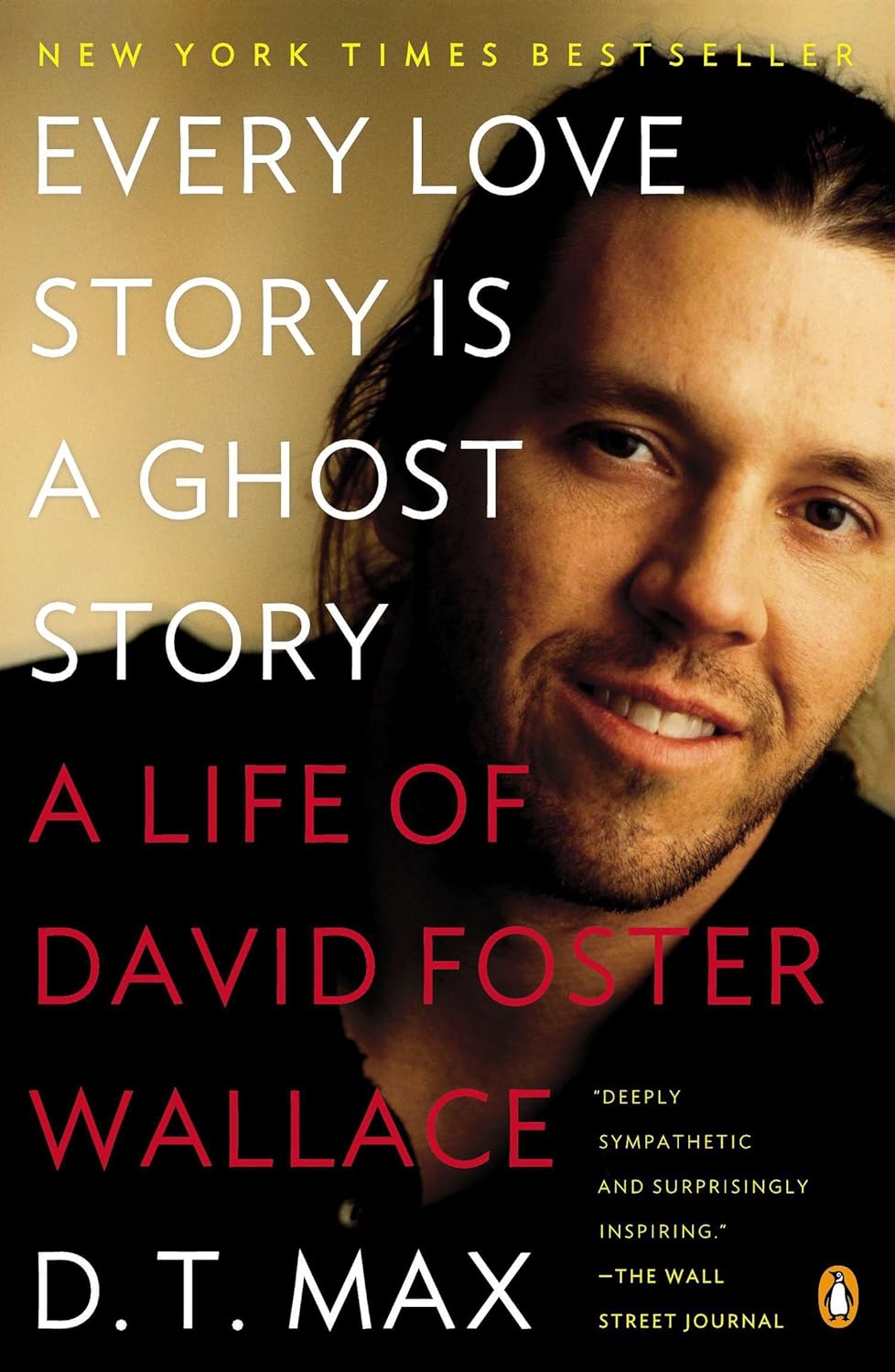
Every Love Story is a Ghost Story
by D. T. Max
I kept this on my nightstand to read before bed, which means it took me forever (ok, around 5 months) to finish. I read at least half of it at a couple of cubing competitions I took Jonah to.
In high school, I bought Infinite Jest at Hastings, not knowing anything about it. I got about 100 pages in, so around 8%, then gave it up. I remember reading a Harvard Lampoon around this time, where the “Jester Ibis Blot” (like a letter from the editor) was in the style of DFW, with lots of footnotes and long sentences beginning with three conjunctions. And I got the joke! But I figured IJ was either over my head or very pretentious (or both!).
When he killed himself in 2008, I read a Rolling Stone article by David Lipsky called “The Lost Years & Last Days of David Foster Wallace,” which mentioned his books of essays. In my memory, I was at Barnes & Noble while reading it, but I can’t imagine why. After reading it, I did go find his book, “A Supposedly Fun Thing I’ll Never Do Again.” My printout of the article is still tucked inside that book.
By far my favorite DFW essay is called “Authority and American Usage” from the book “Consider the Lobster,” which I read in 2014. It got me interested in usage guides.
Anyway, his writing has popped up for me repeatedly for some reason. And I recently listened to an episode of the podcast The Art of Darkness about him, which made me want to read this book. Here are my notes:
His mother Sally’s “enthusiasm for correct usage might seem extreme. When someone made a grammatical mistake at the Wallace dinner table, she would cough into her napkin repeatedly until the speaker saw the error.” (2)
He called Champagne-Urbana, “Shampoo-Banana.” (10)
“Wallace’s clowning and showing off were, if more than a facade, not quite a self.” (22)
Character name: May Aculpa (35). Fictional town: Prosopopoeia. (Literally “mask-making,” but also a literary trope for the voice of an absent speaker). (62)
He “did not like the literary environment at school. It seemed effeminate and sensitive and self-absorbed.” (38) I wonder if he liked his own readers. I would guess this describes many of them as well.
His creative writing teacher told him his writing was “shallow and tricky, philosophy with zingers.” (39)
Re: the title The Broom of the System, it “came from a phrase Sally Wallace remembered from her grandmother, who when shw would encourage her children to eat an apple would say, Come on, it’s the broom of the system.” (47)
“Once he had decided to become good at something, Wallace usually succeeded. It was the decision to dive, not the entry into the water that was hard.” (80)
From a NYT review of Broom: Its charm is “due to its exuberance – cartoonish characters, stories within stories, impossible coincidences, a hip but true fondness for pop culture and above all the spirit of playfulness that has slipped away from much of recent fiction.” (81) But later, from DeLillo to Wallace, “Where you see fun in my work, I remember doubt, condusion and indecision, and now experience considerable regret…” (236)
The problem with metafiction. “Wasn’t it seduction pretending to be renunciation?”:
And that had been Wallace's whole response for a time. But as he finished his work at Arizona, he also had come to feel that there was something irritating about "Lost in the Funhouse," condescending, and, if you were a recursive cast of mind, false about the way Barth kept breaking into the narrative to show readers falsity. Didn't such an intrusion, in the end, just create more of a performance? Wasn't it seduction pretending to be renunciation? How in the end did Barth really propose to challenge or reward the reader? Preparing to rebut Barth in his own story, Wallace scribbled notes in the margins of his paperback of the Lost in the Funhouse story collection, contesting sentences and penning criticisms like "Talmudic -- obsessed w/ its own interpretation" alongside Barth's words. It was clear that metafiction no longer satisifed Wallace as it once had. (90)

Stories he had his students read include:
- Eudora Welty, Why I Live at the P.O. (102)
- Lee K. Abbott, Living Alone in Iota (102)
- Updike, A&P (115)
- Flannery O’Connor, Good Country People (115)
- Sorrentino, Aberration of Starlight (116)
"I'm a grammar Nazi," he liked to tell his students. One day he put the words "pulchritudinous," "miniscule," "big," and "misspelled" on the blackboard. He asked his students what the four words had in common, and when no one knew, happily pointed out that the appearance of each was the opposite of its meaning.
(Funny story but not a good example of being a grammar Nazi…)
“He came from a family of skeptics.” His parents actively refused to let him and his sister go to church. (114)
Re addiction, he “found his outsized intelligence a liability. To do well in recovery required modesty rather than brilliance. It was not easy for him to accept humbling adages like ‘Your best thinking got you here.’” (114) Intelligence wasn’t the liability so much as pride. Later: “He knew it was imperative to abandon the sense of himself as the smartest person in the room.” (139)
His review of Clive Barker: “One of those dreaded commercial successes who’ve become so impressed with themselves they no longer think they have to work at being interesting.” (143)
“He reluctantly acknowledged that he might suffer from a basically vapid urge to be avant-garde…” The need for the new. Athenian (Acts 17:21 – “All the Athenians and the foreigners who lived there spent their time doing nothing but talking about and listening to the latest ideas.”) I noted a related passage from Poetic Diction, page 171, where a love for the new “is so strong that it binds some men to their libraries for a lifetime, and actually hinders them from increasing knowledge.” I am aware of this danger for myself but not sure what to do about it.
“His interest in cleverness was preventing him from saying things.” (148) Wisdom vs. cleverness.
Low points of his romantic obsession with Mary Karr on pages 151 and 163. Putting his fist through a car window. Planning to buy a gun to murder Karr’s husband. He got a heart tattoo with “Mary” in it which later began to fade, and his joke with a later girlfriend was, “Who’s Marv?” (249, 282)
He wrote about how “television changes our perception of reality”. He wanted fiction to capture this change, but he “had begun to realize that portraying such a world in fiction might be just as harmful as TV itself. There was no reason to think that limning [delineating] a hopeless condition would show a way out.” (155) This is like reading about how the internet is changing our brains – interesting, but what are we going to do about it? Books are getting stupider. Stock up on the old stuff before society becomes too dumb to keep printing it, and read it until you die.
“American fiction was not just an aesthetic crisis but a moral one” with an “avant-pop insistence that the overwhelming incoherence of modern culture was a joyride for the brain.” (155) America was “a nation of addicts, unable to see that what looked like love freely given was really need neurotically and chronically unsatisfied.” (156)
About irony (this is a key insight):
It was not TV as a medium that had rendered us addicts, powerful though it was. It was, far more dangerously, an attitude toward life that TV had learned from fiction, especially from postmodern fiction, and then had reinforced among its viewers, and that attitude was irony. Irony, as Wallace defined it, was not in and of itself bad. Indeed, irony was the traditional stance of the weak against the strong, there was power in implying what was too dangerous to say. Postmodern fiction's original ironists-writers like Pynchon and sometimes Barth-were telling important truths that could only be told obliquely, he felt. But irony got dangerous when it became a habit. (156)
And this: “I have never felt so much a failure, or so mute when it comes to articulating what I see as the way out of the ironic loop.” (191) I want to call this The Ironic Treadmill. Once you get used to implying meaning, you can get into a loop where you imply, others nod knowingly, they imply, you nod knowingly, and soon you are all implication and no longer any meaning. The knowing look becomes the substance of the argument.
“Until there is committment, there is only ineffectiveness, delay.” -Goethe
He bought a truck, then mentioned in class that he had lost it. A student, embarrassed, gave him the keys – he had lent it to her weeks ealier. (239) A monk-like detachment from material possessions.
The success of Infinite Jest gave him fame that made it hard to work – too much pressure. (239) This is like Feynman at Cornell before the wobbling plates. Fame led to creating a mask:
Now Wallace was wondering whether he hadn't become a literal statue, "the version of myself" as he wrote a friend at the time, that I was others to mistake for the real me." The statue was a Mask, a Public Self False Self or Object-Cathect." What made the statue especially deadly to Wallace was that it depended for its subsistence on the complicated interplay between writer and public. Not just: You are loved. But also: You love being loved. You are addicted to being loved. (240)
The danger is, you convince people to think of you as you want them to, but that’s not the real you, so then what?
He called Updike “a thesaurus with a penis.” (243)
He locked the door when working, even when home alone. (250) I understand this. When doing deep work, even the prospect of being interrupted is a distraction.
He rented a place (258) that used to be a Planned Parenthood. He joked to a friend “that if he got bombed or shot there, the police should look for right-to-lifers with an outdated phonebook.” (323)
In “Everything and More,” the high school teacher he writes about (Dr. Goris) is made up. (275) This is like when he writes about AA people as “church members.” It bugs me that he does this without a wink to the audience. I take it as true, because he writes it that way. He said (see p. 325, the final note), “a writer’s justifying embellishment via claiming that it actually enhances overall ’truth’ is exceedingly dangerous, … an Ends Justify the Means rationalization.”
The time before 9/11 was “the heydey of irony.” (278)
The story “Another Pioneer” from his book Oblivion contained the words “evection,” “canescent,” “protasis,” “epitatic,” “hemean,” “nigrescently,” “ptotic,” “intaglial,” “catastasis,” and “extrorse,” not to mention “thanatophilic” and “omphalic.” It had a single paragraph twenty-three pages long. (279)
“Americans were now not passively but frenetically entertained.” (286) More true now than ever.
But changes in technology did not really affect whether one responded to infinite Jest. Video cartridges were the vector of the plot, but they were not responsible for the sadness at its core. What the novel was about was how to feel connected in your own life, and that was still the great strug-gle. The Web might offer a different hope of escape from the self, but actually escaping was no less futile, as those who spent their time trying discovered. (It was named the "Web" for good reason.) (286)