How to Write One Song
December 28, 2022
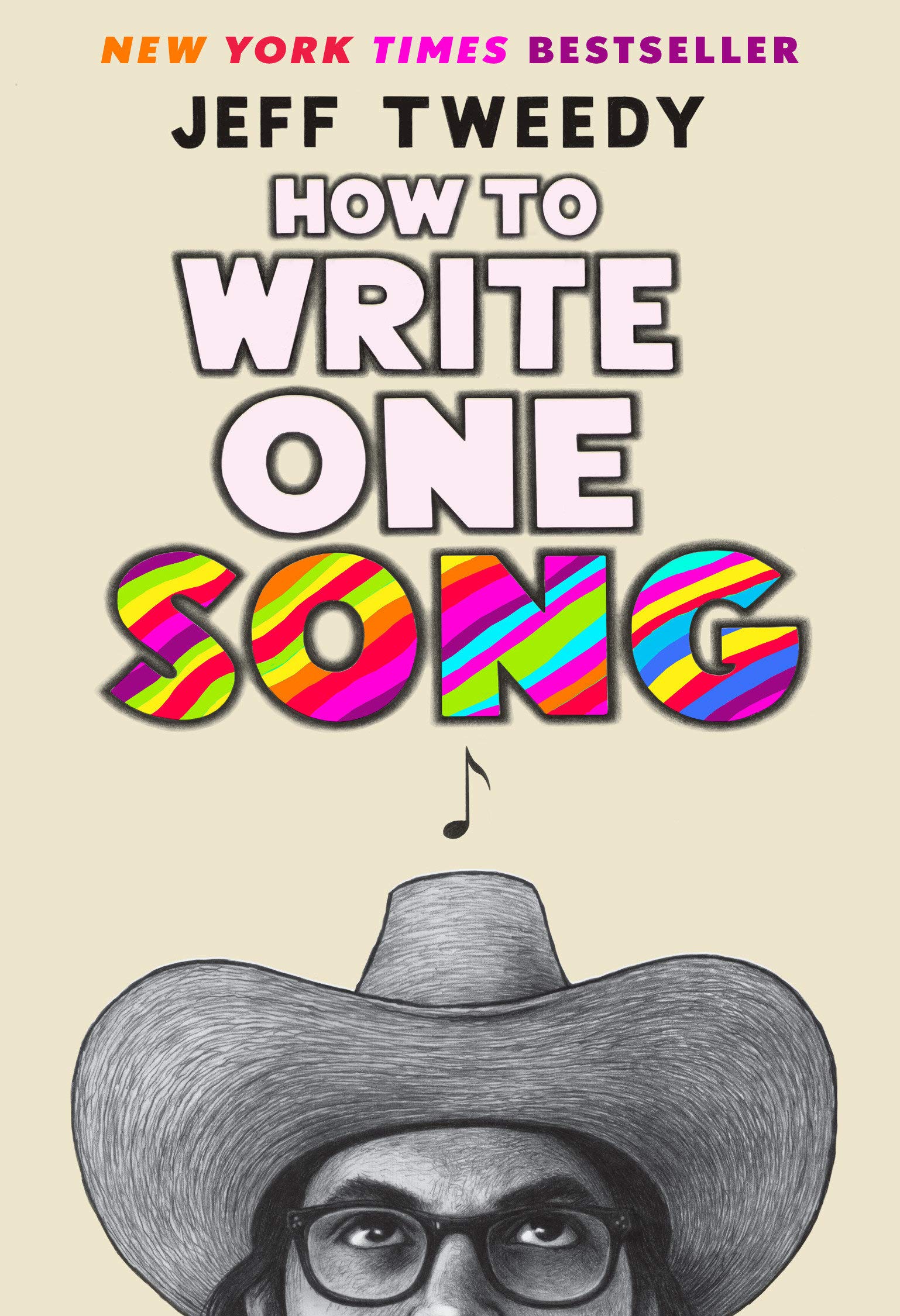
How to Write One Song
by Jeff Tweedy
What you really want in songwriting is to disappear. To spend time in a place where you just are. (3)
“Connection is the loftiest of all aspirations… We all want to feel less alone.” (11) Sacred music helps us connect vertically, to God. Folk, rock, rap, etc. help us connect horizontally, with other people.
I want to encourage more humans to private moments of creativity. (13)
“No work of art is ever finished. It can only be abandoned in an interesting place.” (15)
“Inspiration is rarely the first step.” (17)
“Pick up a guitar, and you’re much more likely to write a song.” (19)
“Nobody makes good choices when they aren’t aware they’re making a choice.” (24)
*** “I’d challenge you to write something that means nothing to you at all. It may be harder than you think. I find it’s almost impossible to put two words together and not find at least some meaning.”
“Working hard is a noble pursuit… All the rock bands you’ve heard of are the rock bands who worked the hardest.” (39)
“Protect your ability to be inspired.” (40)
Walking helps simplify your thoughts. (46) Right before/after sleep is a good time to work on a song. (47) Exercise.
“I want to write a song that would make someone say, ‘This is my favorite song of all time.’” (55)
Like a kid drawing on the floor, enter the flow state.
“I have a shameful amount of gratitude. It’s hard to express sometimes, because I think it might turn people off, the overwhelming gratitude I feel for it all.” (61)
Put your ego in the backseat during songwriting. (78)
*** “I wanted my children to know me as the person I felt I truly was, and not really as the person I happened to have become.” (101) A thought I’ve been having more lately is that the people closest to me, my own family, don’t really know me for who I am. I can’t express my love for them; when I try, it comes out as something else, like criticism. When they hurt me, they know I’m mad or sad, but they don’t really know the reason. Anyway, I keep spotting shadows of this experience as I go over books I’ve read. Jeff tweedy and WP Kinsella both mention it. Once you notice it, maybe its everywhere, a Baader-Meinhof effect of sadness.
He calls writing without turning off self-judgement “a certain mirthless labor.” (120) I think the mirth is important. He encourages unburdening yourself of your judgemental and discerning self with some regularity.
Exercises (lyrics):
- two columns of words from different prompts, draw lines connecting them
- hum while skimming a book, write down words that jump out (I like this one)
- cut lyrics line by line, rearrange them
- write interesting rhyming couplets, NOT part of a song or poem
- write from the POV of another person, animal, inanimate object. KF wrote a song from his TV’s POV.
Exercises (music):
- Listen to other people’s songs
- Listen to albums old and new
- Set a 5-10 minute timer. Whatever comes to you in that time is a song. Record it into your phone.
- Try a different tuning.
- Steal, e.g., chord progressions
- Sample
Songwriting can uncover truths about yourself (131). Cf. On Moral Fiction, the eerie connections a writer uncovers. They may actually mean something.
“The songs you don’t know you want to write are better.” (135)
Re: carving a song from a melody and seeing what shape it wants to take:
The melody being the stone or ivory: I focus on just the sounds at first, carving toward words, and then words with meaning, until an image appears and finally I can add clear, precise language that underlines and reveals a "moose" or an "otter," which, in my case, of course, is almost invariably a song about "death."

That admission floored me. After pages of talk about letting go of your judgement and letting the song take it’s course, what does it mean that the course, however meandering, eventually lands at death?
He avoids multitracking software when writing. “I find it difficult to keep my focus on the song when there are more knobs to push and twiddle than just Record and Stop.” (139)
“When I come across a good line, I almost always put it first.” (145)
After describing the mysteries of melody and lyrics combining to uncover truths about himself he hadn’t known how to express before, he concludes, “I really don’t think God had much to do with it.” (151) Self-criticism inhibits songwriting, though he says, “It must provide some evolutionary advantage to survival.” (154) Like Gardiner (On Moral Fiction), he tries to find artistic meaning in connecting to the deep mysteries of a cold and meaningless universe.
I really hate evolution. I hate how it crops up everywhere to suck the mystery, joy, and Divine glory out of everything. There’s no reason even to mention it in this book about songwriting, but here it is again, Debbie Downer, an unsubtle reminder of the futility and pointlessness of everything. If I believed it was true, I don’t think I could ever write a song.
Play your song at least once for at least one person other than yourself. (157) (Can I find someone who would listen?)