Think Again
December 13, 2022
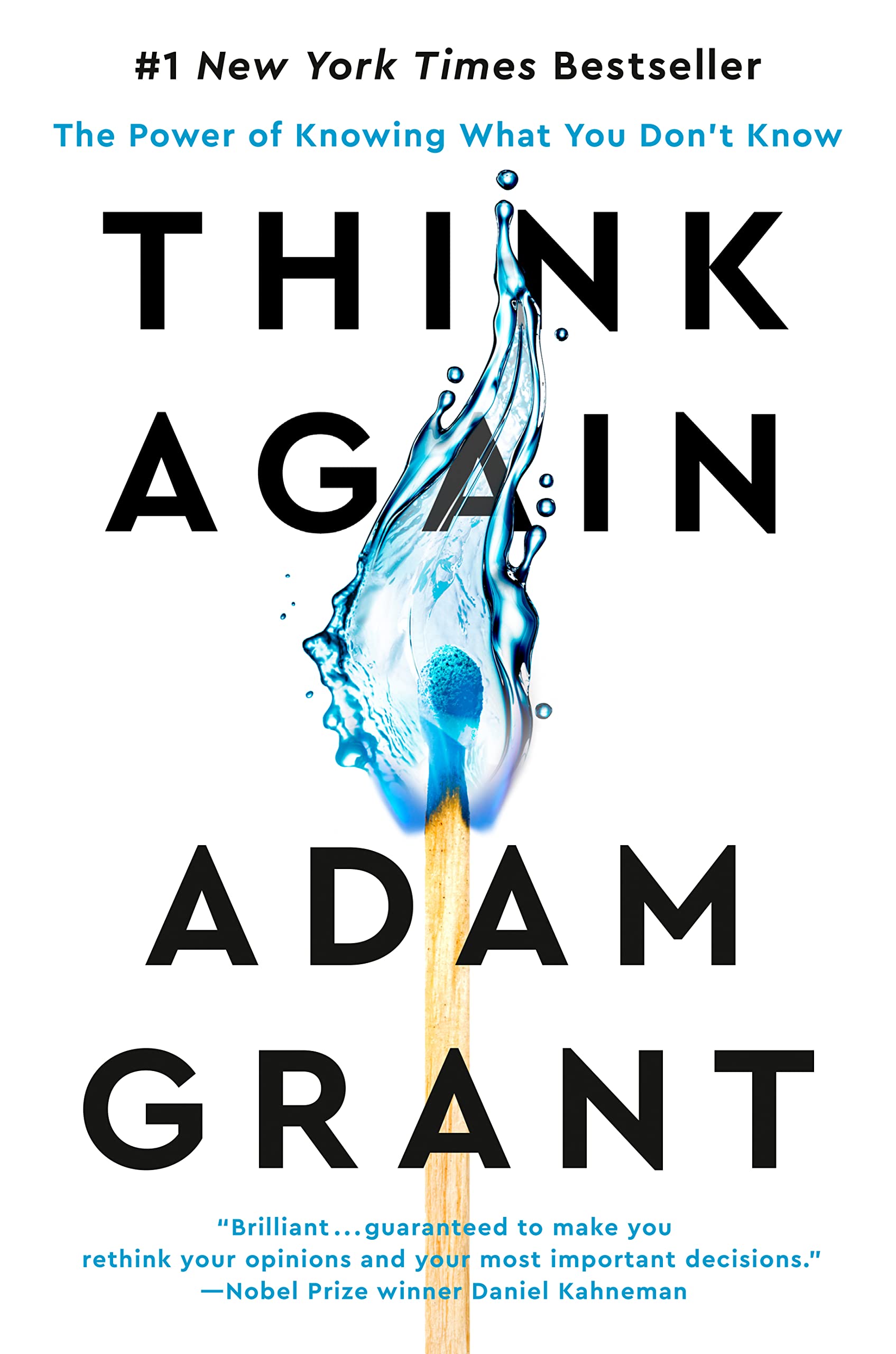
Think Again
by Adam Grant
I feel pretty curmudgeonly this year. This book mostly annoyed me. Science is the way, the truth, and the life for this author.
“We refuse to let our ideas become ideaologies. We don’t start with answers or solutions. We lead with questions or puzzles. We don’t preach from intuituin; we teach from evidence… We dare to disagree with our own arguments.” (25) This reads something like a creed. There is a narcisism inherent here. “In a courtroom, I’d rather be the judge.” (26)
Cognitive flexibility and intellectual humility are noble concepts. He shows Pride as the source of faulty thinking. But in his “rethinking cycle” (28), who makes the discovery? He assumes your curiousity will necessarily lead to answers. This is true for some things, but it is also a different-looking form of pride.
“Feigned knowledge” is his pet peeve. “Where people pretend to know things they don’t.” (40)
He writes about questioning our “core beliefs” as if, ideally, this would be as easy as questioning some trivial fact. (59) When a core belief is questioned, should we immediately react with surprise, curiousity, etc.? You can’t live constantly changing core beliefs. I doubt that he would be quick to question his scientific creed from page 25, for example. Somehow, the tone of the book seems to be “you should question your core beliefs where they do not align with mine,” although I realize I’m probably being unfair.
I've noticed a paradox in great scientists and superforecasters: the reason they're so comfortable being wrong is that they're terrified of being wrong. What sets them apart is the time horizon. They're determined to reach the correct answer in the long run, and they know that means they have to be open to stumbling, backtracking, and rerouting in the short run. (72)

My note from page 76: Christanty has orthodox theologians and self-serving televangelsts. Scence has the intellectually honest (and truly curious), as AG describes, but there are plenty who bear the name “scientist” but use it mainly as cover for their own agendas. Some of AG’s points, while true to a point, might not survive first contact w/ a real human scientist examining a contentions issue (eg, covid response). His constant praise of science activates my cynicism.
“Relationship conflict vs. task conflict” is a useful distinction (79). Disagreeing over how to do a task is different (and much more useful) than arguing because you dislike a person.
*** “The absence of conflict is not harmony, it’s apathy.” (80)
“We learn more from people who challenge our thought processes than from those who affirm our conclusions.” (86)
A weak argument dilutes a strong one. Expert debaters seek common ground, take the other’s POV, and give their best arguments rather than all possible arguments. (105)
Re: E. M. Forster, “To speak with him was to be seduced by an inverse charisma, a sense of being listened to with such intensity that you had to be your most honest, sharpest, and best self.” (158)
If you present information without permission, no one will listen. (This is from chapter 8 somewhere, I think.)
*** Page 175 gives an excellent example of begging the question. Two men are presented with differing views on “emotional intelligence,” and whether it exists. But Grant sidesteps this as follows: “Instead of arguing about whether emotional intelligence is meaningful, we should be focussing on the contingencies that explain when it is more and less consequential.”
But that decides the argument. The men don’t agree on whether it exists, so if the reframe the question as “when does it matter,” you have cleverly assumed that it does exist without having to prove it.
He does this again in a less obvious way in the epilogue, asking, do you agree that science is the way to think? If not, WHAT EVIDENCE would change your mind? If science is not “the way to think,” then looking for evidence would not be the best approach. (I’m not commenting on whether (or when, ha ha) scientific thinking is good, just observing that he sometimes uses question-begging to avoid proving his points.)