On Moral Fiction
May 28, 2022
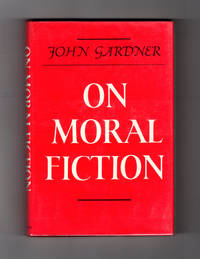
On Moral Fiction
by John Gardner
“Who hath forged the chains of Opinion and Custom? And must I wear them?” –Emerson
I’m interested in defending the idea that art can be objectively Good. This book gave me false hope that it would rigorously address that question. Very early, the author gave up the concept of absolute morality, so his arguments became incoherent, and I found the entire book agitating. So I wouldn’t recommend reading it, but it did prompt me to think about the topic. I wrote more in the margins here than in almost any book I’ve read.
Art vs. Chaos
The theme of art battling chaos keeps coming up. He sees chaos and nihilism as a problem.
The traditional view is that true art is moral: it seeks to improve life, not debase it. It seeks to hold off, at least for a while, the twilight of the gods and us. [He's already giving up when he says, "at least for a while."] I do not deny that art, like criticism, may legitimately celebrate the trifling. It may joke, mock, or while away the time. But trivial art has no meaning or value except in the shadow of more serious art, the kind of art that beats back the monsters and, if you will, makes the world safe for triviality. The art which tends toward destruction, the art of nihilists, cynics, and merdistes, is not properly art at all. Art is essentially serious and beneficial, a game played against chaos and dealth, against entropy. (5)

“Art’s process values chance.” (12) Writers cast about until they “find” a style that interests them, then begin working out its philosophical implications, so the implications are “not entirely purposeful.”
He compares true art to natural selection: lots of “blind experiment” followed by “ruthless selectivity” (although this is often missing in the internet age).
“Art, in sworn opposition to chaos, discovers by its process what it can say. This is art’s morality.” (14)
This thesis does not hold together. Moral Art fights chaos by using natural selection (a chaotic, random process) to find patterns of meaning? I do not see anything moral in this. It is just nihilism plus pattern matching.
But he keeps using words like Good and Evil
“If art destroys good, mistaking it for evil, then that art is false, an error; it requires denunciation. This, I have claimed, is what true art is about–preservation of the worlds of gods and men.”
Most art these days is either trivial or false... For the most part our artists do not struggle toward a vision of how things ought to be or what has gone wrong. Either they pointlessly waste our time, saying and doing nothing, or they celebrate ugliness and futility, scoffing at good. Every new novelist, composer, and painter--or so we're told--is more "disturbing" than the last. The good of humanity is left in the hands of politicians. (16)
Criticism is not much better. “We are rich in schools which speak of how art ‘works’ and avoid the whole subject of what work it out to do.”
The limits and weaknesses of art criticism
“Criticism is easier than authentic art to grasp as immutable doctrine.” (8) I see a connection to Weizenbaum. In Computer Power and Human Reason, he pointed out how AI researchers simplify the problem of replicating human thought by only looking at that aspects of humanity that are easily immitated by computers. When they are successful, they think they’re nearly done building a sentient, human-like program. Similarly, art critics write about the aspects of art that are possible to write about.
Moralistic Art
“As a general rule, the artist who begins with a doctrine to promulgate, instead of a rabble multitude of ideas and emotions, is beaten before he starts.” (14) Compare Christian art intended to proselytize to art that reflects the artist’s Christian beliefs and experiences.
“True art is too complex to reflect the party line. Art that tries hard to tell the truth unretouched is difficult and often offensice.” (15)
“Television… is good (as opposed to pernicious or vacuous) only when it has a clear positive moral effect, presenting valid models for imitation, eternal verities worth keeping in mind, and a benevolent vision of the possible which can inspire and incite human beings toward virtue, toward life affirmation as opposed to destruction or indifference.” (18, emphasis mine)
What are these positive morals and eternal verities? He seems to answer, that life is good and we should care about it. But where does the idea of “good” or of a “valid model for imitation” come from? To say life is good (i.e., to affirm life) assumes that “good” exists. What does he base that on? (I think this is why his arguments don’t really hold together. They assume a Christian worldview but deny the Christian God.)
“Eternal verities” comes up again on page 24. “Either there are real and inherent values, ’eternal verities,’ as Faulkner said, which are prior to our individual existence, or there are not, and we’re free to make them up…” He says if there are real values, “and if those real values help sustain human life,” art should be about them or at least mention them. Again, his fundamental basis is that life is good.
He gives up the whole argument on pp. 25-26. Tolstoy, he says, came out of spiritual crisis thinking that man should “feel out in his heart and bones what God requires of him.” He goes on: “For God, if you wish, read ‘sympathy, empathy, scrupulous study of the everyday world and the best men’s books.’”
So, man should feel out what his own feelings and other men’s books require or him. If man’s search for meaning ends in consulting himself and other men, then it’s a circular argument with no foundation. Specifying “the best men’s books” does nothing to improve the argument. If you don’t know the difference between good and bad, you can’t tell which books are best. And if you do know, that information must have come from somewhere other than those books.
Much later: “God, after all, is merely a word which the poet-priest uses to express a synthesisof feelings…” (156)
I probably should have stopped reading at page 26, then. He doubles down on this on page 35:
Homer, Dante, and Tolstoy derive art's morality from divine goodness. But morality as a principle of art need not be abandoned when the sky comes to be "ungodded." An alternative to the religious interpretation of the notion we've been treating--that ideals expressed in art can have an effect on people's behavior--is what we may describe as the Romantic and post-Romantic interpretation. (35)
I don’t think you need to wait for Romanticism to realize that art can affect behavior. If that were all he wanted to show, it would seem pretty obvious. He’s trying to say that, because art impacts behavior, it should direct toward moral good. But with an “ungodded” sky, who’s to say what actions are good?
His thoughts on God and Romanticism continue (page 36-7). Basically, we no longer need God, but squishy feelings of wishfulness remain in our tummies, and these are worth dying for.
My thought: If guilt means violating Divine Law, we can all be guilty yet still have a notion of virtue. But if our sins are only against what men say is wrong, then there is no virtue, only human opinion. (44)
On page 49, he tries to blame doubts and moral relativism on “cultural interchange” and America’s melting pot. This is idiotic. You can’t have moral absolutes without a law-giver, a concept he gave up on page 41 because it made him “uncomfortable.”
He rightly decries “cynical or nihilistic writers” and their “ideas no father would wittingly teach his children.” (56) “Wherever we look, it’s the same: commercial slickness, misplaced cleverness, posturing, wild floundering – dullness.” “Some deny that any first-rate American novelists now exist. The ordinary reader has been saying that for years.” (57)
“American can do trivia so extraordinarily well. That’s why our cinematography is so far ahead of our cinema.” (57)
He talks about the “operatic use of noise” (62). “Non-conventional sounds… are mere surface, boring or annoying” without context. This reminded me of Brent Farris’s music. He later says, “feeling can come either from texture or from structure.” My note: Feeling that comes from texture should be supported by the song’s structure, or it is superficial and manipulative.
He talks about chance music, such as when each member of an orchestra gets a card with a few notes, or a picture of a banana, or something, and they all have to play them. Which might be a funny idea or experiment, but it’s not music. “God knows what kind of activity we’re engaged in when for forty-five minutes two cellos play a perfect fifth. Asked by the composer what he thought of this piece, an older and wiser composer quipped, ‘Just as I was beginning to get interested, it stopped.’” (64)
“Cultures that survive almost by definition take pleasure in the good…” (105) So “good” is defined as “what survives?” No! And on the very next page he says that noble ideas can fall out of fashion and be plowed under by “progress.”
“I agree with Tolstoy that the highest purpose of art is to make people good by choice.” (106)
He says the very essence of art is “emotional affirmation.” (129) But is this “moral?” Which emotions are to be affirmed?
“There seems to be some question, these days, as to whether those old words the Good, the True, and the Beautiful have any meaning. If not, the kind of criticism I advocate is nonsense.” (133) This is an important acknowledgement.
Later, he writes that “Good is a relative absolute.” (140) I think he means Good is ultimately relative, but we share enough common culture and intrinsic beliefs tht it feels absolute. If that’s good enough for him, then he’s basically given up on the Good.
Nihilism
He objects to “the cult of cynicism and despair.” He says, “in our pursuit of greater truth, we have fallen to the persuasion that the cruellest, ugliest thing we can say is likely to be the truest.” Good so far, but then he says, “The black abyss stirs a certain fascination, admittedly, or we would not pay so many artists so much money to keep staring at it. But the black abyss is merely life… and staring at it dies nothing, merely confirms that it is there.” (126) He was doing okay until right there. If the black abyss of meaninglessness “is there,” then “the cruellest, ugliest thing we can say” is truest. If life seems meaningful but isn’t, that really would be cruel. Thanks be to God that nihilism isn’t just ugly but wrong.
“It is impossible for art not to assert man’s intuition of the beautiful, whether the artist knows this or not. It either asserts or it stops being art. Insofar as the long dead ‘Art Is Dead’ movement felt like art, it denied its nihilistic premise.” (157) My note: Art is inherently meaningful, so nihilistic art is an oxymoron. Expressions of nihilism are self-defeating, since an idea cannot be expressed or received without meaning." (157)
Creativity and the Internet
Artists have the drive to create. And maybe to show off. The internet makes learning about an art tradition easier, but that’s boring. It also makes creating and sharing your work easy – the fun part. Artists develop technical skill (by making) but have nothing interesting to say (e.g., Beeple). (168)
Other thoughts
He uses the words “true art” repeatedly, which reminds me of the “No True Scotsman” fallacy.
“Ironically, what a careful study of freaks reveals is that they’re all alike.” (81)
Kurt Vonnegut’s novels “can easily be read by people who dislike long sentences.” (87)
On the value of fiction: “In fiction we stand back, weigh things as we do not have time to do in life; and the effect of great fiction is to temper real experience, modify prejudice, humanize.” (114) “The writing of fiction is a mode of thought” (116). It embodies “knowledge in the old sense,” stuff a robot can’t know but a person can.
“A writer writes a novel, a poet writes a poem, to find out what he can honestly maintain, not just with his head but with all his nature.” (146) There’s something to this. It completes a long thought about what a good book is (132), that the eerie connections a writer unconvers aren’t just interesting but may actually mean something (122), what’s wrong with new criticism (126, 128, 129), and how good criticism is difficult (137, 140, 146).
“Everyone has had the experience of listening to and struggling to take part in an argument in which somehow the truth keeps eluding its hunters. One sits nervously on edge, wide awake, sensing with every nerve end the truth that will not show itself, trying to put one’s finger on where the speakers are going wrong, and at last, if one is lucky, recognizing, with a shock of relief, what it is that needs to be stated.” (153) A good description of a familiar feeling. This is basically how I felt reading this book.
Oddities
For years the Oz books were kept away from children because pseudo-critics (second-rate educators and amateur psychologists) decided that beheadings, however comic or acceptible in context, meant castration. (15)
I thought this sounded crazy, so I googled it and found this, from a 1983 Washington Post article:
Then there's Osmond Beckwith, a man with a Freudian outlook on such icons of Oz as the Tin Woodman. "The drama of decapitation (in the psychoanalytic vocabulary, decapitation and castration are synonymous) is played over and over again as entr'acte." In other words, says Beckwith, the Tin Man's longing for his lost "heart" is merely euphemistic.
Take that, librarians!
(We're Off to Read the Wizard, Michele Slung, 14 Aug 1983)