The Count of Monte Cristo
December 26, 2022
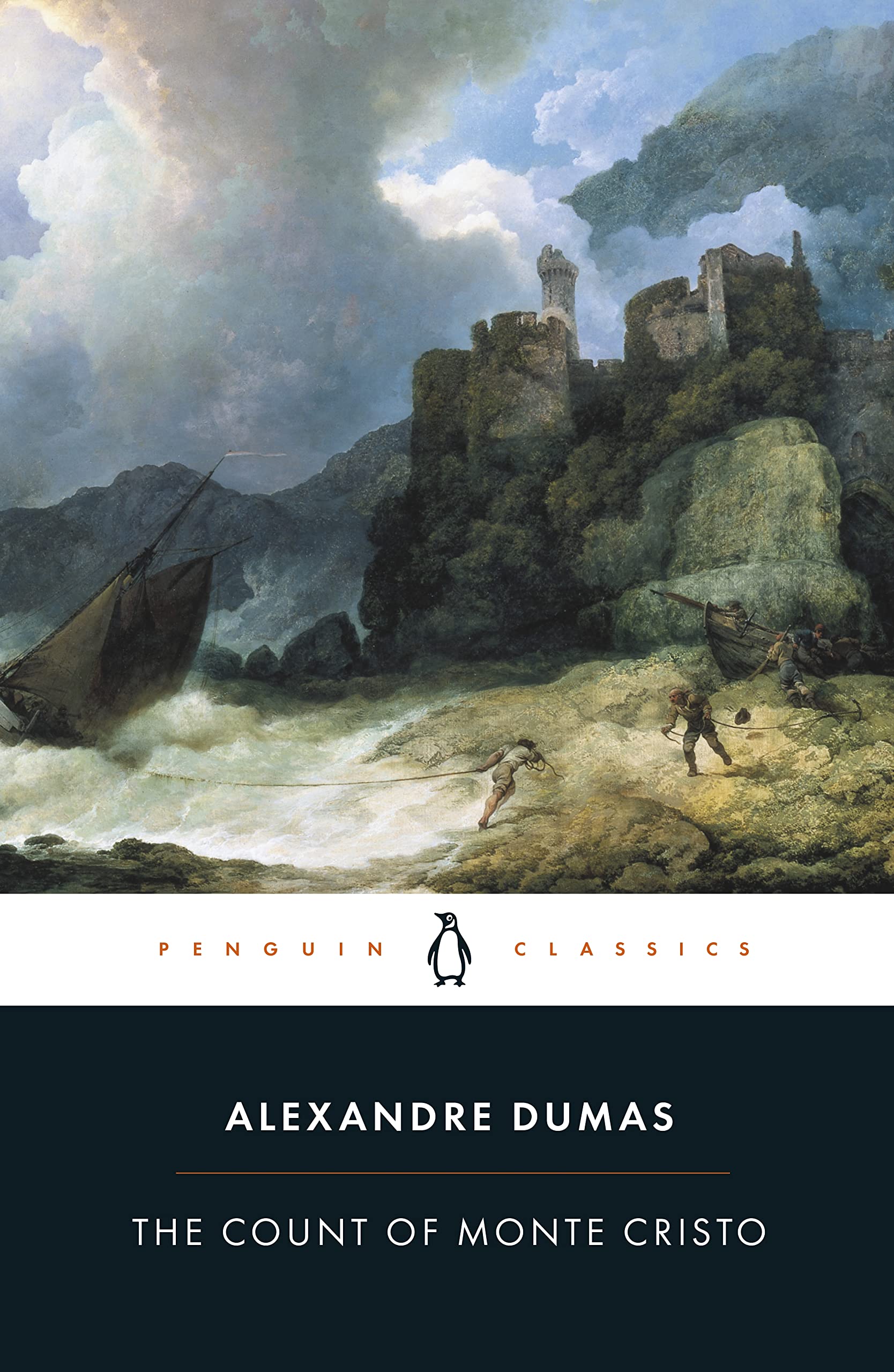
The Count of Monte Cristo
by Alexandre Dumas
Over a few months, several friends and people I follow online mentioned how good this book is. One mentioned a specific translator (Robin Buss), so when I found that translation at Half Price Books, I bought it. It took me a few months to summon the will to embark on a 1200+ page novel, but I’m glad I did. Here are passages I noted.
An Italian proverb that means: “Whoever has a [business] partner, has a master.” (14)
Old Dantes to Edmond: “May God bless you as much in your wife has He has blessed me in my son.” (20) That would make a good wedding toast.
Young Dantes was “eloquent with the heartfelt eloquence that is never found by those who seek it.” (66)
“Enemies!” Dantes says. “I am fortunate enough to be too unimportant to have any.” (66) This reminds me of a phrase I read recently (here): “Pursue obscurity.” Quoting from that article, “It is not enough simply to accept obscurity, if it happens to be our lot. Rather, there is virtue in positively pursuing obscurity, in seeking anonymity and nonrecognition. I have thought about this proverbial advice a lot over the years. In fact, it has become a kind of life code…” (The article is about not practicing your righteousness to be seen by others; Dantes did this naturally. But I think of it also in the sense of “leading a quiet and peaceful life in all Godliness and honesty.”)
Perhaps relevant to all of my own marginalia: King Louis XVIII writes a note in the margin of a book. “Then, when the note was written, he looked up with the satisfied air of a man who thinks he has made a discovery when he has commented on someone else’s idea.” (90)
“Grognards” (92) is a great word. It means an old soldier, a groaning curmudgeon. It’s also slang for someone who likes playing old war games like Axis and Allies, a pedant, someone who points out inaccuracies in movies, etc. Can also be used as a verb, grognarding.
We don’t rise to the heights of men of old. “Kings today, confined within the limits of probability, no longer possess the audacity of willpower… They no longer have any sense of superiority of their divine being: they are men who wear crowns, nothing more. At one time they would have believed themselves the sons of Jupiter…, but nowadays kinds are well within reach.” (129)
Page 133 references the Lord’s Prayer, Dante, and the book of Daniel (the writing on the wall). Asking God to “forgive us our trespasses” is called “self-interested.”
When Faria realizes he won’t escape, he says, “Let God’s will be done.” Dantes looks with admiration on “this man who, with such philosophical resignation, could give up the hope that he had nurtured for so long.” (150)
Natural Law: “It is not the laws of society that condemn murder, but the laws of nature.” (154)
On the benefits of constraints:
[Dantes:] 'Firstly, I am thinking of one thing, which is the vast knowledge that you must have expended to attain the point that you have reached. What might you not have done, had you been free?'
[Faria:] 'Perhaps nothing: the overflowing of my brain might have evaporated in mere futilities. Misfortune is needed to plumb certain mysterious depths in the understanding of men; pressure is needed to explode the charge. My captivity concentrated all my faculties on a single point. They had previously been dispersed, now they clashed in a narrow space; and, as you know, the clash of clouds produces electricity, electricity produces lightning and lightning gives light.' (160)

“Shilly-shallying” (167) refers to indecisive, irresolute behavior; it comes from saying, “Shall I? Shall I?”
“Breviary” = a book of hymns, prayers, etc.
On page 186, Faria calls Dantes “my son, the child of my captivity… God sent you to me…” Reminds me of Psalm 68:6, “God setteth the solitary in families: he bringeth out those which are bound with chains…”
Page 187ff: Even at death, this priest says nothing of God, sin, forgiveness, etc. He is said to be a priest but is more like a materialist scientist. The governor calls his treasure obsession “monomania” (195), and he’s not far off when consider the abbe’s dying words – “Monte Cristo! [where the treasure is] Do not forget Monte Cristo!” (192)
“In great sorrow as in great storms, the abyss lies between the crests of two waves.” (197) And much later in the book: “Grief is like life, and there is always something unknown beyond it.” (1126)
Dantes was in prison 14 years, from age 19 to 33. Once he is out, his heart begins to harden to suffering. A mortally wounded man (217) “made little impression on him… His heart was turning to stone in his breast.”
“At last, by one of those unexpected chances which sometimes happen to people on whom misfortune has exhausted its ingenuity, Dantes was going to reach his goal by a simple, natural means…” (220)
The hedonic treadmill: Dantes, “who three months earlier had wanted nothing but freedom, felt already not free enough, but wanted wealth.” Dumas blames this on God, for creating man with limited power but infinite desire. (224)
After saving Morrel, he turns to vengeance. “And now, farewell, goodness, humanity, and gratitude. Farewell all those feelings which nourish and illuminate the heart! I have taken the place of Providence (!) to reward the good; now let the avenging God make way for me to punish the wrongdoer!” (300) So he loved his neighbor (Morrel), which is always our vocation, but now wants to pursue vengeance, which is NOT his vocation.
The next big section of the book, from page 300 until the count arrives in Paris (page ~460) was not terribly interesting to me. Anything with Franz d’Epinay. There is a lengthy paean to hashish starting on page 318, after Franz eats a spoonful of it. Dumas belonged to a club of hashish-enthusiast writers (including Victor Hugo) who would meet at a hotel once a month to get high and talk.
About 9 years pass between chapters 30 and 31 (established on page 464; Morrel’s sister has been married 9 years. Page 328 is the first use of “Count of Monte Cristo.”
Rome vs. Paris: “In Rome, either things can be done, or they cannot. In Paris, it’s much more convenient: when something can’t be done, you pay double and immediately you get what you wanted.” (332)
Re: a law that weapons are confiscated, “My dear host, do you realize how convenient this regulation is for thieves–so much so that I suspect it was introduced in collusion with them?” (334) Dreams of gun ownership come up again on page 339.
“The better is the enemy of the good” (376). I didn’t realize this was an old expression.
The Roman mandaia (390) was apparently like a guillotine with a crescent blade.
Re: crab mentality:
Put two sheep in the slaughter-house or two oxen in the abattoir and let one of them realize that his companion will not die, and the sheep will bleat with joy, the ox low with pleasure. But man, man whom God made in His image, man to whom God gave this first, this sole, this supreme law, that he should love his neighbour, man to whom God gave a voice to express his thoughts - what is man's first cry when he learns that his neighbour is saved? A curse. All honour to man, the masterpiece of nature, the lord of creation!' (394)
“I warn you, I am fearfully punctual.” (432) See p. 298, where his plan saves Morrel at the moment Morrel was about to die.
Page 460: MC espouses egoism, self-interest as a basis for morality. He never worries about his neighbor (so he claims) but remains neutral toward society, likewise expecting nothing from it. I think this is a natural temptation after being wrongly imprisoned. His actions show it to not be quite true – he does show great love to his neighbor in many cases, though usually to those who have shown love to him (Maximillien, Valentine, Haydee, …).
This reminded me of Grant: “When a man has won his epaulettes on the battlefield, he does not know how to manoeuvre on the slippery surface of the drawing room.” (473)
“I’ll be darned.” (496) I thought this was a southern bowdlerism. Actually, it might still be. I tracked down this paragraph in the original French, and what it really says is, Ah! ah! dit Monte-Cristo, avec votre honnête figure, vous faites de ces choses-là, monsieur Bertuccio, et à un procureur du roi, encore! Fi donc! et savait-il au moins ce que cela voulait dire ce mot vendetta? So, “Ah! ah!” is translated “I’ll be darned!”, which seems a little weird.
Re: Benedetto, Bertuccio thinks he must be dead. “Don’t hope too much, Bertuccio,” said the count. “The wicked do not die in that way: God seems to take them under his protection to use them as the instruments of his vengeance.” (522)
On page 523, the age of the earth is implied to be about 6000 years.
Danglars likes old paintings because they are old. “I do not like the modern school,” he says. MC replies, “On the whole, they have one great shortcoming, which is that they have not yet had time to become old masters.” (535)
“My (MC’s) particular study in every country has been justice.” (551) He thinks of himself as “the hammer of God” (553). But if he takes vengeance outside an office (police, governor, etc.), he is only the hammer of himself, usurping the right of God to do justice in His own timing. MC tells Villefort his only enemies are distance and time, that he foresees all the outcomes men call fate, and none can defeat him. V asks him, “You alone are perfect?”, to which he replies, “Not perfect. Just impenetrable.” (555)
MC says to Satan, “I want to be Providence.” Satan replies, “All I can do for you is to make you one of the agents of this Providence.” MC explains to V, “The deal was concluded. I shall perhaps lose my soul. But what matter? If the deal had to be struck over again, I should do it.” (556) So for all his talk of God, divine justice, etc., he is ultimately in league with the devil.
At some point, I wrote up an incomplete cast of characters to refer to:
- Fernand married Mercedes and had a son, Albert de Morcerf
- (Baron) Danglars and Hermine had a daughter, Eugenie
- Hermine is having an affair with Lucien Debray
- Hermine once had an affair with Villefort; they thought their son (Benedetto/Andreas Cavalcanti) was dead
- Maximillien Morrel is in love with Valentine de Villefort
- but Valentine is engaged to Franz d’Epinay
- Haydee is MC’s Greek female slave
- Countess G—, from the Opera in Rome. She thought MC was like a vampire. She doesn’t really come up much.
Acquaintances made on journeys are demanding. They require of you, in any place whatsoever, the same friendship that you showed them once, by chance; as if a civilized man, who can pass an hour with anyone, did not always have some reservations! (619)
When the Villeforts are passive agressively arguing in front of the Count, Dumas writes that “the couple were starting to speak in parables.” Good way of putting it. (670)
“A crestfallen capitalist is like a comet: he always warns of some great misfortune to come.” (724)
“Do you gamble on the Exchange?” (725) It’s interesting that he calls the stock market gambling.
The Gospel gets poor treatment. Mme Danglars takes comfort in it (734) for her sin of adultery with Villefort in the past. But what about repenting of her present adultery with Debray? “I sometimes think God will forgive [my follies] because some compensation for them… is to be found in my sufferings.” This is not the Gospel at all! Imagine. “Behold, I bring you good tidings of great joy: If you suffer horribly, God will overlook your sins.”
And Villefort claims that “the wickedness of men runs… deeper than the kindness of God.” (742) The kindness of God extends all the way to the cross.
MC is a Lutheran? (755) Or maybe a Quaker. (756)
“Everything about the count meant something and carried some weight; for the habit of positive thought had given… incomparable strength” to his features. (765) “The habit of positive thought” seems to mean constant thought directed toward a purpose. Or it’s the title of a self-help book.
Family “attaches you to life” (772).
“Nothing terrifies old people so much as when death leaves their side to strike down another old person.” (777)
*** This was a revelation: On page 803, Morrel jumps Villefort’s fence and enters his house. When a character you love does something stupid and dangerous, you fear for him. But then you remember that the book’s author is clearly in his favor. Even if things go badly for him in this scene, they will all work out in the end. This parallels the Christian life. God is the author, and we are the characters whom He loves.
Although disapproving of duels, MC practices with a pistol. “When one lives among madmen, one should train as a maniac.” (872)
A bon mot: “No one can work all the time!” said Caderousse. “We are not dogs!” MC replied, “Fortunately for dogs.” (921)
The newspapers are openly partisan. (951)
Since MC has promised Mercedes that he will spare Albert in the duel (985), he therefore must die. This is somewhat Christ-like – there is no forgiveness without the shedding of blood.
“Haste is a poor counsellor.” (998)
“Providence does not wish the innocent to pay for the guilty.” (1003) But Christ!
Danglars: “Like a man who is full of ulterior motives, he was preoccupied with finding his own train of thought in the speaker’s ideas.” (1034)
On pp. 1054-55, preparing to run away, Eugenie Danglars puts on men’s clothing “with a rapidity that showed this was surely not the first time.” Then she cuts her hair short. “Her eyes shown, more sparkling and joyful than usual…” and she said, “Don’t I look a hundred times better like this?” Combined with her refusal to submit to marriage, this is interesting.
When people keep dying at the Villeforts’ house, the behavior of the servants is compared to how it was during the plague. Peeking out through slats in the windows, slamming doors and windows if they saw another person. It reminds me of covid. “Please excuse my servants for a regime of terror for which I cannot blame them. Suspect themselves, they have become suspicious.” (1074)
Villefort: “Every man that I found guilty… seemed to me a living proof that I was not some hideous exception!” To justify his own sins, he says he is no worse than other. (1077)
As people gather for Valentine’s funeral, we meet a cousin of Villefort, “an insignificant personage both in the family and in this story, one of those beings who are born to play a purely utilitarian role in the world.” (1107) Dumas is being uncharitable to his own NPC, just as that term is uncharitable. Those who live in (or even pursue!) obscurity are dismissed for serving an uninteresting, “utilitarian” role. In my mind, this NPC cousin could be the only Christian believer in the whole book.
“Quincunx” = an arrangement of 5 things, as the four points of a square plus one in the middle (like the 5 on a die).
“Grief is like life, and there is always something unknown beyond it.” (1126)
This Enlightenment thinking is some combination of Kurzweil and Kevorkian:
One day, when our world has lived another thousand years, when people have mastered all the destructive forces of nature and harnessed them to the general good of mankind, and when, as you just said, men have learnt the secrets of death, then death will be as sweet and voluptuous as sleep in a lover's arms. (1235)
MC says he is “unable to atone for evil except by doing good.” (1236) He sees himself as his own savior. But Valentine redeems him (1239), “an angel of mercy casting out an angel of vengeance.” There is some Gospel at the end: “I wished to punish myself, but God wants to pardon me.” (1241)
Some loose ends that weren’t quite tied up: Who was the Greek woman at the opera in Rome who saw the count as something of a vampire? (Am I recalling that right?) She is mentioned a few other times, but I don’t know her significance. Franz seems like he was going to be a bigger character than he ended up being. And what, if anything, happened to Bertuccio, MC’s servant who was the adoptive father of Benedetto (aka Andrea Cavalcanti, aka the son of Villefort and Mme. Danglars)? What happened to Benedetto after the trial that revealed Villefort to be his father? What happens with Eugenie? It makes sense that these questions aren’t all answered, but I wonder about them.