Master of the Senate
January 8, 2022
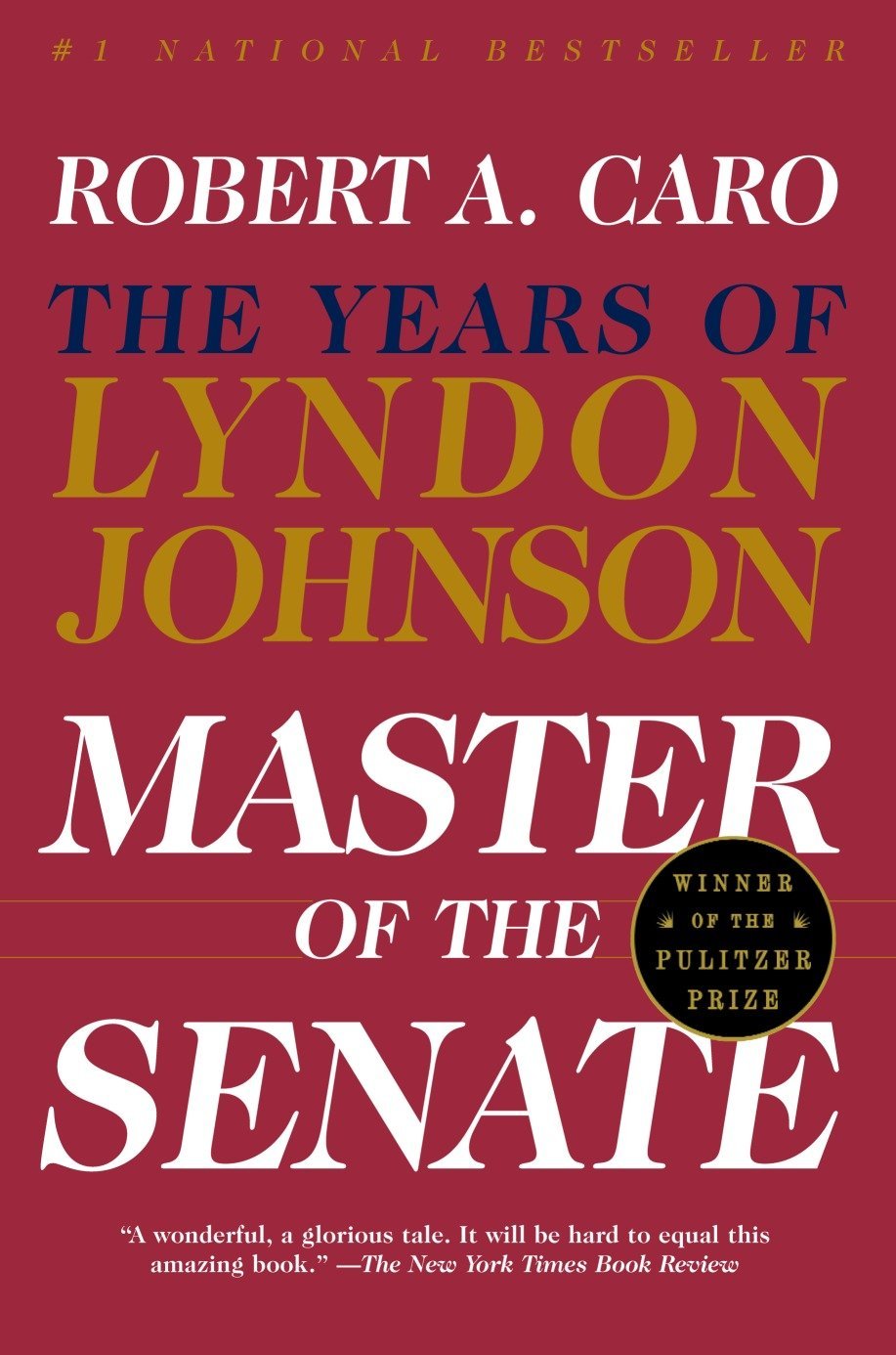
Master of the Senate
by Robert Caro
[Jefferson asked Washington] over breakfast why the President had agreed to a two-house Congress... Washington replied with his own question: "Why did you pour your tea into that saucer?" And when Jefferson answered, "To cool it," Washington said, "Just so. We pour House legislation into the senatorial saucer to cool it." (9)

Whereas the House represented the will of the people, of the majority, the Senate was meant to be a deliberative body that would do what was wisest and best for the country, even over the will of the people, even over the President. “The object of the second branch [the Senate] is to control the democratic branch.” (10) Alexander Hamilton said the Senate should try impeachments because it was sufficiently independent, uninfluenced, and impartial. So the House, representing the people, accuse someone (like the President), but the Senate remains the impartial judge of the case.
Much of this chapter recounts examples of the Sentate “cooling” things:
Daniel Webster’s reply to Robert Hayne, 1830.
Here the Senate cooled thoughts of succession in the South and West. John C. Calhoun of South Carolina, VP under both JQ Adams and Andrew Jackson, had proposed that any state “unwilling to abide a law enacted by the national gov’t could nullify it within its borders.” (4-5) This was called “nullification.”
Robert Hayne (SC) spoke in support, trying to unite the states of the South and West against the meddling of the North. Daniel Webster (MA) replied, to which Hayne gave a brilliant rebuttal. Two days later, Webster gave a speech that became famous, “Webster’s Second Reply to Hayne.” He spoke about the concept of union – “Union and Liberty, now and forever, one and inseparable!” The speech was widely published and read across the country.
From Wikipedia: Webster’s description of the U.S. government as “made for the people, made by the people, and answerable to the people,” was later paraphrased by Abraham Lincoln in the Gettysburg Address in the words “government of the people, by the people, for the people.” The speech is also known for the line Liberty and union, now and forever, one and inseparable, which would subsequently become the state motto of North Dakota, appearing on the state seal.
Jefferson vs. Samuel Chase
Pres. Jefferson sought to use impeachment to oust Supreme Court justice Samuel Chase, essentially over differing political opinions. This set up impeachment as not criminal but, “nothing more than enquiry, by the two Houses of Congress, whether the office of any public man might not be better filled by another.” (12)
Had this worked, it would set a precedent that would undermine the independence of the courts. Although Jefferson was at the height of his popularity (having just been reelected in a landslide), with the people largely supporting him, enough of his own Republican senators voted “not guilty” in the Senate to acquit Chase.
As one of Chase’s attorneys put it, “Justice, ’tho it may be an inconvenient restraint on our power, while we are strong, is the only rampart behind which we can find protection when we become weak.” In this vote, the Senate had stood firm, a dam against the sometimes impassioned will of the people. (The whole Part 1 of this book is called The Dam for this reason.)