Iowa Baseball Confederacy
August 3, 2022
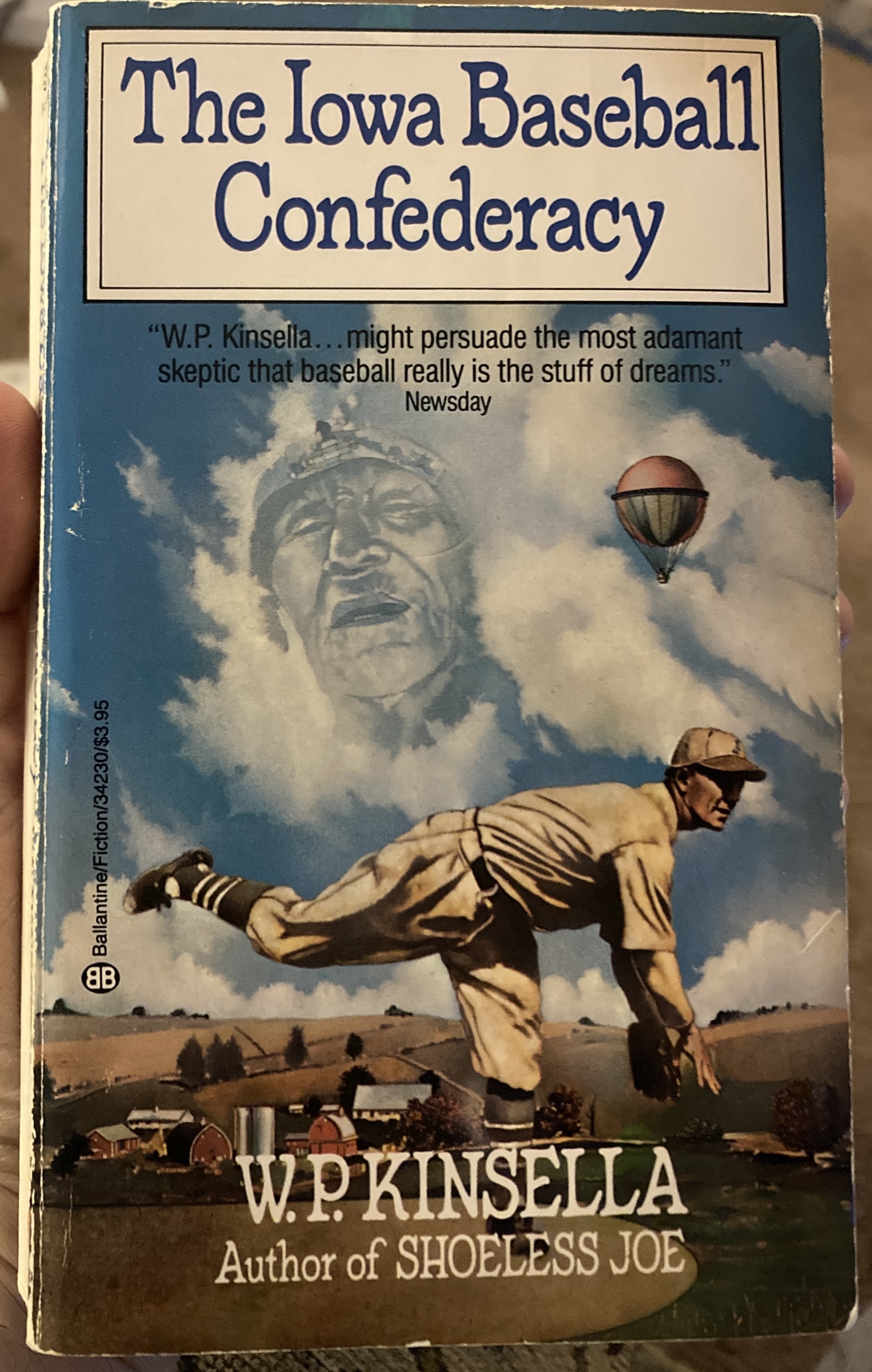
The Iowa Baseball Confederacy
by W. P. Kinsella
Matthew Clarke was struck by lightning and mystically filled with special knowledge. He becomes obsessed with truth he knows but cannot prove – that the town he lives in, Onamata, Iowa, used to be called Big Inning. And it was the home of a farm league baseball team, the Iowa Baseball Confederacy. And they once played the Chicago Cubs in a game that took weeks to play and lasted more than 2000 innings.
No one believes him. He is killed suddenly, hit by a line drive at a Milwaukee Brewer’s game. “It is very hard to take someone seriously who was killed by a line drive.” (45)
His son Gideon is the narrator. He says,
I listened to my father's tales with half an ear... I didn't pay half the attention I should have. Children, thinking themselves immortal, assume everyone else is too. He died when I was a few months short of seventeen. (24)

Although he hadn’t been listening carefully, Gideon gains his father’s knowledge after this. He and his friend Stan (a baseball player) go to the site of the old baseball field and slip into the year 1908. They go to the big game against the Cubs. Gideon tells people he’s a sports writer and becomes the team mascot, with players rubbing his head for luck. Stan eventually plays on the team.
Recapping the plot is difficult and not really the point. It’s magical realism. Kinsella is like Philip K. Dick + Kurt Vonnegut. Elements of this story remind me of VALIS – the lightning strike is like Horselover Fat seeing the pink light or whatever it was in VALIS, and then perceiving reality differently.
On page 239, Leonardo DaVinci lands in a hot air balloon and claims he invented baseball in 1506. So it’s kind of a weird book. There’s something called The Twelve Hour Church, led by Elder Womple; they sleep during the day. Gideon has an affair with Sarah, a member of that church.
The theme of the book is the difference between obsession and love. “Is it so bad not to be moved? To stand by what you believe, no matter what? To have an obsession?” Gideon asks. “It is,” answers the Indian named Drifting Away, “when obsession overrides love, takes precedence over brotherhood.” (255) And later, “I shall not be moved. It sounds like a virtue. The words of the hymn certainly imply that it is. But my obsession with the Confederacy has cost me both Sunny and Sarah.” (290)
"How wonderful, I think, to be able to push grief far to the back of one's mind, like slipping cardboard boxes under the basement stairs." (288)
What [Matthew] did say, on the drive back, as if he was trying to explain something to me but was not exactly sure what, was, "We are haunted by our past, which clings to us like strange, mystical lint. Of the past, the mystery of family is the most beautiful, the saddest, and the most inescapable of all. Those to whom we are joined by the ethereal ties of blood are often those about whom we know the least." I think he was talking about much more than just my grandparents. (24)
When a character kills himself, his wife puts it like this: “John helped himself along.” (287) W. P. Kinsella also helped himself along, committing suicide with assistance from a doctor in 2016, after he suffering from diabetes.