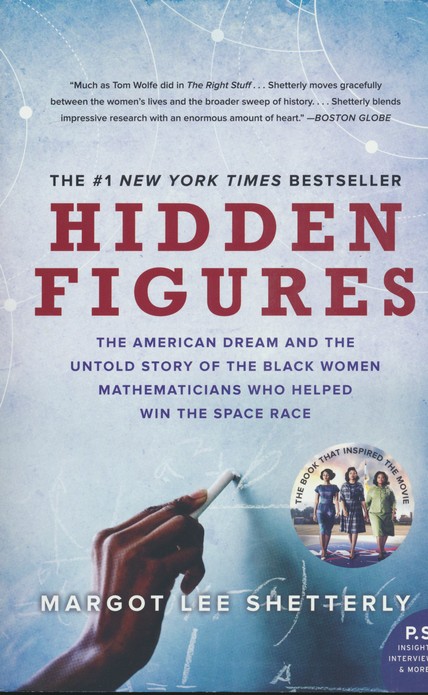
Kaeta got me this book for Christmas. We watched the movie as a family, and now I can say that the movie definitely captures the spirit of the book. Not everything in it is strictly true, but mostly it is.
In the 1940s, the National Advisory Committee on Aeronautics (NACA) needed human “computers” to help scientists and engineers by solving math problems. The book focusses on the careers of black, female computers at NACA and later NASA. Here are some things I noted:
To Langley, Virginia locals, NACA engineers were "NACA nuts." "Around town, they confused and horrified residents by doing things like dismantling a toaster with a screwdriver in the local department store to make sure the heating coil would toast bread just so. One employee brought a pressure gauge from the lab into a store to test the suction capabilities of a vacuum cleaner model..." (53)
Mary Jackson was leading girl scouts in a traditional song called Pick a Bale of Cotton when it suddenly dawned on her what they were singing ("We're gonna jump down, turn around, pick a bale of cotton!"), and she stopped the girls in mid-song and told them they weren't going to sing that one anymore. "Sometimes the most important battles for dignity, pride, and progress were fought with the simplest of actions." (98)
From p. 124, the phrase "racial synecdoches" -- the way one member of a race can represent the race as a whole. A good way of putting it.
Katherine Goble did the math to investigate this case: A Piper propeller plane was flying along normally, then "fell out of the clear blue sky and crashed to the ground." Analyzing the data from the flight recorder, she showed how a vortex left by a jet flying perpendicular to that path became an invisible trip wire that sent the Piper falling out of the sky. Based on this discovery, rules for minimum distances between flight paths were first established. (128)
When Mary Jackson is finally allowed to go into a white school, she finds it to be rundown and antiquated. "Throughout the South, municipalities maintained two parallel school systems, which gave the short end of the stick to the poorest whites as well as blacks." (145)
Following the launch of Sputnik, NACA was rechristened NASA and relocated to Houston. The job of a computer was a very good one, especially for a black woman in the 1960s, and many of them made the move.
On page 162, she quotes LBJ saying, "First in space means first, period." In context here, it seems like LBJ cared a lot about the space program. However, I know from Master of the Senate (pp. 1024 and 1026-1029) that his interest was purely political. He was briefly in charge of some space-related committee, but when the public's interest waned, he quickly dropped it. You see this again later in the book: "As early as 1966, President Johnson, the space program's biggest political champion, began looking at NASA as a 'big fat money pot' that he could drain to ease a budget strapped by social programs and Vietnam." (252)
"As fantastical as American space ambitions might have seemed, sending a man into space was starting to feel like a straightforward task compared to putting black and white students together in the same Virginia classrooms." (185)
A rocket test for Project Mercury was performed using the chimpanzee Ham. The third test (Mercury-Redstone 3; "Redstone" was the name of the rocket) took Alan Shepard into space and back down safely, the first American in space, on May 5, 1961. (208)
"A Republican senator from Pennsylvania called the Mercury capsule-Atlas rocket pairing 'a Rube Goldberg device on top of a plumber's nightmare.'" (214)
The Russians sent Yuri Gagarin to orbit the earth in April 1961, followed by Gherman Titov, who spent nearly a full day in space in October. (215)
Another trained chimp, Enos, flew into space on Mercury-Atlas 5, preparing to send John Glenn into orbit. (I read on Wikipedia that they trained Enos to work the controls when certain lights flashed, and then he'd get a banana tidbit.)
Katherine Johnson told students, "Math was either right or wrong, and if you got it right, it didn't matter what color you were." (244)
She said her greatest contribution to the space program was "her work on the lunar rendezvous, prescribing the precise time at which the lunar lander needed to leave the Moon's surface in order to coincide and dock with the orbiting command service module." (248)