To Rescue the Republic: Ulysses S. Grant, the Fragile Union, and the Crisis of 1876
May 17, 2022
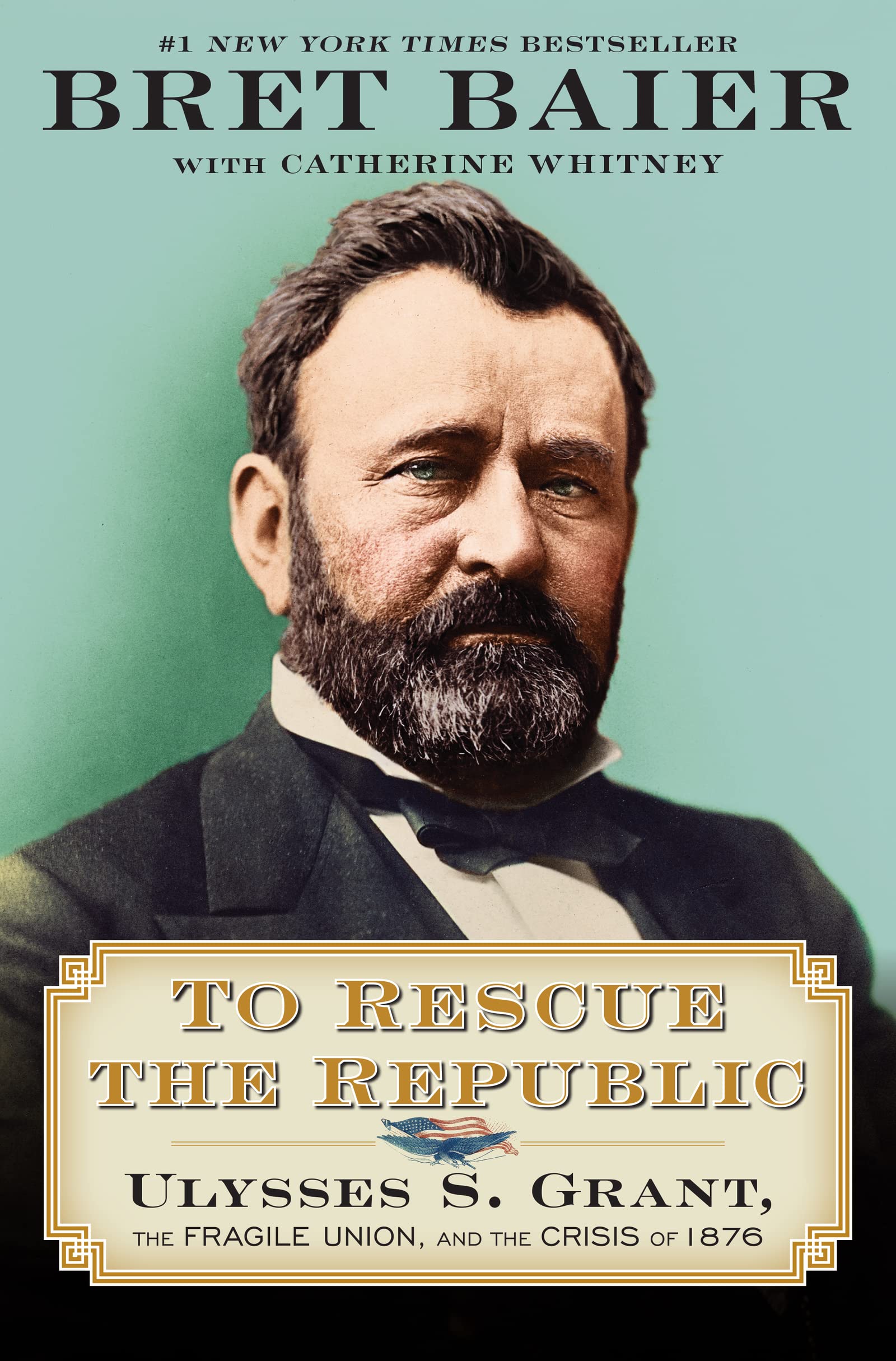
To Rescue the Republic: Ulysses S. Grant, the Fragile Union, and the Crisis of 1876
by Bret Baier with Catherine Whitney
Name part 1
Grant’s parents were Jesse and Hannah Grant. Jesse worked for Owen Brown, father of John Brown, the abolitionist. In their home, “the rod was spared.” Grant did not remember ever being scolded or punished by his parents. (17)
When they had their first baby, and relatives descended to help name him (13). “Only the most majestic name would do for this precious offspring!” Hannah’s father liked Hiram (OT king), Jesse preferred Ulysses, and other names were proposed. In the end, they put them into a hat, and the name “Ulysses was drawn out.” But, to please her father, Hannah named the baby “Hiram Ulysses.”
Horses
He rode horses from a young age, was adept at it by 5, would ride balancing in one stirrup, and broke his own horses. (18)
Eight-year-old Ulysses was obsessed with owning his own colt, and he set his sights on one owned by a Mr. Ralston in a nearby village. He begged his father to buy the horse for him, and Jesse indulgently agreed. However, the negotiation did not go well. Jesse offered $20, but Ralston asked for $25. They haggled back and forth and were unable to reach a deal. Heartbroken, Ulysses pleaded with Jesse to reconsider. Jesse softened and agreed to let the boy approach Ralston himself. He instructed him this way: the pony was worth only $20 and he should offer that. If Ralston rejected the price, he should offer $22.50, and if that failed, finally he could offer $25. So Ulysses hopped on his horse and rode to Ralston's house, where he an- nounced innocently, "Papa says I may offer you twenty dollars tor the colt, but if you won't take that, I am to offer twenty-two and a half, and if you won't take that, to give you twenty-five." Twenty-five it was. This, according to Grant, was his father's version of the story and only "nearly true."

Name part 2
So when did he become Ulysses S. Grant? When he showed up to register at West Point, he learned that the Congressman who had nominated him had written his name as “Ulysses S. Grant” (probably assuming the S from his mother’s maiden name, Simpson). They told him this could not be corrected, so he changed his name in order to be admited! His classmates jokingly called him Uncle Sam. (24)
Misc.
Right after he got engaged to Julia, they were apart for three years!. (34)
His first battle was in the Mexican-American War, 1846. “There is no great sport in having bullets flying about one in every direction,” he wrote Julia, “but I find they have less horror when among them than when in anticipation.” He served under General Zachary Taylor.
At one point, he was responsible for loading and driving the mules, as quartermaster and commissary officer. Describing the way they would run, spill their loads, etc., he said, “I am not aware of ever having used a profane expletive in my life; but I would have the charity to excuse those who may have done so, if they were in charge of a train of Mexican pack mules at the time.” (38)
He was labeled a drunk, but this is likely exaggerated. (55)
Grant ran into an old friend, James Longstreet. Although Grant was down on his luck, he insisted on giving Longstreet a five dollar gold coin to repay a debt from 15 years earlier. “I cannot live with anything in my possession which is not mine.” (57)
Lincoln
A political group promoting Lincoln was called the “Wide Awakes.” I guess you could say they were woke? (65)
“Lincoln fought a war to save the Union. He did not fight it to free the slaves.” (92) He felt that freeing slaves was necessary to save the Union, but he also wrote, “If I could save the Union without freeing any slave I would do it, and if I could save it by freeing all the slaves I would do it; and if I could save it by freeing some and leaving others alone, I would also do that.” This he wrote to a newspaper editor after the Emancipation Proclamation. (93)
The story of Lincoln asking, “Do you know what kind of whiskey Grant drinks?” is most likely apocryphal. It was disputed even by Lincoln, although he thought it was funny. (112)
At one point (113), Lincoln summoned Grant to Washington. Showing up at an elegant hotel looking dissheveled and down on his luck, Grant was told by the clerk that all the rooms were booked except a tiny space on the top floor. Grant said fine and signed the register. When the clerk saw his name, his head jerked up, eyes widened, and he ran to get the manager. Grant was put in the bridal suite, though he said, “I heartily wished myself back in camp.”
Johnson wanted to arrest Lee
In President Johnson’s view, no secession had occurred. There had been an insurrection in the South. He wanted Lee to be arrested and tried. He confronted Grant, wanting him to arrest Lee. “Grant, usually so calm in the face of conflict, erupted in anger. Such arrests and trials, he told Johnson, would violate the understanding at Appomattox. Surely, Lee would not have surrendered had he known that he and his officers might be subject to arrest, trial, and even execution.” (167) Grant would resign before he would arrest Lee.
Mandelbaum! Mandelbaum! Mandelbaum!
Grant’s father and father-in-law were very different, “but that was beside the point of their true conflict – determining which of them was more fit.” Grandfather Dent would say to his daughter Julia, “You ought to take care of that old gentleman… He is feeble and deaf as a post, and yet you permit him to wander all over Washington. It’s not safe!” Grandfather Grant would then say to his grandson, “Did you hear him, Jesse? I hope I shall not live to become as old and infirm as your Grandfather Dent.” (200)
On inaugurations
Grant did not think the military should be involved in inaugurating the president. He said, “I like Jefferson’s way of inauguration… He rode alone on horseback to the capitol, tied his horse to a rail-fence, entered, and was duly sworn; then rode to the Executive mansion, and took possession. He inaugurated himself simply by taking the oath of office. (270)
No one to trust
When leaving office, Grant said “he welcomed the change… He added that it was the saddest hour of his life, not that he was to end his term as President, but because he had come to realize that he did not know where to go, outside of his family, to find a man to be his confidential secretary, in whom he could put entire trust.” (295)
After leaving, Julia began crying. “Oh Ulys, I feel like a waif…” She was inconsolable. Grant smiled at his wife affectionately. “Oh, is that all?” he said. “I thought something had happened. You must not forget that I, too, am a waif. So you are not alone.” (299) (There are many instances of this kind of affectionate teasing between them.)
While Grant was touring the world (“the wonderings of Ulysses,” it was jokingly called), his friends plotted to have him run again in 1880. But Garfield won the nomination (306) and later the presidency. He would be president for only two months before his assassination.
Misc.
Grant came very close to making a bad deal for writing his memoirs, but Mark Twain opened his eyes to it. (318)
Grant died on July 23, 1885. Two Union generals and two Confederate were among his pallbearers.
“There is nothing inevitable or predetermined in the onward march of freedom and equality. Reconstruction and its aftermath remind us that rights in the Constitution are not self-enforcing, and that our liberties can never be taken for granted.” (331)
Re: BLM statue toppling, “I’m sure Grant would not have cared about his statue being toppled. He wouldn’t have wanted a statue in the first place.” (332)