Chestertons Gateway
January 30, 2022
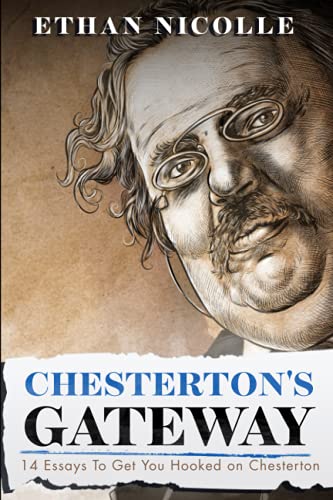
Chesterton's Gateway
by G. K. Chesteron, Ethan Nicolle
Ethan Nicolle (until recently of the Babylon Bee) has started a couple of Chesterton reading groups, and people ask him what GKC work they should read first. So he collected these 14 essays to help introduce people to Chesterton’s work.
Nicolle added an intro and footnotes to each essay. The footnotes are not that helpful but are at least charming (e.g., the footnote explaining “draughts” is, “Checkers. He means checkers.” Or for “biscuits” he notes, “They’re called crackers, sir.”). Sometimes they are pointless (like the footnote for Poe that says, “We all know who Poe is, right? I don’t need a footnote for the guy, he’s huge!”). At least once they are very wrong (He tries to explain a Latin phrase used by GKC but says it “is apparently from Ayn Rand,” (127) who was three years old when the essay in question was written.). After a while, I mostly quit reading the footnotes.
Here are some notes and quotes from some of the essays:
A Piece of Chalk
I suppose every one must have reflected how primeval and how poetical are the things that one carries in one’s pocket; the pocket-knife, for instance, the type of all human tools, the infant of the sword. Once I planned to write a book of poems entirely about things in my pockets. But I found it would be too long; and the age of the great epics is past.

From E.N.’s intro on page 21: Modernists were all going for efficiency and “art for art’s sake.” People had stopped caring about fundamental ideals, a Philosophy of the Universe, meaning and eternity. They were only concerned with what worked.
On Certain Modern Writers and the Institution of the Family
On small towns and families, his point is that being thrust among people who are different from you and forced to get along with them, as in a small town or even in a family, exposes you to more of humanity than a supposedly cosmopolitan city would. Though the people in the city express an interest in other cultures, they tend to find like-minded groups and stay with them, which you can’t always do in smaller settings.
“The man who lives in a small community lives in a much larger world. He knows much more of the fierce varieties and uncompromising divergences of men. The reason is obvious. In a large community we can choose our companions. In a small community our companions are chosen for us.” (33)
“To make a man comfortable is to make him the opposite of sociable.” (33)
“The best way that a man could test his readiness to encounter the common variety of mankind would be to climb down a chimney into any house at random, and get on as well as possible with the people inside. And that is essentially what each one of us did on the day that he was born.” (38)
“The reason why the lives of the rich are at bottom so tame and uneventful is simply that they can choose the events. They are dull because they are omnipotent. They fail to feel adventures because they can make the adventures.” (41) This reminded me of something I saw recently about Notch (creator of Minecraft), who became a billionaire and throws massive parties every week but is very lonely. He can do anything, but he doesn’t know what to do, and nothing is interesting. This was compared to his earliest versions of Minecraft, where there were no enemies and you could do whatever you wanted.
Cheese
He makes a similar point in his short essay, Cheese. He writes about visiting lots of small villages and sampling their local cheeses, which are each unique and delightful. Back in London in the end, he gets a kind of generic cheese (and crackers, not bread!).
The Maniac (from Orthodoxy)
Here he writes against the idea of “believing in yourself.” The maniac does that. The madman often has a very consistent internal logic and can’t break out of it. The English poet Cowper was “driven mad by logic, by the ugly and alien logic of predestination” (70) but saved (or almost) by his own poetry.
“How much larger your life would be if your self could become smaller in it” (74)
“The ordinary man has always been sane because the ordinary man has always been a mystic. He has permitted the twilight. He has always had one foot in earth and the other in fairyland… He has always cared more for truth than for consistency. If he saw two truths that seemed to contradict each other, he would take the two truths and the contradiction along with them. His spiritual sight is stereoscopic, like his physical sight: he sees two different pictures at once and yet sees all the better for that.” (82)
The Ethics of Elfland (from Orthodoxy)
“Tradition is only democracy extended through time,” and, “Tradition means giving votes to the most obscure of all classes, our ancestors. It is the democracy of the dead. Tradition refuses to submit to the small and arrogant oligarchy of those who merely happen to be walking about. All democrats object to men being disqualified by the accident of birth; tradition objects to their being disqualified by the accident of death. Democracy tells us not to neglect a good man’s opinion, even if he is our groom; tradition asks us not to neglect a good man’s opinion, even if he is our father.” (88)
People question why God made things the way He did but take for granted that He made things (and indeed they themselves) at all. “It seemed to me that existence was itself so very eccentric a legacy that I could not complain of not understanding the limitations of the vision when I did not understand the vision they limited.” (98)
I appreciated this essay (really another chapter from Orthodoxy) for the way he is clearly struggling to relate something very dear to him. It’s on page 100, and he does a decent job here:
The modern world as I found it was solid for modern Calvinism, for the necessity of things being as they are. But when I came to ask them I found they had really no proof of this unavoidable repetition in things except the fact that the things were repeated. Now, the mere repetition made the things to me rather more weird than more rational. It was as if, having seen a curiously shaped nose in the street and dismissed it as an accident, I had then seen six other noses of the same astonishing shape. I should have fancied for a moment that it must be some local secret society. So one elephant having a trunk was odd; but all elephants having trunks looked like a plot. I speak here only of an emotion, and of an emotion at once stubborn and subtle. But the repetition in Nature seemed sometimes to be an excited repetition, like that of an angry schoolmaster saying the same thing over and over again. The grass seemed signalling to me with all its fingers at once; the crowded stars seemed bent upon being understood. The sun would make me see him if he rose a thousand times. The recurrences of the universe rose to the maddening rhythm of an incantation, and I began to see an idea.
“I began to see an idea,” and “an emotion at once stubborn and subtle.” I think these are the best and most frustrating thoughts or beliefs. You hold them precious but can hardly begin to articulate them. You can only get them across to someone who already “gets it,” in which case you can say all you need to with a knowing look.
The Paradoxes of Christianity (from Orthodoxy)
Now, actual insight or inspiration is best tested by whether it guesses these hidden malformations or surprises. If our mathematician from the moon saw the two arms and the two ears, he might deduce the two shoulder-blades and the two halves of the brain. But if he guessed that the man's heart was in the right place, then I should call him something more than a mathematician. (111)
Christianity confesses an “illogical truth.” “It is simple about the simple truth; but it is stubborn about the subtle truth.” (111)
“Courage is almost a contradiction in terms. It means a strong desire to live taking the form of a readiness to die.” (124)
In the church (or in Christ), pure gentleness and pure fierceness meet. “It is constantly assured… that when the lion lies down with the lamb the lion becomes lamb-like. But that is brutal annexation and imperialism on the part of the lamb. That is simply the lamb absorbing the lion instead of the lion eating the lamb. The real problem is–Can the lion lie down with the lamb and still retain his royal ferocity? THAT is the problem the Church attempted; THAT is the miracle she achieved.” (132)
“It is always easy to let the age have its head; the difficult thing is to keep one’s own.” (135)
The Drift from Domesticity
He uses the word “Robot” (capitalized) on page 141 without explanation. He wrote that essay in 1929, and the word was coined in 1920. This shows that the word became common enough not to require explanation in that time frame.
In practice, the pursuit of pleasure is merely the pursuit of fashion. The pursuit of fashion is merely the pursuit of convention; only that it happens to be a new convention. The jazz dances, the joy rides, the big pleasure parties and hotel entertainments, do not make any more provision for a really independent taste than did any of the fashions of the past. If a wealthy young lady wants to do what all the other wealthy young ladies are doing, she will find it great fun, simply because youth is fun and society is fun. She will enjoy being modern exactly as her Victorian grandmother enjoyed being Victorian. And quite right too; but it is the enjoyment of convention, not the enjoyment of liberty.
“It is perfectly healthy for all young people of all historic periods to herd together, to a reasonable extent, and enthusiastically copy each other.”