Kon-Tiki
August 16, 2021
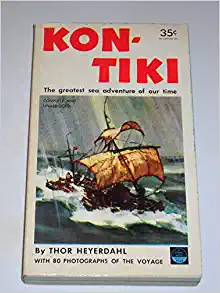
Kon-Tiki
by Thor Heyerdahl
Thor Heyerdahl spent some time living in the South Pacific on an island called Fatu Hiva. He observed to his wife that “the huge stone figures of Tiki [the chief Polynesian god] in the jungle are remarkably like the monoliths left by extinct civilizations in South America.” (13) He developed a theory that the Pacific islands were discovered by a people coming from Peru on rafts. No one bought this idea, so he got a group of five other explorers to join him in building a raft and trying to ride it from Peru to the Pacific islands to prove it was possible.
Blindly copying
They made built the raft themselves from balsa wood, using methods as close as possible to those of the ancient Peruvians. “If balsa wood had floated and lashings held for Kon-Tiki in 500 AD, they would do the same for us now if we blindly made our raft an exact copy of his.” (66) So when experts told them they’d have to use wire ropes or chains instead of rope because the ropes would break, Thor ignored them, doing everything the old way. (In the end, this blind copying approach saved them. Wires or chains would have eaten through the balsa wood as things rubbed together. “The balsa wood was so soft that the ropes wore their way into the wood and were protected, instead of the logs wearing the ropes.” (86))
The raft was 8x14 feet (130). On the whole, it traveled an average of 42.5 miles per day. (166)
The launch, almost getting left behind
They set out on April 27, 1947, hoisting the Norwegian flag (68). The raft was christened with milk from a coconut (the champagne having been accidentally packed at the bottom of one of their boxes). But the launch was confused. Thor was at the raft with a huge crowd, but his five mates were off having their last beer or doing other last-minute things, thinking they had more time. The raft was cut loose and launched by the crowd with only Thor aboard. There was then a larger boat that was going to pull the raft out to sea, and noone on board spoke English. Thor finally got them to send a small boat back to shore for his companions. “It was away a good while, and then it came back full of pretty senoritas but without a single one of the Kon-Tiki’s missing men. This was all very well but it did not solve my problems…” (73) Meanwhile, the men on shore figured out they had been left, and when the boat came back a second time, they didn’t miss it.
But as they were pulled out to sea, the towrope connecting them to the larger boat broke. “We flung ourselves down along the side of the raft to fish for the end of the rope… Stinging jellyfish as thick as washtubs splashed up and down with the seas alongside the raft and covered all the ropes with a slippery, stinging coating of jelly.” They got the rope eventually.
Flying fish
What did they eat while at sea? Fish, of course. For one thing, flying fish would shoot out of the water and land right on the boat. “The cook’s first duty, when he got up in the morning, was to go out on deck and collect all the flying fish that had landed on board in the course of the night… Knut was rather upset one morning because, when he was standing operating with the frying pan, a flying fish struck him on the hand instead of landing right in the cooking fat.” (87)
Snakefish
Other things flew onboard, too. One night, “Torstein was awakened by the lamp tumbling over and something cold and wet flapping about his ears. ‘Flying fish,’ he thought, and felt for it… He caught hold of something long and wet, which wriggled like a snake…” He threw it away and got the lantern lit, and Herman caught it. “The fish was over three feet long, as slender as a snake, with dull black eyes and a long snout with a greedy jaw full of long sharp teeth.” (88) They found out much later that the six of them were “the first men to have seen this fish alive.” It was the Gempylus, and only its skeleton had been seen before. It was assumed that it lived at a great depth because it had not been seen before.
Whale shark
Clearly, these men long remembered their magical encounter with a whale shark:
[Knut was washing his pants in the ocean] and when he looked up for a moment he was staring straight into the biggest and ugliest face any of us had ever seen in the whole of our lives. It was the head of a veritable sea monster, so huge and so hideous that, if the Old Man of the Sea himself had come up, he could not have made such an impression on us. The head was broad and flat like a frog's, with two small eyes right at the sides, and a toadlike jaw which was four or five feet wide and had long fringes drooping from the corners of the mouth. (91)

It was surrounded by pilot fish. The men had a dolphin hanging by hooks off the side of the raft as bait for sharks (!), and “a swarm of pilot fish shot straight off, nosed the dolphin without touching it, and then hurried back to their lord and master, the sea king.”
It rubbed against the raft and gave them a close-up view. “I thought we had all gone mad, for we roared stupidly with laughter… Walt Disney himself, with all his powers of imagination, could not have created a more hair-raising sea monster than this.”
Eventually, Erik thrust a harpoon into the whale shark, and it swam away. I found it interesting that, after being so delighted with it, they tried to kill it. There’s a hunter instinct that these adventurers have, which I do not think I share, though I sometimes admire it. I admire their bravery in learning to catch and eat sharks (although they didn’t like the flavor that much, so they mostly used the sharks as bait, or caught them for sport), but in the case of the whale shark, I thought it’s majesty should go unmolested.
Salt tablets
On hot days in the tropics, you can drink until you burst and still feel thirsty. What you need then is a salt tablet. They brought these along and took them regularly. (101)
Plankton
The blue whale lives on plankton, so the men were curious if they, too, could collect and eat some. Their method of using a little net “seemed to us sadly primitive when we sat on the raft and saw a passing whale … filtering plankton through it’s celluloid beard. And one day we lost the whole net in the sea.” “‘Why don’t you plankton-eaters do like him?’ Torstein and Bengt said contemptuously to the rest of us, pointing to a blowing whale. ‘Just fill your mouths and blow the water out through your mustaches!’” (108)
Ants
Hard to believe, but while on a raft in the middle of the ocean, they had an ant problem. Ants had been in the logs that made the raft, and as the sea water penetrated the balsa, the ants fled… into their sleeping bags. But they didn’t last long at sea. (110)
Sharks
This image from the book has stuck with me more than anything. While describing the almost daily visits from sharks:
If there was a high sea, the shark might be lifted up by the waves high above our own level, and we had a direct side view of the shark as in a glass case as it swam toward us in a dignified manner with its fussy retinue of small pilot fish ahead of its jaws. For a few seconds it looked as if both the shark and its striped companions would swim right on board, but then the raft would lean over gracefully to leeward, rise over the ridge of waves, and descend on the other side. (112)
Remoras
Remoras attach themselves to sharks, so when the men were able to catch a remora, they tried an old natives’ trick. They would tie a line to the remora, then let it swim away. “It then tries to suck itself on to the first fish it sees and clings so tightly that a lucky fisherman may haul in both fishes by the remora’s tail.” In their case, though, this didn’t work, because the remoras thought their raft was “an extra-fine big shark,” and they kept attaching to it instead.
Life before technology
The world was simple -- stars in the darkness. Whether it was 1947 B.C. or A.D. suddenly became of no significance. We lived, and that we felt with alert intensity. We realized that life had been full for men before the technical age also -- in fact, fuller and richer in many ways than the life of modern man. Time and evolution somehow ceased to exist; all that was real and that mattered were the same today as they had always been and would always be. We were swallowed up in the absolute common measure of history -- endless unbroken darkness under a swarm of stars. (132)
Ham radio, the King of Norway, and a darkroom
Using a ham radio, Knut was able to communicate with a guy from Oslo (!). They sent birthday wishes to King Haakon; the next day, they talked to the guy again, and he passed along that the king wished them success on their trip.
Amazingly, they had a working darkroom for developing negatives and prints onboard. When his first attempt failed, Erik reached a radio amateur in California, who got advice from a photo lab and passed it along (the developer was too warm, it turned out). With that advice, Erik’s next attempt worked well! (150)
Overboard
Herman fell overboard reaching for a bag and was nearly lost. They failed at throwing him a rope. They tried to get to him in a rubber dinghy, but they would have to release the dinghy from a rope, and then in all likelihood they’d be unable to reach the Kon-Tiki again. Still, “three men in a rubber dinghy had some chance; one man in the sea had none.”
But before they had to do that, Knut, holding a lifeline tied to the raft, jumped into the water and began swimming for Herman. They reached each other and were hauled back aboard. The only casualty in the hubbub was Torstein’s sleeping bag, which some creature pulled under. “Glad I wasn’t in it,” he said. (160)
Land
There were clues that they were close to land, especially the presence of birds. They sighted the island of Puka Puka but were unable to land there (170). They nearly landed at another island (172), where native Polynesians came out to the raft and were astonished to learn there was no motor. They tried lashing the raft to canoes and rowing it in through a gap in the reef, but ultimately they weren’t able to do it.
At the next island, they lashed everything they could down and eventually crash-landed into the reef. “On we ran with the sea rushing in behind us; this was the Kon-Tiki’s baptism of fire.” (191 - Reminds me of Moby Dick) Johannes the crab, who had been with them the whole way, survived! The swam to shore on the island of Raroia and met the natives.
There, they were able to save the life of a small boy with a bad infection, because they had some penicillin. (212, 222)
These natives had been taught by Christian missionaries, but with the arrival of the Kon-Tiki, some talked of how Tiki (their heathen god) had clearly been real. “Horrified at the thought of upsetting the missionaries’ work,” Thor explained that Tiki had surely lived but also surely died. His explanation “had fallen on good soil” and did not cause them to abandon their faith, but they were glad to learn that Tiki had lived.
Misc.
Sea sickness was referred to as “making offerings to Neptune.”