Dying to Live: The Power of Forgiveness
September 30, 2021
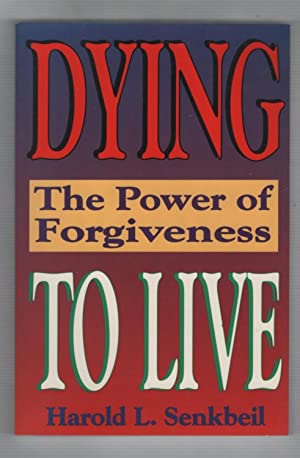
Dying to Live: The Power of Forgiveness
by Harold L. Senkbeil
Pastor recommended this book very highly and said it highlighted many “Lutheran distinctives.” It took around 50 pages before I began to appreciate it, but I am glad to have read it.
Through Death Into Life
The title “Dying to Live” comes from a frequent theme in the book. “The road of Jesus Christ always leads through death into life.” (51) As Romans 6:3 puts it, “all of us who have been baptized into Christ Jesus were baptized into his death.” And, “There’s no other way to live than through the death of Jesus.” (55)
Jesus actually lives out His own life through every baptized child of God. Since "you who were baptized into Christ have clothed yourselves with Christ" (Gal 3:27), we can truthfully say, "I have been crucified with Christ and I no longer live, but Christ lives in me. The life I live in the body, I live by faith in the Son of God, who loved me and gave himself for me." (Gal 2:20)
And Jesus Himself is the real power at work in our life. "I am the vine, you are the branches. If a man remains in me and I in him, he will bear much fruit; apart from me you can do nothing." (John 15:5)

The False God of Pleasure
“We have to get rid of the idea that we live in a godless world… The chief false god of our age is Pleasure.” (16) He quotes Ecclesiastes 1:14 (“I denied my heart no pleasure”) and 2:10-11 (“Yet when I surveyed all that my hands had done… everything was meaningless.”).
“Reaching out to others, too often we run into a wall of isolation or rejection… We all sense a need to protect ourselves from others’ demands.” This leads to an epidemic of loneliness. (An “epidemic of loneliness” describes the covid era well! This book was written in 1994.)
Will God Really Dwell on Earth?
King Solomon asked, “Will God really dwell on earth?” God’s response comes at least three times: When His glory filled the temple, in the Incarnation, and in the sacraments. “Still today we gaze upon the back side of God [like Moses did] in water, bread, and wine” (38).
1 John 5:6-8 says,
This is he who came by water and blood—Jesus Christ; not by the water only but by the water and the blood. And the Spirit is the one who testifies, because the Spirit is the truth. For there are three that testify: the Spirit and the water and the blood; and these three agree.
“The one who came by water and by blood still comes hidden in water and blood: the water of Baptism and the blood of the Holy Supper.” (39)
At His temptation, “a new actor played in Eden’s drama. Once again a perfect man confronted sin. And once again the life of mankind hung in the balance.” (46)
While he hung on the cross, the mob jeered, “he saved others, but he cannot save himself.” “But he didn’t come to save Himself. He came to save us.” (48)
He distinguishes between guilt and shame. Guilt is abstract, and we can often shrug it off by blaming others. “But there’s no passing off shame. It lies there, deep inside the human heart; an ugly, festering wound within.” (48)
Baptism
In Mark 1:8, John says Christ will baptize “with the Holy Spirit.” “In other words, it was to be a life-giving baptism. And it is… For in this water we share in the life of Jesus Christ and His new creation. ‘He saved us,’ St. Paul says, ’through the washing of rebirth and renewal by the Holy Spirit, whom he poured out on us generously through Jesus Christ our Savior.’ (Titus 3:5-6)” (62)
“If anyone is in Christ, he is a new creation; the old has gone, the new has come.” (2 Cor. 5:17)
In 1 Peter 3:20-21, Baptism is compared to the Flood. In Gen 8:10-12, Noah leaves the ark on day 8 after releasing the dove. Eight is associated with baptism; ancient sanctuaries and fonts were octagonal. “Noah stepped out of the ark on the eighth day with his family of eight. Jesus stepped out of His grave on the eighth day. And you and I step out of the death of our sinful nature on the day of our Baptism into Christ, which is our personal eighth day – the first day of our new creation in Christ. And our baptismal day is the first day of the rest of our life to all eternity. It is a circumcision to end all circumcisions.” (66)
The sign of the cross, traced in baptism, reminds us that “the true gift in Baptism is invisible to the naked eye.” (68) “You were marked with a seal, the promised Holy Spirit, who is a deposit guaranteeing our inheritance until the redemption of those who are God’s possession” (Eph 1:13-14).
Baptism Tied to Resurrection
“In His resurrection from death He has broken the stranglehold of sin on mankind.” (74) Romans 6:9 says that “Since Christ was raised from the dead, he cannot die again; death no longer has mastery over him.” Good for Him, but what about me? Well, I was baptized “into his death.” “We were therefore buried with Him through baptism into death in order that, just as Christ was raised from the dead through the glory of the Father, we too may live a new life.” (Rom 6:3-4) In Baptism, we go through death into life. (74)
Sanctification
Living a holy life is not a matter of my willpower or of trying harder. In baptism, I “have put on Christ” (Gal 3:27), so that my past Baptism “has ongoing implications.” (77) The Old Adam dies in Baptism, and a new man emerges. “I have been crucified with Christ, and I no longer live, but Christ lives in me.” (Gal 2:20) “This new man newly created is constantly being renewed ‘in the image of its Creator’ (Col. 3:10).”
The change that took place in baptism is a death and burial (Rom 6:3), a crucifixion (Gal 2:20), a stripping and reclothing (Gal 3:27), a washing of rebirth and renewal (Titus 3:5).
In Eden, Adam and Eve were ashamed of their nakedness, and the Lord made them garments (Gen 3:21). These covered their bodies but not their sin. “In Holy Baptism God delivers what he first promised in the Garden. We are stripped bare of our Old Adam and clothed in Jesus Christ Himself.” (78)
“The truth is, all of the New Testament’s imperitives are based on its indicatives. In other words, everything God demands of His children He first gives His children. Everything God wants us to do He has already done in His Son, and He continues to work in us in and through Jesus Christ.” (79)
“The best way to tell you what to do as a Christian is to tell you who you are in Christ. He will do the rest." (163)
Before his neighbor, the Christian is a doer. Before God, he is a receiver. (175)
Confession
“We can see others’ sins, but we can’t see our own.” “That’s the problem when we self-medicate with the Gospel.”
- 1 John 1:8-9 (If we say we have no sin, we deceive ourselves…)
- Rom 7:18 (nothing good lives in me)
- Ps 32:3-4 (When I kept silent, my bones wasted away…)
- Eph 2:1 (you were dead in your transgressions and sins)
The Lord’s Supper
Three meals: Passover, the Lord’s Supper, and the feast in Heaven.
At Passover, “the very lamb which had delivered them from death by the shedding of its blood was also the main course in the meal.” (96)
(I didn’t mark many passages in this section, although it was good.)
Liturgical Life Together
The gathering of the Church is “an island of life in an ocean of death” (117).
John 4:23 spells out the Trinitarian shape of the liturgy. “The true worshipers will worship the Father in spirit and truth.” Worship the Father in the Holy Spirit and the Son (ie, the Way, the Truth, and the Life).
“The liturgy rescues us from the tyranny of individualism.” (125) He calls this an American heresy. The Gospel is seen as a path to self-improvement, and we are taught to be solo-practitioners of our faith even as we long for community. Again, it’s the spirit of the Enlightenment, of Emerson writing, “No law can be sacred to me but that of my nature.”
Personal rapport with the pastor is irrelevant. He has been called to “perform the sacred duties of the Holy Ministry” for us. To deliver to us the forgiveness of sins in the means of grace. To pronounce our sins forgiven.
“Solemn assembly calls for solemn actions.” (128) Because the Divine Service is where we deal with our sins and receive forgiveness, we approach it differently than we would approach a concert or other gathering.
The liturgy grows slowly, “like a coral reef.” (128)
The liturgy is not our final home, but it provides rest along the way. Right now we walk by faith, not by sight. Our eternal rest is “already; but not yet.” “So then, there remains a Sabbath rest for the people of God; for whoever enters God’s rest also ceases from his labors as God did from His.” (Hebrews 4:8-10)
“Jesus Christ is the true Sabbath of God.” (132) We find our rest in Him. All our festivals and observances “are a shadow of things that were to come; the reality, however, is found in Christ.” (Col. 2:16-17)
In this world, “our songs of joy are sometimes sung with broken hearts.” Like the Israelites in captivity in Babylon, we say, “How can we sing the songs of the Lord while in a foreign land?” (Ps 137:1-4) “In a world consumed by things below, she [the Church] longs for things above.” We sing the “distant triumph song of those whose rest is won” (136).
For many, of whom I have often told you and now tell you even with tears, walk as enemies of the cross of Christ. Their end is destruction, their god is their belly, and they glory in their shame, with minds set on earthly things. But our citizenship is in heaven, and from it we await a Savior, the Lord Jesus Christ, who will transform our lowly body to be like his glorious body, by the power that enables him even to subject all things to himself. (Phil 3:18-21)