Theodore Rex
September 20, 2020
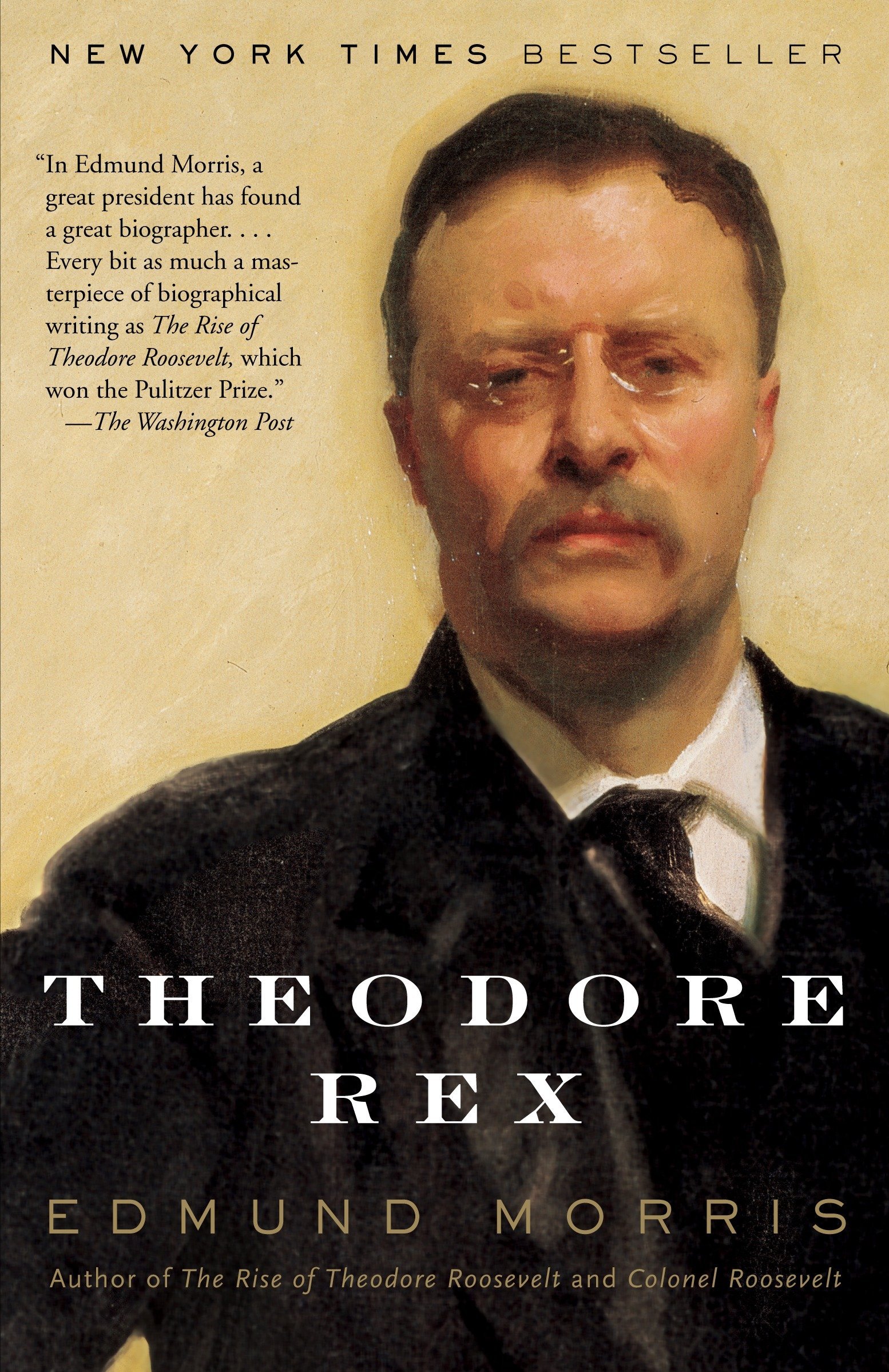
Theodore Rex
by Edmund Morris
Prologue
Leon Czolgosz, a Polish-American anarchist from Michigan, shot President McKinley twice at close range with a .32 caliber pistol on September 6, 1901. McKinley died 8 days later from infection, and Czolgosz was executed by electric chair 45 days later. Roosevelt became the youngest US president in history at the age of 42. (Kennedy, at 43, is the youngest ever elected.)
Roosevelt was not worried about assassination. If a bullet came from behind, he could do nothing about it, and would 'go down into the darkness,' that being his fatalistic image of death. If the attack was frontal, as on McKinley, he had confidence [in his own reflexes]. Last winter, in Colorado, he had leaped off his horse into a pack of hounds, kicked them aside, and knifed a cougar to death. What a great fight that had been! (8)

The prologue follows TR on a train from upstate New York to Washington, DC for his emergency swearing in. When he went to pay his respects before the body of McKinley, he had to borrow a suit. Here’s a sentence (in italics) which exemplifies why I like this writer: “His bull-like neck presented no problem, as he had brought a fresh shirt and collar. The Rooseveltian head, however, proved too large for any of Wilcox’s tall silk hats. John S. Scatchard, a macroencephalic neighbor, entered the annals of history by lending his own capacious topper.” I say, cheers to John S. Scatchard!
His inaugural address was the shortest anyone could remember. He wisely pledged “to continue absolutely unbroken the policy of President McKinley…” This effectively calmed the stock market and other national concerns at a moment of crisis.
The gist of his presidency is laid out in the prologue. Panama. Trust busting. Conservation.
The First Administration
TR had Booker T. Washington to dinner at The White House – the first time a black man was invited there.
Several railroad companies combined to form Northern Securities. TR applied anti-trust legislation to break up the monopoly, beginning his reputation as a “trust buster.”
His attorney general was Philander C. Knox:
He was short, smooth, pale, and expressionless, a porcelain egg of a man, weighted in place, yet tilting to the slightest touch. His dark blue eyes stared in different directions. No spoon could crack him open for inspection. In the words of a frustrated interviewer, "He offers no point of attack."
Knox was the quintessential attorney, ready to argue any brief for a fee. The larger the fee, the better he argued. (61)
Knox and Elihu Root were TR’s favorites at this time, and Knox argued the anti-trust case against Northern Securities.
There is a lot of time given in this book to things like presidential “Messages” and the dispositions of various Senators. Overall, it makes the book much less interesting than the first volume. Some topics that must have been very important at the time, but which now seem remote, include:
- The behavior of the occupying US forces in the Philippines, where a general ordered his men to “kill and burn” anyone over the age of ten. (100) Taft was governor of the Philippines at this time.
- Brigadier Gen. Leonard Wood, who was the US’s military governor of Cuba, transfered control of the island to the people and gov’t of Cuba. (105) (I note on p. 457 that Wood was to Roosevelt like Joab was to King David – a bloodthirsty and effective army commander.)
I thought this part about Wood’s forced sanitation of Cuba was interesting:
A trained surgeon, he [Wood] had transformed Cuba from one of the world's most pestilential countries into one of its healthiest. He had achieved the "miracle" or eliminating Stegomyia fasciata. As a result, Cuba was free of yellow fever for the first time in almost two centuries. The miracle had not happened gently. Doors barred against Wood's sanitation teams had been smashed open, hidalgos forced to pick up their own litter, and public defecators horsewhipped at the scene of the crime. Buildings in Havana and Santiago de Cuba had been purged with disinfectant so strong that "even insects came out of the ground to die." But, thanks to this draconian treatment, Havana was now a more sanitary city than Washington, D.C. (105)
Right after that, it says that “the old Cuba Libre coalition – intellectuals, radicals, and peasants – welcomed the departure of the yanquis”. First, yanquis is a great name for Cubans to call Americans. But also, I wonder why “intellectuals, radicals, and peasants” always seem to go together. Seems like a strange pairing, but it’s a common one.
There is a LOT of time given to whether the canal will be built in Panama (then part of Columbia) or Nicaragua. About this, “the President kept his own counsel. Two senators visited him with learned arguments for Nicaragua, and he listened to them solemly, scribbling on a notepad. Had they been able to look over his shoulder, they would have seen that he was merely doodling the names of his children, over and over again.” (113)
In Chapter 8, he goes to Oyster Bay with the family. George Cortelyou (McKinley’s personal secretary, later chair of the RNC among other offices, and at this point something like a press secretary to Roosevelt) had a telephone line run to this remote location.
TR disliked being constantly protected by the secret service, but he “gave up protesting that he could adequately defend himself. (The sight of a gun butt protruding from the presidential trouser-seat caused some consternation at Christ Episcopal Church.)” (122)
He spent a lot of time with children – his and others – at Oyster Bay. After describing the rustic buildings, fields, lawns, gardens, etc., Morris writes,
These haunts, Elysian as they were, needed the transforming touch of a Zeus to make them divine. Roosevelt did not disappoint. He gave off a godlike aura of radiance and vitality, and the children luxuriated in it, like bees in the sun. (124)
This may be the quality of TR I most admire or most wish that I had. I have been around people like this, and it is a wonderful feeling.
Around page 148, he has surgery on his leg (to remove “an accumulation of serum under the shin’s periosteum”). He joked with the surgeons: “Gentlemen, you are formal! I see you have your gloves on.” He did this without anesthesia, but for a second surgery involving a deeper cut, he drank some whiskey, and they rubbed cocaine around the swelling!
He brokered peace between the anthracite miners and the coal companies in a special meeting at the White House. The turning point for the negotiations ended up being tiny – the terminology used to refer to a man appointed to a commission that would settle the dispute:
I found that they did not mind my appointing any man, whether he was a labor man or not, so long as he was not appointed as a labor man.... I shall never forget the mixture of relief and amusement I felt when I thoroughly grasped the fact that while they would heroically submit to anarchy rather than have Tweedledum, yet if I would call it Tweedledee they would accept it with rapture; it gave me an illuminating glimpse into one corner of the mighty brains of these "captains of industry." (168)
Typical Rooseveltian thinking: “The Constitution was made for the people and not the people for the Constitution.” (165 – He’s right, as far as it goes, but if the Constitution was made for the people, this does not entitle a president to ignore it.)
The origin of the “Teddy” bear
TR spent five miserable days hunting in Mississippi without getting a decent shot. He allowed members of the press to come watch, embarrassingly. Finally, his guides chased a black bear into a pond, cracked it over the head without killing it, and tied it to a tree, leaving it alive for TR to make the kill. But when he saw it like that, he wouldn’t kill it himself just for killing’s sake, and had someone else “put it out of its misery.” From this incident, he got the reputation for being sportsmanlike, and political cartoons about him featured the bear. Over time, the bear was drawn “smaller, rounder, and cuter.” Toy makers began producing Teddy Bears.
Page 176: “Knowing her husband’s love of all things nautical, she [Edith] set an old desk carved from the timbers of the HMS Resolute in the center of the room.” The Resolute Desk is still in the oval office today!
The Monroe Doctrine
Any intervention by external powers in the politics of the Americas is a potentially hostile act against the US, according to the Monroe Doctrine. This came up around ch. 13, because Venezuela was deeply in debt to Germany and Great Britain. Not wanting Venezuela to turn into a European colony, TR amassed Navy ships to protect against invasion there. He applied the West African proverb he is famously fond of: “Speak softly and carry a big stick.”
But it’s a problem for South American countries to go into debt and then expect America to bail them out all the time. So TR added the Roosevelt Corollary to the Monroe Doctrine: “The debts will be paid. I’ll do whatever’s necessary to ensure that.” (201)
“These requests, written in English, were passed to Philander Knox, who translated them into language convoluted enough for Congressmen to understand.” (196)
In Roosevelt, one ambassador “sensed no brutality, only the ‘force of will to do things.’” (205)
He repeated the same platitudes and sayings in his speeches “until reporters no longer bothered to transcribe them… He was quite unapologetic: ‘Platitudes and iteration are necessary in order to hammer the truths and principles I advocate into people’s heads.’” (222)
In Iowa's fecund fields, glistening with spring rain, women in faded Mother Hubbard gowns crowded around his car, their arms bursting with progeny. A platoon of boys and girls hoisted a banner over their heads: NO "RACE SUICIDE" HERE, TEDDY! It was another of Roosevelt's catchphrases, broadly biological rather than ethnic in its implications. Bachelors declining to marry, urban women repressing their natural reproductive function, denied America the seed she needed to grow and be great. Ripeness was all. "I congratulate you upon your crops," he said, smiling around at the clustered families, "but the best crop is the crop of children." (224)
Re: deaths in the Russo-Japanese war, “casualty figures ‘worse than the censor would permit to publish’ were leaking out.” Imagine the media NOT putting such things in huge headlines. This is the opposite of “if it bleeds, it leads.” (229)
This reminded me of BLM receiving police protection while protesting to defund the police:
[While I was Police Commissioner of NYC,] a man came from abroad -- I am sorry to say, a clergyman -- to start an anti-Jewish agitation in New York, and announced his intention of holding meetings to assail the Jews. The matter was brought to my attention. Of course I had no power to prevent these meetings. After a good deal of thought I detailed a Jewish sergeant and forty Jew policemen to protect the agitator while he held his meetings. So he made his speeches denouncing the Jews, protected exclusively by Jews! (244)
Page 246-249 gives a detailed account of a lynching near Wilmington, DE. It’s too long to quote here, but it was eye-opening to read the details. TR had to combat lynching and racial unrest with an easy hand, since they were such hot issues, but he did make some progress. “He admitted that long-term justice for the Negro concerned him more than any other issue.” (258) Lynchings were still occurring at a rate of one every 4 days in 1904 (351).
Panama
Panama was a part of Columbia, but they were separated by a mountain range and not ruled all that well. There was a revolution in 1903, they separated into their own nation, and the US immediately recognized them. The US didn’t really help in the revolution, at least not directly, but they did nothing to oppose it. (chapter 18, p. 270 ff) Philippe Bunau-Varilla, who became Panama’s ambassador to the United States, was asked jokingly by Roosevelt, “What do you think… of these people who print that we have made the Revolution of Panama together?” He replied, “It is necessary to patiently wait until the spring of the imagination of the wicked is dried up, and until truth dissipates the mist of mendacity.” (297)
Page 285 has a little detail I enjoyed. The President of Columbia University had written TR asking for a list of recommended books. So he “cast his mind back over what he had read since taking the oath of office” – about 2 years ago – “and began to scribble.” What follows is a pretty lengthy list of challenging reading, including Herodotus, Plutarch, etc. Some books he read in translation, others in French. There’s a six-volume “Studies of the Greek World.” The list picks up again and ends with ellipses. Then the author returns to what was going on with the Panamanian revolution, but twice he comes back to give us a little more of Roosevelt’s recent reading! “By the time Roosevelt tired of jotting, he had listed 114 author names. ‘Of course I have forgotten a great many.’ His catalog did not strike him as impressive. ‘About as interesting,’ he concluded, ‘as Homer’s Catalogue of Ships.’”
A certain financier refers to Roosevelt’s “terrifying habit of ‘suddenness.’” (300) He can only have this by being prepared. I think careful and long-term preparation gives one the appearance of acting suddenly and decisively because one is able to do that when the opportunity finally comes. And such attentive thought means that one recognizes the opportunities when they do arise.
Still re: the Panama Revolution:
Roosevelt, congenitally unable to question the rightness of his own decisions, did not understand what Hoar [a Senator] and other moralists meant when they talked of "conscience" in foreign-policy making. If conscience was something more lasting than emotion, more flexible than intellect, he could do without it. He did not regret what he had done, because it was done. Second thoughts were like grief; they inhabited the vital onrush of life, of the world's work. (302)
Similarly, this passage from Father James Wilson describes Roosevelt’s philosophy: “If I am asked, how do you know that you ought to do [something]…, I can only say, I feel that such is my duty. Here investigation must stop; reasoning can go no farther.” (462) Right and wrong were seemingly based on feeling and ultimately subjective. (Earlier in the same paragraph, the author notes “Roosevelt’s tendency to use the word sovereign as if it were a personal pronoun.”)
Chapter 20 (p. 307) opens with this description by Henry Adams of attending a reception at the White House:
I was stuffed into place at the imperial table... We were straws in the Niagara. Never have I had an hour of worse social malaise. We were overwhelmed in a torrent of oratory, and at last I heard only repetition of I-I-I...
This experience of being just a sounding board for someone else to talk about themselves is familiar, and “social malaise” is a good descriptor for it. He finally says, “When I was let out and got to bed, I was a broken man.”
On p. 311, Mark Hanna is seriously ill. “Doctors worked all morning to stimulate life. They blew ether up his nose, poured champagne and whiskey and nitroglycerides down his throat, and pumped brandy into his abdomen in eight-ounce shots.” It seems to me like the doctors were just trying things at random. I wonder what procedures doctors do now that are the modern equivalent of pumping brandy into the abdomen.
Page 313 lists the 9 members of the Supreme Court in 1904, including TR-appointee Oliver Wendell Holmes.
“Old Guard Republicans wondered about the undignified spectacle of a President campaigning for his own office.” (319) How things have changed!
Description of the Russo-Japanese War begins around page 352. TR won the Nobel Prize for brokering peace between the two countries. Around this time, there is a sweet interlude (392) while he and Edith went to a cabin for a getaway. This was pretty rustic – “it consisted of one rough-cut, stone-chimneyed boarded box, with two smaller boxes upstairs. The pitched roof… created a piazza at mosquito level. Edith called the place Pine Knot, after the most noticeable feature of its interior decoration.” I like the tradition of naming a home (Pine Knot, Sagamore Hill, Fred Rogers’ Crooked House, Sue and Carl’s The Patch). It seems like the house needs to have some personality to be worthy of a name, though.
Dan Carlin of Hardcore History has said that, “The Japanese are like everyone else, only moreso.” (This is based on a saying about the Jews, but he applies the same idea to the Japanese.) You can see this play out as Japan takes on Russia with intensity. In San Francisco, Japanese school children were segregated (482), and Japanese workers were harrassed simply “because of their efficiency as workers.” The labor unions agitated to send Japanese back to Japan to protect their jobs.
Tokyo responded to the situation in San Francisco, saying they would work with Washington to keep the ingress of cheap labor to a workable level. “The only flaw in this committment was something hard for imperialistic minds to understand: the government of a federal republic, while able to wage war, could not tell a local school board what to do.” (484) Roosevelt had to negotiate, not coerce, and he was able to get the Japanese children allowed into the schools as before.
Racism
Though TR avoided raising the issue of black disenfranchisement in his speeches, he also would not tolerate the governor of Arkansas saying, “the only good Negro is a dead Negro,” and spoke out against lynching laws in response (425). At other times, he said things that would embarrass us today (or get one “canceled”), about black people, the Irish, foreigners in general, … But there is an important point beginning at the bottom of 425: “These floods of apparent aggression, half fierce, half humorous, wre more indicative of energy than of serious thought.” Like a Trump tweet, they do not necessarily reflect a deeply held belief, and it’s useful to remember that and treat them with some charity. “They [these comments] were part of … the excess that was part of Roosevelt’s nature. The weid [a low dam] had constantly to spill, to keep the deep water behind clear and calm.”
Progressivism, Socialist Movement
TR would sometimes schedule a meeting while he was being shaved (“his daily shaving levee,” 433. A levee being a daily moment of intimacy/accessibility to a monarch or leader). One journalist, Baker, discovered that the only time he could interrupt Roosevelt during these meetings “was when the razor made further loquacity perilous.”
At one point, Baker said:
"You may not agree with me, Mr. President, but I believe that we cannot stop short of governmental ownership of the railroads."
Roosevelt became vehement. He said that he knew, better than anyone else, how "inefficient and undependable" federal employees were. It would be "a disaster" to have them in charge of free enterprise. (434
Socialist Upton Sinclair (author of The Jungle) exemplifies “what was emerging as a common characteristic of the progressives: their fierce, preachy, perpetual grimness. They could no more convey the humor of a situation than they could view a perquisite [privilege] without frowning.” (435)
TR spoke about taxing “enormous fortunes” (444), similar to modern discussions of taxing the “one percent.” Conservatives heard this as a proposal that the government confiscate “the rewards of private enterprise,” and as “a declaration of idealogical war.” On the other hand, TR had the “habit of following every statement with a counterstatement” and using “on the other hand” as a kind of conjunction. In context, he would “sound progressive one minute and reactionary the next.”
His “campaign against privelege” (507) sounds very modern. He can be all over the map sometimes. His final Annual Address in 1908 “was so imperious a call for enhanced executive authority that it amounted to a condemnation of the doctrine of checks and balances.” (541)
A guiding principle of progressivism: “Society cannot exist unless a controlling power upon will and appetite be placed somewhere.” (448) (But, I say, who controls the will and appetite of the controlling power?)
Edith, Marriage
From chapter 27, about Edith Roosevelt: “mediocrity bored her, as did class resentment. ‘If they had our brains,’ she was wont to say of servants, ’they’d have our place.’” (450)
His attitude toward her [Edith]... was one of doglike adoration. He looked to her for porch company, for approving pats and hugs, and sometimes, guiltily, for discipline when he had done something wrong...
Her attitude toward him was complementary, yin to his yang. Theodore represented "the fire of life"..., and she warmed both hands at him. ... She had enough quiet humor to suffer his idiosyncracies--the yodels of falsetto laughter, the mad rock-climbs, woodsmen and their wives invited to stay at the White House--even though he often outraged her sense of propriety.
"You only have to live with me," she periodically reminded him, "while I have to live with you." (451)
“The medieval humor sanguis expressed TR’s character exactly: courageous, optimistic, affectionate, ardent.” (453) When Rodin got permission to sculpt him, he declared, “I try to make the blood circulate through the marble.”
Nature
Roosevelt remarked on the anomaly whereby man, as he progressed from savagery to civilization, used up more and more of the world's resources, yet in doing so tended to move to the city, and lost his sense of dependence on nature. Lacking that, he also lost his foresight, and unwittingly depleted the inheritances of his children. (516)
The 1908 Republican Convention was a TR love fest, even though he adamantly declared he did not want to run for another term. Having taken over for McKinley, he considered himself to have already served two terms. It’s hard to tell why he stood aside when he could so easily have won. At the convention, “Senator Lodge was trying and failing to restore order; a huge American flag with Roosevelt’s face on it had been unfurled on the platform.” Sounds like a Trump rally!
Church
During some gathering at Sagamore Hill, on a Sunday, Edith “announced that she and the President were going to church, but expected no one to accompany them unless conscience so dictated.” Their guests took the hint and came to church.
Knowing them both to be Protestant, he [Captain Archibald Butt] ventured an anti-Catholic remark during the automobile ride to Christ Episcopal Church. Roosevelt gave him a quizzical look.
"Archie, when I discuss the Catholic Church, I am reminded that it is the only church which has ever turned an Eastern race into a Christian people. Is that not so?"
TR “needed no prayer book, singing all the plainsong chants and the Te Deum by heart.” He did not bow during the Creed or the Gloria, possibly because that was not the practice in the reformed church in which he was brought up. He said his favorite hymns were:
- How Firm a Foundation
- Holy Holy Holy
- Jerusalem the Golden (good choice!)
- The Son of God Goes Forth to War
Taft, we learn on 537, was Unitarian!
After the Presidency
Taft defeated William Jennings Bryan in 1908. TR took a job writing for Outlook magazine. (541)
Tidbits
“Harvard, to Theodore, was a temple defiled by mugwumps.” (117)
The Roosevelt family motto is, “Qui plantavit curabit,” which means, “The one who planted it will care for it.”
TR’s VP, Charles W. Fairbanks, is only mentioned a couple of times in the whole book. “The New York Sun compared him unfavorably to a table of logarithms.” (353)
The book’s title comes from the writer Henry James (370).
“…Sir Mortimer Durand [was] unaware that Roosevelt privately rated his intelligence at ‘about eight guinea-pig power.’” (393)
On page 397, Alice Roosevelt and W.H. Taft board a steamer for a PR cruise to Hawaii, the Philipines, then Tokyo. That pairing seems like a setup for a movie. There’s a great picture of the two on p. 394. TR missed Alice and wrote her letters that have little illustrations, like personalized zines (facsimile on 401).
“The President had Washington correspondants [journalists] working on his behalf as if they were in his employ.” (430) – Sounds familiar!
The origin of the term “muckraker” is given on page 439. It comes from a character in Pilgrim’s Progress, “the Man with the Muckrake,” who would only look down as he raked up filth. This came to mean one who publicizes scandals about famous people.
The president issued an edict that “simplified spelling” would be required in all Administration documents. (460) “Unpronounced letters caused confusion” and should be eliminated! (Thus, “plow” instead of “plough,” for example.) But this was unpopular and was eventually “dropt.”
Tom Reed (speaker of the House): “If there is one thing for which I admire you more than anything else, Theodore, it is your original discovery of the Ten Commandments.” (502)
He did not have great respect for wealth. “I find I can work best with those people in whom the money sense is not too highly developed.” (504)
TR on ghost stories: “I want ghosts who do things. I don’t care for the Henry James kind of ghosts. I want real sepulchral ghosts, the kind that knock you over and eat fire… none of your weak, shallow aparitions.” (532)
The Great White Fleet (pictured 549) – TR sent sixteen battleships around the world, leaving in December 1907 and returning in February 1909.