Talking to Strangers
December 3, 2020
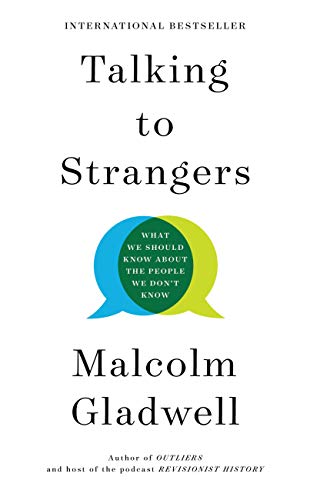
Talking to Strangers
by Malcolm Gladwell
I bought this book based on the author rather than the content. When I read the intro and learned that it was going to be a deep dive into policing and Black Lives Matter cases, I became pretty disinterested. I trust Malcolm Gladwell to produce an interesting narrative that takes the facts seriously, but I did not know if I could trust him to handle such a hot topic without bias.
I’m glad I stuck with it. The book starts and finishes with the case of Sandra Bland, who was stopped in Prairie View, Texas in 2015 for failing to signal a lane change. The officer asked her to put out a cigarette, which she did not want to do, so he asked her to get out of the car, which she didn’t do until he threatened to taze her. He arrested her and she hung herself in her jail cell three days later. The whole thing made no sense, and the book examines in detail why something like this, an interaction between strangers, could escalate and end so badly.
Default to truth
We do not assume people are deceiving us. CIA agents trust their own judgement over polygraph results (They think, “I’m such a good case officer, they can’t fool me.” (25)). There’s an interesting experiment (p. 68+) where a subject is encouraged to cheat on a test, then asked if they cheated. Later, people watch videos where someone says they didn’t cheat, and try to tell if they are lying or not.
We assume that seeing people’s outward behavior gives us useful information about their thoughts and intentions. But this can be wrong: Neville Chamberlain and others misjudged Hitler’s intentions after meeting him, whereas Churchill did not. Judges deciding bail hearings (p. 36+) want to look the defendant in the eye, but their prediction of who will skip bail is little better than a coin flip would be.
The illusion of assymetric insight
Page 46+ describes this experiment: People were given a group of words with letters missing, like “S _ _ R E”, then asked to fill in the letters with the first thing they thought of, like SCARE or SPIRE. When they were asked what their words said about their personality, they generally said, “nothing much, they’re just words.” Immediately after that, they were given someone else’s list of words from the same experiment and asked what that said about the other person’s personality. Responses were like: “He doesn’t seem to read too much. Pretty vain. Goal-oriented. Competitive. This girl is on her period. Dishonest.” This is called the “illusion of assymetric insight” – my words say nothing about me, but yours say a lot about you.
“We jump at the chance to judge strangers. We would never do that to ourselves, of course. We are nuanced and complex and enigmatic. But the stranger is easy.” (50)
The Holy Fool
The opposite of “default to truth” is The Holy Fool. That is the term for a certain archetype of Russian folklore (98). “The Holy Fool is a social misfit – eccentric, off-putting, sometimes even crazy – who nonetheless has access to the truth.” MG’s example of a Holy Fool is a guy names Harry Markopolos, who was one of the few people not fooled by Bernie Madoff. Markopolos reported Madoff repeatedly to the SEC – he did not default to truth and was incredibly skeptical. On the other hand, he also became paranoid, thinking Madoff (and later even the SEC itself) would try to have him killed. MG’s point is that we can’t all be Holy Fools.
He delves into the Jerry Sandusky pedaphilia case. A troubling thing is how long it took to bring charges against him – around 10 years! – after a guy reported seeing Sandusky showering inappropriately with a kid. The report was not entirely clear, it came weeks after the event, and things only get muddier from there. As MG writes, “Some people had doubts about Sandusky. But remember, doubts are not the enemy of belief; they are its companion.” The people had doubts, but they ultimately believed Sandusky wasn’t doing anything wrong. They defaulted to truth.
Mismatched behaviors
Can you tell if someone is happy by looking at a picture of them? MG describes a scene from Friends, and how the actors’ faces perfectly match the feelings of the characters.
Some sociologists showed pictures of facial expressions matched to emotions (happy, sad, angry, afraid, disgusted, neutral) to people in… somewhere, I forget, but I think it was in the USA. And people could easily identify which face went with which emotion. But they showed the same images to people in a remote part of Papua New Guinea (i.e., “strangers”), and the results were much worse. You may think you can read a person’s face, but if they are from a different culture, you may read it completely wrong. To you, the person’s face would be “mismatched” with their feelings or intentions.
A funny aside: MG describes the Tobriand islands where this test was done, and he says that social scientists like to “stress test” their ideas in remote places like this. I imagine a remote village, no TV or internet, completely cut off from other civilizations, but every couple of weeks you get a group of sociologists who troop in there and run some wacky experiment.
Another example: Amanda Knox’s roommate was murdered in her apartment in Italy. But she did not match the expectations of the Italian police (destraught, emotional, etc.). She seemed cold. She and her boyfriend went out shopping the next day. While waiting in an interrogation room at the police station, she did some exercised including the splits. She did not “read” as being in grief, and as a result, she spent four years in prison before the ruling against her was overturned. She was, as MG puts it, “censured for her weirdness.” She was definitely weird, but that’s not a crime, and there was zero evidence that she was involved in the murder.
(This is a good example of a place where I have doubt – the companion of belief! – about what I’m reading. I default to truth, trusting MG when he says there was zero evidence Knox was involved in the murder, but I don’t really know anything about that case. Who knows, it may be much more difficult to be sure about. But he’s sure, and I simply believe him.)
Alcohol
There is a lot of time spent on alcohol and the phenomenon of the “black out” drunk. I found it very interesting. But it seems to have basically nothing to do with the events of the Sandra Bland case, so I’m not sure why it’s in the book. It shows how alcohol makes some things (like sexual consent) incredibly hard or impossible to determine, and I guess it’s a little related to being “mismatched.”
Dwight Heath, Yale anthropology student in the 1950s, spent a year and a half living with the Camba people in Bolivia. Nearly every weekend, they were invited to a drinking party that was pretty ritualistic. People would sit in a circle. Someone might play a drum or guitar. They would take turns “toasting” different people in the circle, and basically continue doing this all night (or even all weekend). If you got too drunk or sleepy, you would just curl up on the ground and rejoin the party when you woke up (204). Interestingly, Heath reports that there were no arguments, disputes, violence, sexual aggression, or alcoholism (really??) arising from this (205-6).
Testing the alcohol back in the states, he learned that it was 180 proof – laboratory grade alcohol. A leading alcohol researcher, also at Yale, didn’t believe that Heath could drink as much of this as he claimed (“You’d be in the hospital!”), but Heath proved it to him.
Re: people blacking out while drunk, here’s what happens, according to MG: Alcohol first reaches the amygdala, triggering a kind of myopia (living in the moment – can be a happy or sad moment, but it is hard to see beyond it). Then, the cerebellum, affecting balance and coordination. If you drink a lot quickly, it will next shut down the hippocampus, where memories are formed. You are still able to do anything you could do while drunk, but you won’t be able to remember it.
When blood alcohol content reaches .08%, you are legally drunk. At .15%, you enter the black-out state. MG recounts a story of a salesman coming to his senses in a Las Vegas hotel room – He had purchased a plain ticket, packed, flown to Vegas, and been hitting the town for nearly a week, and he remembered none of it. His clothes were hung in the closet and he had shaved.
Per the footnote on p. 222, women are more affected by alcohol than men, and it’s not just a factor of their weight. “Women have much less water in their bodies than men, with the result that alcohol enters their bloodstream more quickly.”
Dead mice memory experiment (band name!)
Page 217 recounts an experiment done on black-out drunks to test their memory:
One such [memory test] was to show the person a frying pan with a lid on it, suggest that he might be hungry, take off the lid, and there in the pan are three dead mice. It can be said with confidence that sober individuals will remember this experience, probably for the rest of their lives.
But bourbon drinkers? Nothing. Not thirty minutes later, and not the next morning. The three dead mice never got recorded at all.

KSM
There’s a discussion of how Khalid Sheikh Mohammed (KSM) was interrogated. I think the point is how torture can affect one’s memory, but (like the stuff on drunkenness) it was mostly tangential, though interesting. Here’s something very unusual about waterboarding him:
“Waterboarding did not work on him. Somehow, KSM was able to open his sinuses, and the water that flowed into his nose would simply flow out his mouth. No one understood how he did it… After a few sessions, KSM grasped the cadence of the pours. He would mock the room by counting down the remaining seconds on his fingers–then making a slashing gesture with his hand when it was over.” (248) One time they left the room for a minute and came back to find him snoring. This was, needless to say, unheard of by anyone in the US intelligence community!
Coupling
MG gives several examples of behaviors being coupled to a specific place or situation. Many suicides occurred in England during the 60s because the ovens all used “town gas,” which contains carbon monoxide. When the gas was changed, the people just didn’t commit suicide as much. You might think someone who wants to kill themself would just choose a different method, but they were somehow coupled to the CO poisoning method (possibly because it was clean, painless, and very available).
Another example: San Francisco resisted putting up a safety barrier on the Golden Gate bridge for decades, even though there are many jumpers there every year. People thought the jumpers would just go elsewhere. But when they finally erected a barrier in 2018, the number of suicides was measurably reduced.
In multiple cities, it has been shown that 50% of the crime happens on 3% of the blocks. Policing those blocks heavily reduces crime. For whatever reason, it is coupled to those blocks, and if you police them more, the crime doesn’t move elsewhere, it just doesn’t occur.
Back to Sandra Bland
So, what happened in the police encounter with Sandra Bland? The officer (Brian Encinia) saw her run a stop sign (on University property, so he couldn’t stop her). He watched her suspiciously – not defaulting to truth – and sped up to get closer. She responded by changing lanes to get out of his way but did not signal (further adding to the frustration of the encounter – his speeding up caused her to change lanes in the first place, and that’s why he pulled her over).
He was trained to stop people a lot. Lots of stops, seeing people up close, means you catch them doing things more, even though this also means impinging on the liberty of law abiding people. Not defaulting to truth went with his training.
He was not patrolling an area coupled with crime. It was a reasonably safe road in the middle of the afternoon.
Her responses were curt/rude, but that’s because she was upset. She had been stopped pointlessly before. The total of all her previous traffic tickets totalled thousands of dollars. Encinia interpreted some of her behavior as threatening – he thought she might have a gun, have drugs in the car, etc. She was “mismatched” from his perspective (or, I would just say that he misinterpreted her). He missed a couple of obvious points where he could have deescalated the encounter, and things spiraled out of control. (The book doesn’t mention this, and it would sound like victim-blaming, but she also may have misread him as being a bully when he was actually afraid. Which made her more belligerent, which be interpreted as further aggression, …)
Interestingly, race is hardly mentioned. Encinia is hispanic (I think – he looks white), Bland was black. But this really doesn’t seem to have much to do with the interaction, BLM notwithstanding. I credit MG for not ginning up a controversy there.
In the end, the book leaves you wanting to be more thoughtful about encounters with others, realizing that other people may be different from yourself and just as nuanced. There are no NPCs. Even though defaulting to truth means you may miss it when someone is lying to you, MG concludes that we don’t really want everyone (including cops) to be suspicious all the time. In general, treating one another with some grace would ease all of our lives.
And never drink with Bolivians.