Pandora's Lab
July 12, 2020
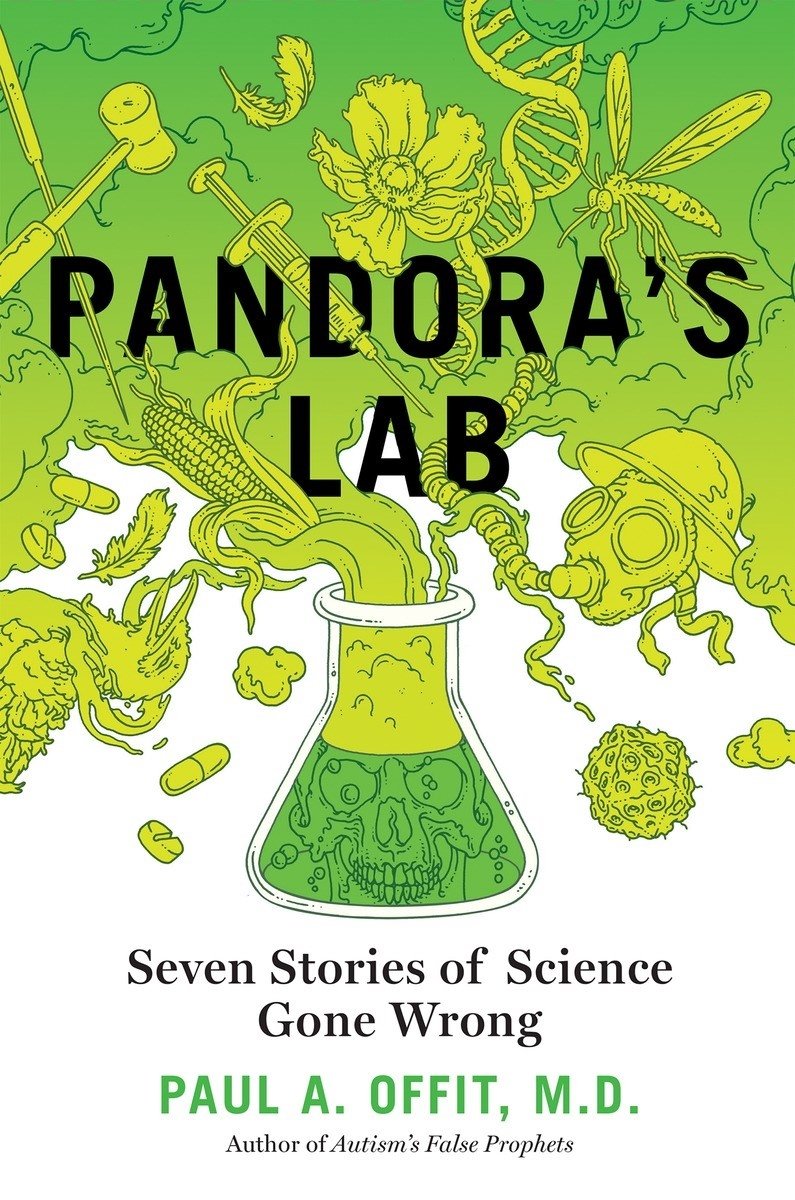
Pandora's Lab: Seven Stories of Science Gone Wrong
by Paul A. Offit, M.D.
Ch. 1: Opium
In 183 BC, Hannibal killed himself with opium. Emporer Claudius’s wife killed her stepson (Britannicus) with it so Nero could become emporer. In “wine mixed with gall” (Matthew 27:34), gall may have been opium.
From 1839 to 1860, China fought two “opium wars” with Britain; they lost, and one result was the British rule of Hong Kong.
“junkies” = opium addicts would often search for salable items in junkyards.
1853: Scottish doctor Alexander Wood invented the syringe. His wife became the first person to die from an intravenous drug overdose (of morphine).
morphine = the active part of opium. heroin = acetylated morphine, invented 1895 by the same guys who invented aspirin (for Bayer). Asperin was originally by prescription, but heroin was over-the-counter!
1924: Heroin declared illegal in the US. Became distributed by Jewish mobsters. The term “smack” for heroin comes from the Yiddish word “schmecher” (“addict”)
Withdrawal symptoms include gooseflesh (hence, “going cold turkey”) and leg spasms (“kicking the habit”). (The Wikipedia article on “Cold Turkey” confirms that this is the origin of these terms.)
Ch. 2: Margarine
Scientific data supporting a link between fat and heart disease was scanty, but a government committee under Senator George McGovern issued a report in 1977 saying Americans should limit fat intake to less than 30% of their total calories. AFTER issueing the report, they asked scientists for input, somewhat pointlessly. The recommendations became standard. Studies over the next 20 years found no link between dietary fat and heart health, but the standard advice from doctors was to limit saturated fat (e.g., butter, lard, coconut oil, cream, cheese, milk, fish oil, bacon, ground beef, …) So margarine became popular, but it was full of trans fats, which turn out to be MUCH worse for you.
The problem here is not that people ate trans fats before learning how unhealthy they are. That kind of thing is unavoidable. But the government gave a strong recommendation to limit fat intake based on no data. Later, they targeted saturated fat specifically, when the studies about that were conflicting. Those in leadership can be so anxious to provide an answer or to issue a proclamation that they don’t wait for the facts, and this is harmful.
Ch. 3: Synthetic fertilizer leads to war crimes
According to its subtitle, this book is about “Science Gone Wrong.” In the cases of opium and margarine, the experts pushed forward with an advancement that turned out to be very harmful. This chapter is different. It is not the advancement that was harmful but the morality of the scientist, Fritz Haber. It also shows how an advancement in one field can have unintended uses in another.
First, Haber invented a way to produce Nitrogen synthetically. Commercialized by BASF, this process produced fertilizer that meant much better crop yields.
(On the other hand, dumping chemicals from this process into the ocean has led to a “dead spot” in the Gulf of Mexico the size of New Jersey, as well as similar problems in other bodies of water. These are real problems, but they are not “Science Gone Wrong.”)
During WWI, Haber helped pioneer gassing enemy soldiers. The first use of chlorine gas (April 22, 1915 near Ypres, France) was known as “Operation Disinfection.” He died of a heart attack while Hitler was in power after suffering persecution for his Jewish heritage. A gas he helped manufacture for killing the body louse, hydrogen cyanide (HCN), was later used to gas Jews in concentraton camps.
Ch. 4: Trump is Racist
I do not think that Trump is a racist. But, this book was published in 2017, and therefore it is required by the Virtue Signaling Statute of 2016 that it depict Trump as a racist. So it starts with an oft-repeated quote that, out of context, makes it sound like Trump thinks all Mexicans are rapists and criminals.
The rest of the chapter is about eugenics, a term introduced in 1869 by Francis Galton. The idea of selectively “breeding” (or sterilizing) parts of the population to produce the best people possible was very popular for a while. Alexander Graham Bell headed a eugenics organization. H. G. Wells wrote, “We want fewer and better children… and we cannot make the social life and the world peace we are determined to make with the ill-bred, ill-trained swarms of inferior citizens that have been inflicted upon us.” Margaret Sanger founded the American Birth Control League and referred to some children as “human weeds.”
Even Theodore Roosevelt supported it. He wrote in 1913, “Some day we will realize that the prime duty of the good citizen of the right type is to leave his or her blood behind him in the world; and that we have no business to permit the perpetuation of citizens of the wrong type.”
Madison Grant’s book The Passing of the Great Race warned about the decline of Nordic European races. America began denying entrance to more immigrants. Then Hitler and Mengele.
The warning that ends the chapter is to “beware the zeitgeist.” He quotes Lillian Hellman: “I cannot and will not cut my conscience to fit this year’s fashions.” This is good advice. I think the Trump example (which he returns to at the end) is misplaced and makes a good chapter unnecessarily political.
Ch. 5: Lobotomies
Walter Freeman popularized the frontal lobotomy and invented the “icepick lobotomy,” which he performed using two icepicks in about 7 minutes. He ignored the negative impacts of his procedures, focusing only on the positive, and was able to convince many thousands of people to be lobotomized. He called his car “The Lobotomobile.” (Internet research says this claim is false: the car wasn’t refered to that way until at least a decade after his death, according to this: http://www.wondersandmarvels.com/2016/03/fighting-the-legend-of-the-lobotomobile.html)
The lesson of the chapter is “beware the quick fix.” I think there is also a lesson about seeking greatness. Walter Freeman had a famous surgeon father, and he wanted to match or eclipse his accomplishments, so he overlooked obvious problems with what he was doing.
Ch. 6: DDT
In the 60’s, a well-known science writer named Rachel Carson wrote a book called Silent Spring which said that the pesticide DDT was killing birds. The book was compelling and well-written. It looks like it wasn’t really true, but Nixon created the EPA and DDT was banned. Wikipedia still says banning DDT helped save the bald eagle and the peregrine falcon. Pandora’s Lab claims that counts of birds in areas sprayed with DDT were actually higher than before spraying, rather than being dramatically lower.
The downside here is that DDT is really good at killing mosquitos, lice, and other disease-carrying insects. It essentially eradicated malaria from America, but then we banned it before other countries could receive the same benefit.
Ch. 7: Nobel Price Disease
Linus Pauling is the only person to single-handedly win two Nobel prizes. But he also got sucked into quack vitamin mega-dose ideas. Mega-doses of vitamins do not cure cancer; in fact, they can cause it. He was unwilling to consider that he might be wrong, and this hubris led to his promoting large vitamin doses that can be harmful.
Final thoughts
This book shows how you can go wrong by trusting experts. But is the author expert enough to write authoritatively? In chapter 5, he wrongly claimed that Walter Freeman called his car the Lobotomobile. In the final chapter (ch 8) he writes that GMOs in foods are fine, contrary to people’s concerns, but why should I believe him? Is he an expert? On that topic, he leaves it at this: “Although many people fear that genetically modified foods might be more dangerous than other foods, careful scientific studies show they have no reason for concern.” How, after 200+ pages of experts not knowing what they are talking about, am I supposed to simply accept a statement like that?
In the end, I’m left feeling like no one is taking Truth seriously. Assertion doesn’t cut it, not if you’re Linus Pauling or Paul A. Offit, M.D.