Means of Ascent
February 21, 2020
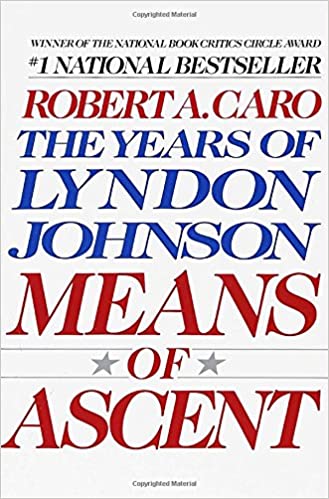
The Years of Lyndon Johnson, Volume 2: Means of Ascent
by Robert Caro
At the end of the last book, in 1941, LBJ came very close to winning/stealing a seat on the US Senate after a sitting Senator from Texas died. He and his opponents had both bought votes from certain counties. Near the end of the night, some of the bosses running those counties called LBJ and asked when they should report their numbers. He said they could report whenever, so they did it right then. But this gave his opponent, “Pappy” O’Daniel, information: he now knew how many votes he needed in order to win. So he had his counties report enough to win, and that’s how LBJ lost. McDaniel out-robbed him.
This meant that O’Daniel would finish the term, but there would be another election in 1942 for a full term, and Johnson planned to run again. Then came the attack on Pearl Harbor.
WWII, “find another plane”
He had loudly and repeatedly claimed he would join the troops if America entered the war, and now he had to. He skirted responsiblity for a while, becoming a Navy liaison. During this time, he had a photographer photograph him from many angles, trying to determine his best side and the best poses for him to strike (p. 25). He spent time with Alice Glass (now married to Charles Marsh). But eventually, he had to actually, sort of, go to war.
He was sent to a base in Australia as an observer, not a combatant (37). Although he was extremely averse to physical danger, he flew along on a mission, even though it had nothing to do with the Navy. He needed to be able to say he’d seen battle.
During a delay before takeoff, he got off his plane to urinate. When he came back, another man had taken his seat. He told Johnson to “find another plane,” (40) which he did. In the end, that plane would be shot down, and the man who took Johnson’s seat would die.
In the face of Japanese Zeroes shooting directly at them, Johnson was calm, looking directly toward the enemy planes and calling out their positions. Eventually, Gen. MacArthur awarded him the Silver Star for bravery; I couldn’t tell why, but maybe as a political act?
The Summer Lady Bird Read War and Peace
Ch. 4 (p. 54ff) is about Lady Bird. I liked the story on p. 59 about “the summer that Lady Bird read War and Peace.” Everyone at Longlea snickered at her for carrying around that massive book all summer. But at the end of the summer, she had read it, and they hadn’t. She often read the books they all talked about, not so she could talk about them, but so she could know what the books said. She did things to improve herself for her own sake, not in order to look more impressive.
When, during the loud arguments to which she sat silently listening [at Longlea], a book would be cited, Lady Bird would, on her return to Washington, check it out of the public library. One was _Mein Kampf_, which Charles Marsh had read, and to which he was continually referring. She read it, and while she never talked about the book at Longlea, when Hitler's theories were discussed thereafter, she was aware that, while Marsh knew what he was talking about, no one else in the room did -- except her. (59)

LBJ did not relinquish his congressional seat upon joining the Navy. Lady Bird took over his duties. Given her shyness, this seems crazy, but she rose to the occasion, and she accomplished with kindness what he could only accomplish with unrelenting bossy badgering.
Buying KTBC in Austin
Ch. 6 first reviews Johnson’s history with money. He needed it, wanted lots of it, but would not allow greed to interfere with his “path to power.” In 1940, he had turned down a free partnership in an oil company, something that would have freed him from financial worries, because having oil interestes “would kill me politically.” His ambitions even then were not just for the Senate (where a man from Texas with oil interests could get elected) but clearly for the Presidency. He wouldn’t jeopardize that.
Now, the war interfered with his plans. He couldn’t get a good war appointment, so he found a way to make money in the meantime. He bought KTBC, a struggling radio station in Austin.
“Because KTBC was purchased in his wife’s name, and she became president of the company and was activig in its affairs, LBJ was able to maintain for the rest of his life that the company, which was eventually to consist of a galaxy of radio and television stations, was not his bet hers – all hers and only hers.” (88)
I have heard this mentioned when people outline Lady Bird’s accomplishments, but the financial success of the station was largely due to LBJ’s backroom deals. He became close with the FCC administrators in order to get Lady Bird’s application to purchase the station approved. Other potential buyers, who had already applied, had no luck for years, but her application got approved in 3 weeks.
Furthermore, “everyone knew that a good way to get Lyndon to help you with government contracts was to advertise over his radio station.” (103) A company that made power saws, for example, paid for a half-hour show on the station 6 days a week. This was not to attract business in Austin; they didn’t do much business in Austin or want to. But it enabled the company to sell saws to the Army and Navy, with Johnson’s help!
Senate Election, 1948
As he was making money in radio, he was losing power in Congress, getting further from the Presidency particularly when FDR died (4/12/45). The rest of the 40s were depressed years for him, until 1948, when he decided to run for Senate in Texas. This was a huge risk. Texas law prohibited running for two offices in the same election, so he would not be able to keep his current congressional seat. It was Senate or bust.
He’d be running against Pappy O’Daniel (the flour-mill owner who beat him for the Senate seat at the end of Path to Power), but Pappy’s popularity was waning. But then he learned that Coke Stevenson, the most popular Governor in Texas’s history, a living legend, was going to run as well. (141)
Coke Stevenson (ch. 8)
Born into poverty, Coke spent his teenage years hauling freight across the rough country between Junction and Brady in the hill country west of Austin, fording seven streams on each trip. By the campfire at night, he studied bookkeeping from textbooks he had written away for. “The courage and ambition which had brought the boy out into the emptiness symbolizes the legend of the West. Indeed, Coke Stevenson’s whole life was the raw material out of which that legend is made.” (146)
He became a rancher, rising in the wee hours to read (4am! See p. 178) for a while before setting about a day’s work. But he was repeatedly pressed by others (mainly his wife) into politics, because they believed he was a great man. He loved the Constitution and limited government.
Men who went hunting with him learned that behind that stolid exterior was a sense of humor. Some of Coke's "gags" would, in fact, become staples of Austin lore. During a hunting trip with several fellow legislators and a lobbyist, for example, a rancher, an old friend, called Stevenson aside and told him that in one of the back pastures where the men were to hunt was an aged horse--an old family pet--so infirm that it should be destroyed. The rancher asked Stevenson to do it for him. Stevenson agreed. As the hunters' car was passing teh horse, he asked teh driver to stop, and got out.
"I think I'll just kill that ol' horse," he said, and, taking aim, shot it in the head.
His companions, unaware of the rancher's request, stared in amazement. "Why did you shoot that horse?" the lobbyist finally asked.
"I just always wondered what it would feel like to shoot a horse," Stevenson drawled. Pausing, he stared hard at the lobbyist. "Now I'm wondering what it would feel like to shoot a man."
Although he hated politics, he rose to Speaker of the House in Texas and eventually Governor. His campaigns were not pushy – he never even asked for people to vote for him. He drove around and gave speeches, but his car didn’t have so much as a bumper sticker on it promoting himself. He never replied to criticisms from other candidates. Texans loved him, to the point that he was known as Mr. Texas.
After being Governor, he did not plan to return to politics. But his wife Fay died, and he was lonely, alone on his ranch. With prodding from friends, he announced on Jan 1, 1948 that he would enter the Senate race.
The rest of the book (ch. 9 on) is about that Senate race.
Kidney Stone
Johnson had a terrible kidney stone, and everyone told him to get an operation to remove it, since it wasn’t passing on its own. He refused to give up campaigning, even when he could barely stand up. When he finally went to a hospital, he concealed his identity and continued saying “I’ll pass it,” rather than undergoing a procedure to remove the stone.
The key moment was on p. 202. Johnson believed his campaign would be over if people found out he was in a hospital. He ordered absolute secrecy, but his aide John Connally told the press. Johnson thought he was finished, so he ordered his other aid, Woodward, to call some Dallas newspapers and read a statement he dictated, withdrawing from the race. “Can you imagine what would have happened if I had done that?” Woodward would later say. Instead, he convinced Johnson to “wait until Mrs. Johnson gets here.” In the end, he would lose two weeks of campaign time, be treated at the Mayo clinic (where the stone was removed via “cystoscopic manipulation” without surgery), and miss the deadline to file to run for his congressional seat. “It was going to be the Senate, or nothing.” (208)
The Flying Windmill
Facing such a formidable opponent, Johnson made the obvious choice. He got a helicopter.
He flew the helicopter all over Texas, circling a landing area until a crowd gathered, then landing and giving a speech. He called it “The Johnson City Windmill,” and it got him a lot of attention.
At the same time, he spread rumors that Coke Stevenson had made a back-room deal with the labor unions, something he would never do. This was preposterous, but Stevenson’s character would not allow him to respond to such a charge. He felt that Texans knew him and knew his record, and that’s where the conversation should end (see p. 267). But with Johnson’s nearly endless stream of money and press connections, he was able to make the accusation stick in the minds of voters.
The Election
It’s too much to go back through all the details of the election. What it came down to was this: Johnson bought votes from people like George Parr of Duval County (“The Duke of Duval”). He did not repeat the mistake he made when running against Pappy O’Daniel (at the end of The Path to Power); he had Parr report vote counts only after he knew how many votes he needed. And when it turned out that he needed more, they would just call in and ammend their counts. The crucial ballot box was from Precinct 13, and when Stevenson’s attorneys showed up wanting to see it (323), they were rebuffed. They had the law on their side, but Parr’s man simply refused to unlock the vault for them.
So, Stevenson enlisted Frank Hamer, a friend of his and possibly the most famous Texas Ranger alive. Hamer had been responsible for bringing down Bonnie and Clyde. He’d killed 53 men and been wounded 17 times. He strapped on a gun and accompanied Stevenson to the Valley, to the town of Alice, where Precinct 13 was.
Entering town, George Parr’s pistoleros tried to intimidate, but Hamer basically ignored them, and they walked into the bank where the ballot box was being held. Now the attorneys were briefly allowed to see the voting lists – to briefly to learn much, but they did notice something odd: The last 201 voters all had the same handwriting, and their names were in alphabetical order!
There were a lot of courthouse machinations, and Johnson came very close to getting caught, but in the end, the vote stood. He won by 87 votes.
In 1986, Robert Caro tracked down Luis Salas, who had been Parr’s “enforcer” (187) in Alice, TX. Salas had actually written down an account of all of this (called “Box 13”), which he shared with Caro (390). It confirms what was already obvious: that the Senate election was stolen.
If there is a happy ending to this story, it is for Coke Stevenson. He met a woman known as “Teeney,” much younger than himself, and they fell in love and were married. He had a daughter, Jane. When Jane became a teenager, he finally had a telephone installed at his ranch, because, “Well, you know how teenagers are.” (407) It’s clear that his latter years were full of life and happiness.