The Innocent Anthropologist
December 19, 2020
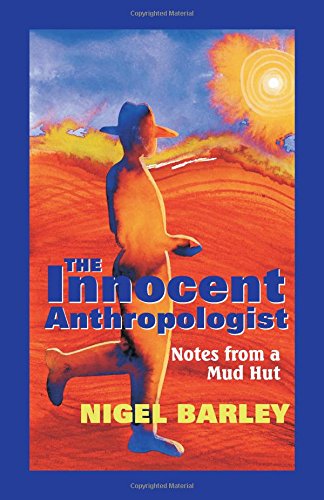
The Innocent Anthropologist
by Nigel Barley
Along with The Long Ships, this was recommended by Michael Lewis on the Tim Ferris podcast. The book is absolutely delightful. I’d place it alongside My Family and Other Animals and Last Chance to See. I sometimes mark passages in a book because they are especially interesting or funny, but this is one of the rare cases where I had to raise my standards, or I’d be marking the entire book.
The author goes to Cameroon to study a tribe called the Dowayo. Initially, many pages describe the process of travelling there. “Air Cameroon regarded all customers as a confounded nuisance. I did not realize at that time that this was the way all government monopolies are run in Cameroon and put it down to language difficulties.” (15) He has a hard time convincing various officials that he’s not a spy from Nigeria or some kind of smuggler. “The basic difficulty here … is explaining why the British government should find it worth while to pay its young people fairly large sums of money to go off to desolate parts of the world purportedly to study peoples who are locally notorious for their ignorance and backwardness.” (16)
Beaurocracy
Dealing with beaurocracy is a theme in the book. On the advice of some missionaries, he goes to register with the local police in N’gaoundere, a city near his destination. When the commandant arrives, he inspects all of Nigel’s documents, his research permit, etc. He asks, “What is your reason for being here?”
He was clearly very unhappy as I tried to expound the essential nature of the anthropological endeavor. "But what's it for?" he asked. Choosing between giving an impromptu version of the "Introduction to Anthropology" lecture course and something less full, I replied somewhat lamely, "It's my job." Subsequently, I came to realize what a highly satisfactory explanation this was to an official who spent most of his life in pointlessly enforcing rules that seemed an end in themselves. (38)

[In the face of a days-long wait on some paperwork:] A sort of calm fatalism had settled upon me. Things would take as long as they took; there was no point in worrying about it. It is one of the marks of the fieldworker that he has a supplementary gear into which he can shift at such moments and let the slings and arrows do their worst. (42)
This same “fatalism” helped in fieldwork, where the pace of Dowayo life meant constant long delays. NB would “drop into ‘fieldwork gear,’ a state almost of suspended animation where one is able to wait for hours without impatience, frustration, or expectation of anything better.” (85) And later, “The fieldworker can never hope to maintain a good rate of work for very long. In my time in Africa, I estimated that I perhaps spent one percent of my time doing what I had actually gone for. The rest of the time was spent on logistics, being ill, being sociable, arranging things, getting from place to place, and above all, waiting. I had defied the local gods with my intemperate urge to do something. I would soon be cut down to size.” (98)
Western views
Missionaries: “Young anthropologists know all about missionaries before they’ve met any. They play a large role in the demonology of the subject… Missions destroy traditional cultures and self-respect, reducing peoples all over the globe to the state of helpless, baffled morons living on charity and in economic and cultural thraldom to the West.” (28) These are the views he arrives with, but he found the actual missionaries there to not be “rampant cultural imperialists” but to be favorable to anthropology as a “remedy against unfortunate cultural misunderstandings.” He eventually has a very good relationship with several missionaries.
Relations between the rich and the poor:
Being seen checking the fuel level [on one's car] is enough to trigger a barrage of requests for transport. To refuse is held to be inadmissible. Those who reproach Europeans with paternalism fail totally to perceive the relations that traditionally exist between rich and poor in much of Africa. A man who works for you is not just an employee; you are his patron. It is an open-ended relationship. If his wie is ill, that is as much your problem as his an you will be expected to do all in your power to heal her. If you decide to throw anything away, he must be given first refusal on it. To give it to someone else would be most improper. It is almost impossible to draw a line between what is your concern and what is his private life. The unwary European will get caught up in the vast range of loose kinship obligations, unless he is very lucky indeed. (40)
Being accepted:
People talk about “being accepted” as one of the tribe, but this is unlikely. “The best one can probably hope for is to be viewed as a harmless idiot who brings certain advantages to the village,” like money and employment. “I had disadvantages. I attracted outsiders to the village, which was bad. I would fatigue my hosts with foolish questions and refuse to understand their answers. There was danger that I would repeat things I had heard and seen. I was a constant source of social embarrassment.” (56)
News
News was “a concept almost entirely alien to a seemingly timeless Dowayoland.” (143)
Bats
Much has been written on the excellence of bats' navigation equipment. It is all false. Tropical bats spend their entire time flying into obstacles with a horrible thudding noise. They specialize in slamming into walls and falling, fluttering into your face. As my own "piece of equipment essential for the field," I would strongly recommend a tennis racket; it is devastatingly effective in clearing a room of bats. (50)
Beer
“Millet beer has been described by an imminent French colonial official as having the consistency of pea soup and the taste of paraffin. The description is accurate.” (64)
Circumcision
Dowayo beliefs involve circumcision, but women are not supposed to know about it. Women “are told that it involves an operation to seal the anus with a piece of cattle-hide.” (75) So Dowayo men have to wait until the coast is clear if they ever need to relieve themselves.
Food, living with nature
Dowayos do not normally eat eggs; they regard the idea as mildly disgusting. "Don't you know where they come from?" they would ask. (60)
[At a restaurant in Garoua,] I was brought a cow's foot in a large enamel bowl of hot water. When I say "cow's foot," I do not mean something based upon a cow's foot, but the entire article complete with hoof, hide and hair. Try as I might, there seemed no way of even getting into it. I declared a sudden loss of appetite. Augustin seized it and reduced it to bones with the dedication of a swarm of driver ants. (100)
As far as 'living in harmony with nature' is concerned, the Dowayos are non-starters. They reproached me often for not bringing a machine gun from the land of the white men to enable them to finally eradicate the pathetic clusters of antelope that still persist in their country. (95)
[A Frenchman he met in Cameroon] was an enthusiastic taxidermist and specialized in the stuffing of pangolins (scaly ant-eaters). These, it seems, are extraordinarily difficult beasts to kill and he was always experimenting in new ways of doing them to death. It was not unusual to find the bath full of remarkably lively pangolins that he had purportedly just drowned, or the lid being forced off the freezer by pangolins he had "frozen to death." (119)
Photographs
To help him learn the Dowayo names for various animals, NB gets some postcards with pictures of African fauna. It turned out that the Dowayo people could not spot the difference between a picture of a lion and one of a leopard, for example. “They could not identify photographs. It is a fact that we tend to forget in the West that people have to learn to be able to see photographs. We are exposed to them from birth so that, for us, there is no difficulty in identifying faces or objects from all sorts of angles, in different light and even with distorting lenses. Dowayos have no such tradition of visual art…” (96) “Old men would stare at the cards, which were perfectly clear, turn them in all manner of directions, and then say something like, ‘I do not know this man.’”
The Dentist
“It is a bad Western habit to assume that because a road goes into a corner, it will continue round the other side.” (99) Chapter 8 starts with NB and an African named Augustin tried to drive to Garoua for supplies and ended up driving around a corner and into a rut that broke their car. Having gotten it repaired later that day, they were driving it home when the stearing failed and they drove right over the edge of a ravine. (I remember this being a forty foot drop, but I can’t find that detail in the book now, so I may have invented it.)
“A sappling caught us neatly and gradually collapsed under the weight.” In a calm shock, they evacuated the vehicle with no major injuries – maybe a couple of fractured fingers and toes and some bruised ribs. NB’s jaw and teeth were injured and became infected. After a while, he realized he would need to see a dentist. He headed back to Garoua and found one of the only two in Cameroon. Being propelled by waiting Africans to the front of the line, he saw “a large diploma from the University of Lyons, which reassured me somewhat.”
I explained the problem to a huge man inside. Without more ado, he seized a pair of pliers and pulled out my two front teeth. The unexpectedness of the attack somewhat dulled my senses to the pain of extraction. The teeth, he declared, were rotten. He had removed them. I was cured. I should pay the nurse outside. I sat blankly in the chair, blood gushing down my shirtfront, and tried [to speak French with two missing teeth.] Very well, he declared huffily, if I was not content with his treatment, he would bring the dentist himself. He disappeared, leaving me wondering who had just operated upon me. (110)
The dentist made him some dentures, gave him a shot of novacaine for some reason, and gave him a liquid to gargle with. The infection did get better, but he ended up getting hepatitis from the novacaine needle!
I have recounted this story to people a number of times since reading it. Now looking back at the book, it’s interesting how many details I changed unintentionally to make the story work better. The facts of it are great, but when I tell it, he drives around the corner and straight into the ravine; now I see that those were separate events. And there are some other minor changes.
The Garden
I won’t type up the whole story of his garden (pp. 147-149), but it’s pretty funny. In short, the Dowayos were “appalled when I attempted the smallest act of physical labour.” When he wanted to plant a small garden using some seeds sent from England, they insisted that he hire a gardener to do the work for him. He gave the man the seeds and suggested trying a few of each to see what would grow well here. Then he sort of forgot about it for a while. The man did extensive work hauling good soil into a steep area by a river. He arrived one day and said the garden was ready. When Nigel went to see it, he found that he had 3000 heads of lettuce. All were planted at the same time, so they were all ready right then. He sent lettuce everywhere (the mission, to the government at Poli, etc.) but still much of it rotted.
Racism
Even educated Africans find themselves unable to accept that it is possible to be both black and a racist, though they still posess what we would call slaves and spit on the floor to clean their mouths after muttering the mere name of Dowayos. (151)
Leaving
A wave, a crunch of gears and I drove away from the mountains where I had spent so many months in so off a pursuit. Every parting leaves an empty feeling, a slight touch of cosmic loneliness. It is hard not to begin at once forgetting that fieldwork consists largely of intense boredom, loneliness and mental and physical disintegration. A golden haze descends, the savages become more noble, the ritual more stirring, the past is restructured as leading inexorably to some great purpose of the present. It is only by reference to the diary I kept that I now know that my feeling was primarily one of hystical joy to be done with Dowayoland. (181)
Time
One of the least appreciated differences between an African village and a European city is the passage of time. To one used to the regular pulse of farming life, where one thinks in seasons and the days have no names, urban dwellers seem to flash past in a frenzy of frustrated endeavour. I paced the streets of Rome like a Dowayo sorcerer whose unearthly slowness sets off his ritual role from everyday activities. Cafe menus offered so many possibilities that I felt unable to cope: the absence of choice in Dowayoland had led to a total inability to make decisions. In the field, I had dreamed endlessly of orgiastic eating; now I lived on ham sandwiches. (184)
A paradox that has much exercised mathematicians is that of the Einsteinian space traveller. Having journeyed at great speed for several months around the universe, he returns to Earth to find that whole decades have passed. The anthropological traveller is in the reverse position. He goes away for what seems an inordinately long period to other worlds, ponders cosmic problems, ages greatly. When he returns, only a few months have elapsed. The acorn he planted has not become a great tree; it has scarcely had time to put forth a tentative shoot. His children have not grown to adulthood; only his closest friends have noticed he has been away at all. (187)