For Lancelot Andrewes
February 12, 2020
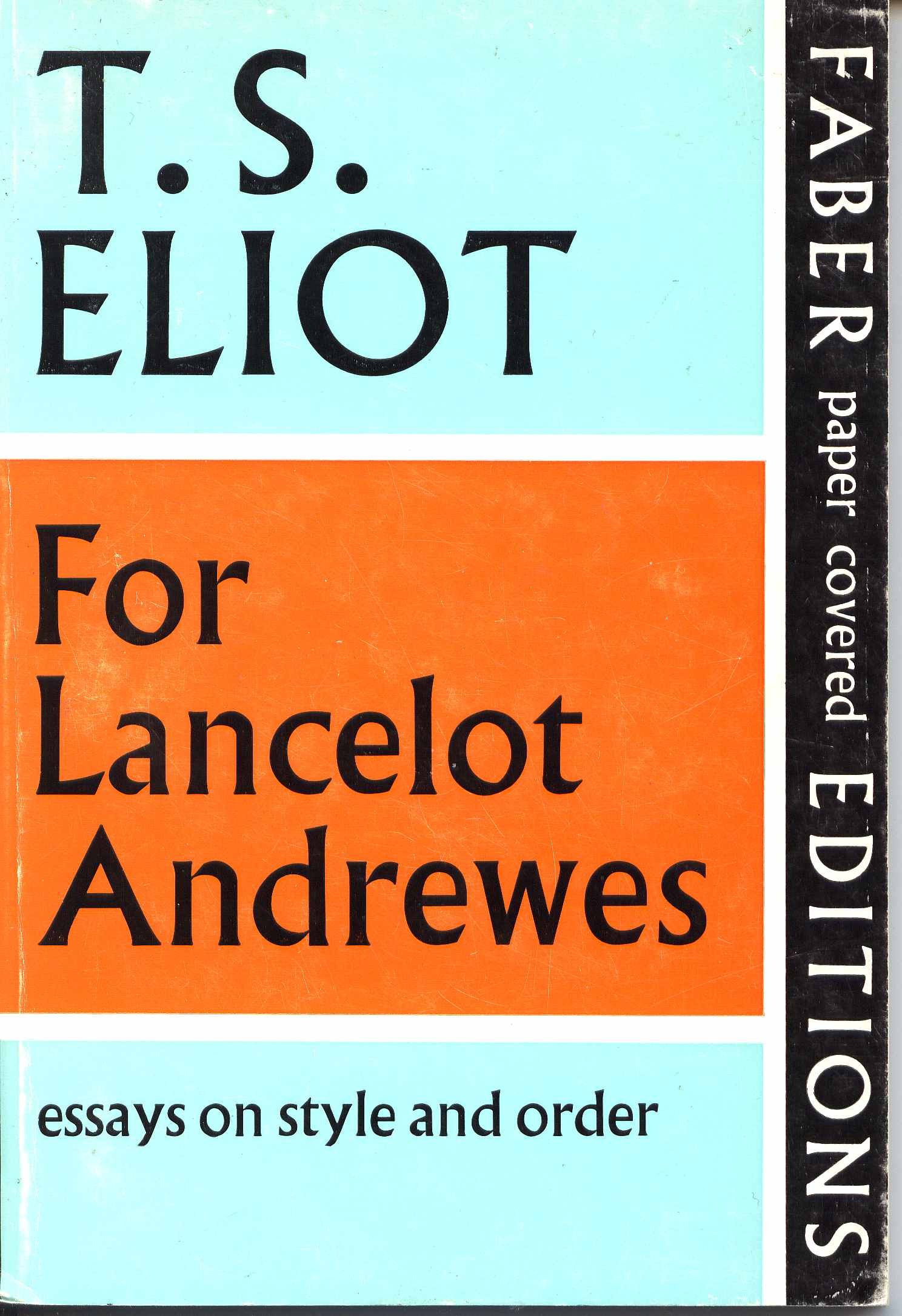
For Lancelot Andrewes
by T. S. Eliot
My second inter-library loan book!
T. S. Eliot published this book in 1928, the year after he was baptized at the age of thirty-nine.
Lancelot Andrewes
Andrewes was one of the translators of the King James Bible. The king named him Director of the First Company, the group which translated Genesis through 2 Kings. Many of his sermons can still be found, including “Seventeen Sermons on the Nativity,” a collection of Christmas sermons preached before King James between 1605 and 1624.
Eliot notes 3 qualities of LA’s style:
- ordonnance (arrangement and structure)
- precision in the use of words
- relevant intensity
He compares him to Donne, whose sermons were better known because he was a “religious spellbinder” lacking spiritual discipline. “Bishop Andrewes is one of the community of the born spiritual, one che in questo mondo, contemplando, gusto di quella pace.” (“one who living in the world, through contemplation, tasted of that peace.” This is from Paradiso XXXI.110-111, not that TSE tells you even that much, let alone what the Italian means! Were people in 1927 so educated that they didn’t require even a citation for this?)
LA “is said to have passed nearly five hours a day in prayer.”
Bishop Andrewes ... tried to confine himself in his sermons to the elucidation of what he considered essential in dogma; he said himself that in sixteen years he had never alluded to the question of predestination, to which the Puritans, following their Continental brethren, attached so much importance. The Incarnation was to him an essential dogma, and we are able to compare seventeen developments of the same idea. Reading Andrewes on such a theme is like listening to a great Hellenist expounding a text of the Posterior Analytics: altering the punctuation, inserting or removing a comma or a semicolon to make an obscure passage suddenly luminous, dwelling on a single word, comparing its use in its nearer and in its most remote contexts, purifying a disturbed or cryptic lecture note into lucid profundity. To persons whose minds are habituated to feed on the vague jargon of our time, when we have a vocabulary for everything and exact ideas about nothing - when a word half-understood, torn from its place in some alien or half-formed science, as of psychology, conceals from both writer and reader the meaninglessness of a statement, when all dogma is in doubt except the dogmas of sciences of which we have read in the newspapers, when the language of theology itself, under the influence of an undisciplined mysticism of popular philosophy, tends to become a language of tergiversation [evasion of straightforward action or clear-cut statement] - Andrewes may seem pedantic and verbal. It is only when we have saturated ourselves in his prose, followed the movement of his thought, that we find his examination of words terminating in the ecstasy of assent. Andrewes takes a word and derives the world from it; squeezing and squeezing the word until it yields a full juice of meaning which we should never have supposed any word to possess. In this process the qualities which we have mentioned, of ordonnance and precision, are exercised.

John Bramhall
Bramhall was an Anglican theologian who TSE pits against Hobbes. He says “Hobbes was undoubtedly an atheist” but was not “willing to sacrifice his worldly prospects for the sake of establishing consistency in his argument.” He considers Bramhall to walk the via media in establishing a position on Church and State and the divine right of Kings, recommending Just Vindication of the English Church (which I did find online, although poorly OCRed).
Hobbes shows considerable ingenuity and determination in his attempt to carry out his theory of the Will rigorously to explain the whole and every aspect of human behaviour. It is certain that in the end he lands himself in sophistries. But at the time of Hobbes and Bramhall, and indeed ever since until recently, it was impossible that a controversy on this subject should keep to the point. For a philosopher like Hobbes has already a mixed attitude, partly philosophic and partly scientific, the philosophy being in decay and the science immature. Hobbes's philosophy is not so much a philosophy as it is an adumbration [outline] of the universe of material atoms regulated by laws of motion which formed the scientific view of the world from Newton to Einstein. Hence there is quite naturally no place in Hobbes's universe for the human will; what he failed to see is that there is no place in it for consciousness either, or for human beings. So his only philosophical theory is a theory of sense perception, and his psychology leaves no place in the world for this theory of government. His theory of government has no philosophic basis: it is merely a collection of discreet opinions, prejudices, and genuine reflections upon experience which are given a spurious unity by a shadowy metaphysic.
Niccolo Machiavelli
TSE says Machiavelli has always been misunderstood. He was “a retired, inoffensive, quiet Florentine patriot occupied with chopping trees and conversing with peasants on his meagre estate.” And “no great man has been so completely misunderstood.”
His concern is chiefly patriotic, seeking for a united Italy. “His first thought always is for peace an prosperity and the happiness of the governed; but he knows quite well that this happiness does not reside merely in peace and wealth. It depends upon, and in turn supports, the virtue of the citizens. Civic virtue cannot exist without a measure of liberty, and he is constantly concerned with what relative liberty is obtainable.”
“As for M’s ‘personal’ religion, it seems to have been as genuine and sincere as that of any man who is not a specialist in devotion but intensely a specialist in statesmanship; and he died with the ministrations of a priest about him.”
“It is easy to admire M in a sentimental way. It is only ofe of the sentimental and histrionic poses of human nature … to pose as a ‘realist,’ a person of ’no nonsense,’ to admire the ‘brutal frankness’ or the ‘cynacism’ of M.” His cynacism is, according to Eliot, actually due to a genuine belief in original sin. “What M did not see about human nature is the myth of human goodness which for liberal thought replaces the belief in Divine Grace.”
“No one was ever less ‘Machiavellian’ than Machiavelli.”
Francis Herbert Bradley
F. H. Bradley was a British philosopher who wrote around the end of the 19th century.
In philosophical combat, “we must know in advance, if we are prepared for conflict, that the combat may have truces but never a peace.”
If we take the widest and wisest view of a Cause, there is no such thing as a Lost Cause because there is no such thing as a Gained Cause. We fight for lost causes because we know that our defeat and dismay may be the preface to our successor's victory, though that victory itself will be temporary; we fight rather to keep something alive than in the expectation that anything will triumph.
A pattern emerges in these essays. Eliot compares a lesser-known thinker to someone more popular, then describes the virtues of the lesser-known, which are usually first clarity and precision of language, and ultimately wisdom. Since clear language tends to lead to clear thinking, it makes sense that the writers Eliot admires for their wisdom would also be admired for their diction, and I take that to be the main point of this book, whether he compares Lancelot Andrewes to John Donne, Bramhall to Hobbes, or in this case Bradley to Matthew Arnold (an English poet and cultural critic with enormous sideburns). In this case, Eliot notes that Bradley had a “scrupulous respect for words,” as well as wisdom based on common sense.
From page 79, “Wisdom consists largely of scepticism and uncynical disillusion… [which] are a useful equipment for religious understanding.”
Bradley calls out Arnold in this quote for his Ethical Studies:
"Is there a God?" asks the reader. "Oh yes," replies Mr. Arnold, "and I can verify him in experience." "And what is he then?" cries the reader. "Be virtuous, and as a rule you will be happy," is the answer. "Well, and God?" "That is God," says Mr. Arnold; "there is no deception, and what more do you want?" I suppose we do want a good deal more. Most of us, cretainly the public which Mr. Arnold addresses, want something they can worship; and they will not find that in an hypostasised copy-book heading, which is not much more adorable than "Honesty is the best policy," or "Handsome is as handsome does," or various other edifying maxims, which have not yet come to an apotheosis.
In another passage, Bradley concludes a look at Arnold’s philosophical writing with this: “Here again we must not be ashamed to say that we fail to understand what any one of these phrases means, and suspect ourselves once more to be on the scent of clap-trap.”
I haven’t read anything by Arnold or Bradley, but these sentiments resonate. The idea that a statement like, “Be virtuous, etc.” is God is the sort of thing that sounds good in the head of a high school sophomore but should be worked out before he graduates. Much of philosophy seems weighed down by so much vernacular that it’s difficult to believe a cogent and helpful (or at least correct) idea lays at the center. It is better to recognize “clap-trap” and move on without wasting one’s time.
Bradley’s wisdom comes, in part, because he “could never be deceived by his own metaphores.” If he ever had the thought that an aphorism is God, metaphorically, he wouldn’t fool himself into believing it literally.
Finally, one more quote from Bradley:
As we turned towards the dawn, we sighed over poor Hegel, who had read neither Goethe nor Homer, nor the Old and New Testaments, nor any of the literature which has gone to form "culture," but, knowing no facts, and reading no books, nor ever asking himself "such a tyro's question as what being really was," sat spinning out of his head those foolish logomachies which impose on no person of refinement.
“tyro” = “beginner, novice”
“logomachy” = a dispute over words
The full text of Brandley’s Ethical Studies is on the Internet Archive, or I have copied to content here.
Baudelaire, Thomas Middleton, Richard Crashaw, Irving Babbitt
I read these but don’t have much to say about them. The most interesting was Babbitt, who apparently tried to separate humanism from religion, which TSE did not think worked out well as a philosophy.
Babbitt wrote, “It has been the constant experience of man in all ages that mere rationalism leaves him unsatisfied. Man craves in some sense or other of the word an enthusiasm that will lift him out of his merely rational self.”
About which TSE writes, “But it is not clear that Mr. Babbitt has any other enthusiasm to offer except the enthusiasm for being lifted out of one’s merely rational self by some enthusiasm.”