Celine Dion's Let's Talk About Love: A Journey to the End of Taste
October 2, 2020
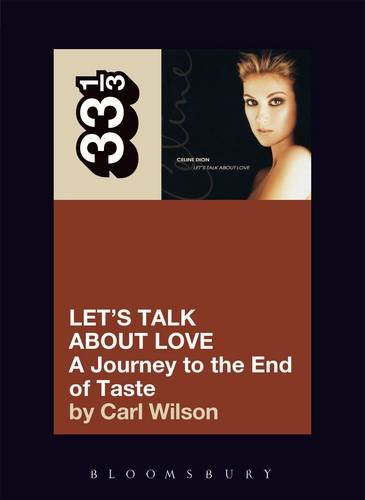
I listened to this as an audiobook, so I couldn’t mark key passages easily. Since I’m writing this a couple of months after reading the book, I’m left with only vague impressions and a couple of noteworthy ideas.
He delves into the nature of schmaltz. It’s “sentimental, kitsch, phony, exaggerated, manipulative, self-indulgent, hypocritical, cheap and clichéd” (to borrow a list of words from an article in The New Yorker). The word shmaltz comes from Yiddish and means “to melt.” Sinatra, Bing Crosby, etc. He notes that hair metal bands can also be overly sentimental (think, “Every Rose Has It’s Thorn”) – they are basically schmaltzy like Celine, just using a different musical style.
Lots of people like CD’s music. How is this possible? Flipping the question, why is the music so distasteful to most taste-makers and critics? “Artistic taste is most competitive among people whose main asset is cultural capital… In adult life, it’s only in culture-centered fields (the arts, academia) that musical or other culture-centered taste matters the way it does in high school.” So maybe music critics are still basically living in high school and trying to seem cool. (In that case, am I also still living in high school?)
Online reviews helped me remember a few things, and I will now steal quotes from those reviews as follows:
Punk, metal, even social-justice rock like U2 or Rage Against the Machine, with their emphatic slogans or individuality and independence, are as much “inspirational” as Céline’s music is, but for different subcultural groups. They are just as one-sided and unsubtle.

The bias that “conformity” is a pejorative has led, I think, to underestimating the part mimesis – imitation – plays in taste. It’s always other people following crowds, whereas my own taste reflects my specialness. (cf. the part in Talking to Strangers about the experiment where people fill in missing letters to form words.)
Double-standards arise everywhere for sentimental music: excess, formulaism, two-dimensionality can all be positives for music that is not gentle and conciliatory, but infuriated and rebellious. You could say punk rock is anger’s schmaltz.
(This quote comes from here.) Wilson pressed forward with his experiment. He met Celine’s fans, including a man named Sophoan, who was as different from Wilson as possible. He is sweet-natured and loves contemporary Christian music, as well as the winners of various international Idol competitions. “I’m on the phone to a parallel universe,” Wilson mused about their first phone conversation. But by the end of it, he genuinely likes Sophoan, and he is starting to question his own tastes. “I like him so much that for a long moment, his taste seems superior,” Wilson concludes. “What was the point again of all that nasty, life-negating crap I like?”