Redshirts
October 18, 2019
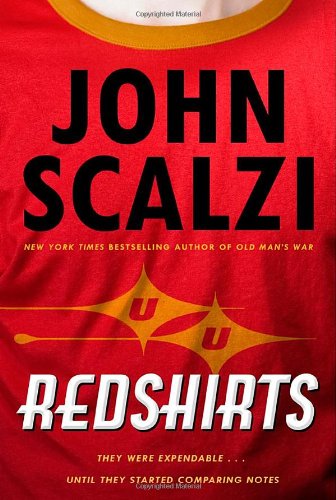
Redshirts
by John Scalzi
Curt wanted me to read this so I could tell him if he liked it or not. Having just finished it, I can say that I understand why that’s a conundrum.
Early on, I thought it seemed fun, but the writing was a little sloppy. When the characters are first getting to know each other, they have conversations (“Can I ask you a personal question?”, p. 22) that just wouldn’t happen like that in real life. The “good with my tongue” line on p. 20 reminded me of the Friends “Christmas lookie/cookie” joke – very forced.
After the first 30 pages or so, the writing seemed better, though, and I thought the revelation of their situation was well-paced and intriguing. I had guessed the general premise based on the book’s title, but it’s a good premise. I enjoyed watching the characters try things (drugging Duvall, e.g.) to figure out the extent of their free agency.
Eventually, they went back in time, and I noticed that from p. 200 onward, things seem to go a little too smoothly. No real setbacks, just a complicated situation and plan. Everyone basically believes their insane (though true) story. It felt like a roller coaster: exciting, but you know it’s all going to be fine.
The payoff of Dahl realizing he’s in a book (sort of) at p. 227 was cool. Although the possibility of a meta-narrative like that had occurred to me, I definitely wasn’t expecting it when I got there, and I thought it was well done.
Then, with the story told, there are three codas, which are basically writing exercises. Coda I: one of the writers for Chronicles of the Intrepid writes a blog explaining the situation and gets doxed by Gawker. Coda II: The story of Matthew Paulsen (who had been in a vegatative coma but is saved by the Intrepid crew’s time-traveling shenanigans) realizing that something is fishy about his recovery. Coda III: The story of an actress who learned about her character’s marriage, then meets up with the actor who played her husband (and wrote the blog in Coda I), and romance blossoms.
The codas are okay. Each of them is well-written and interesting. They don’t really match the tone of the story, though. I ended up skimming long parts of them.
Imagine you made a broad, campy war movie set in WWII, with a bunch of silly Nazis doing exagerated goose steps and running into each other. And then, you tacked on a scene about a Jewish family, hiding and worried that they are about to be murdered – something very serious. It would be jarring, and as an audience member, I would feel like you didn’t earn the right to talk about that with me.
Matthew Paulsen’s new lease on life (Coda II) feels a little like that. And Samantha (Coda III) burning printed pics of her Intrepid counterpart and scattering them on the water might be touching if death had been more than a punchline in the first 2/3 of the book. (That’s not entirely fair. The characters did take death seriously, but it remained somewhat comical, since it was associated with underlying bad sci-fi TV writing).
I enjoyed the first 200 pages of this book quite a bit. If you ignore the codas, that’s 87% of the book, so I think I can honestly say I enjoyed it.