The Gulag Archipelago
June 14, 2019
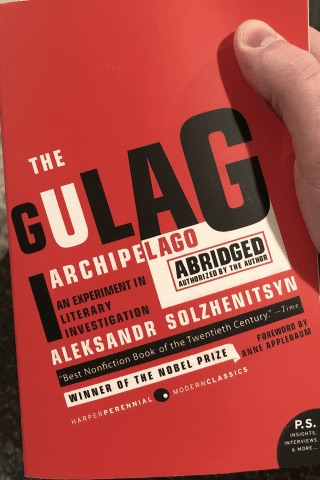
The Gulag Archipelago: An Experiment in Literary Investigation
by Aleksandr Solzhenitsyn
I started this in January, so it took me about 6 months to finish, but it was worth the effort. Last year I began writing in my books, so I have notes penciled or lines underlined in this one, and I am going to transcribe the ones that still seem worth recording. I tried to look up words I didn’t know, so here are some of those to start with:
Vocab
- samizdat: clandestine copies of literature banned by the state
- zek: slang for inmate
- Black Marias: vehicles for transporting prisoners
- kulak: Russian peasant wealthy enough to own a farm. They resisted Stalin's forced collectivization. (26)
- atavism: reverting to the ancient/ancestral (40)
- autos-da-fé: burning heretics (40)
I’m shortening some of these quotes without altering their meaning, but I’m not always including ellipses, because there were too many, and this isn’t a research paper after all. Here are most of the things I noted in the book, more or less in order:
From p. xxii:
But those same hands which once screwed tight our handcuffs now hold out their palms in reconciliation: "No, don't! Don't dig up the past! Dwell on the past and you'll lose an eye."
But the proverb goes on to say: "Forget the past and you'll lose both eyes."

On p. 44, this application of moral relativism to the problem of arresting your political enemies:
Vyshinsky pointed out in a report which became famous in certain circles that it is never possible for mortal men to establish absolute truth, but relative truth only. Therefore, when we sign a sentence ordering someone to be shot we can never be absolutely certain that we are punishing a guilty person. Thence arose the most practical conclusion: that is was useless to seek absolute evidence or unchallengeable witnesses. The proofs of guilt were relative, approximate, and the interrogator could find them without leaving his office, "basing his conclusions on his moral forces" (i.e., the superiority of someone who has slept well, been well fed, and has not been beaten up) "and on his character" (i.e., his willingness to apply cruelty!
Beginning on p. 44 is a list of thirty-one psychological methods the NKVD (secret police, precursors to the KGB) used during interrogations, including arresting at night (the darkness hates the light), stripping off the prisoner’s clothes (humiliation), beatings, weird diversions like tickling or shouting into megaphones, and many others.
How can one remain in control through such an interrogation? From p. 63:
What do you need to make you stronger than the interrogator and the whole trap?
From the moment you go to prison you must put your cozy past firmly behind you. At the very threshold, you must say to yourself: "My like is over, a little early to be sure, but there's nothing to be done about it. I shall never return to freedom... From today on, my body is useless and alien to me. Only my spirit and my conscience remain precious and important to me."
Confronted by such a prisoner, the interrogator will tremble.
Original Sin
Page 75:
So let the reader who expects this book to be a political exposé slam its covers shut right now.
If only it were all so simple! If only there were evil people somewhere insidiously committing evil deeds, and it were necessary only to separate them from the rest of us and destroy them. But the line dividing good and evil cuts through the heart of every human being. And who is willing to destroy a piece of his own heart?
Re: the OSO (Ministry of State Security), which sentenced people to the camps and basically caused them to disappear from the face of the earth (p. 116):
There was nowhere to appeal to. There was no appeals jurisdiction above it, and no jurisdiction beneath it. It was subordinate only to the Ministry of Internal Affairs, to Stalin, and to Satan.
Execution Stats
Chapter 11, starting on p. 129, gives the following stats on total executions ordered by the Russian government in different periods:
| Years | Total Executions |
|---|---|
| 1876-1904 | 486 |
| 1905-1908 | 2,200 |
| June 1919-Oct 1919 | 16,000 |
| 1937-38 | 500,000-1 million |
From p. 133,
Thus many were shot—thousands at first, then hundreds of thousands. We divide, we multiply, we sigh, we curse. But still and all, these are just numbers. They overwhelm the mind and then are easily forgotten.
The story about the astrophysicist
There’s a wonderful story on pp. 144-145. It’s about a brilliant astronomer, Kozyrev, who spent his time in prison developing his theories. He began to discover a new field in physics this way, but he reached the point where he could no longer make progress without access to certain figures, theorems, etc. that he had forgotten.
Now just where could he get them in his solitary-confinrement cell with its overnight kerosene lamp, a cell into which not even a little bird could enter? And the scientist prayed: "Please, God! I have done everything I could. Please help me! Please help me continue!"
At this time he was entitled to receive one book every ten days. In the meager prison library were several different editions of Demyan Bedny's Red Concert, which kept coming around to each cell again and again. Half an hour passed after his prayer; they came to exchange his book; and as usual, without asking anything at all, they pushed a book at hi, It was entitled A Course in Astrophysics! Where had it come from? He simply could not imagine such a book in the prison library. He threw himself on it and began to memorize everything he needed immediately. After just two days, there was an unscheduled inspection by the prison chief. His eagle eye noticed immediately. "But you are an astronomer?" "Yes." "Take this book away from him!" But its mystical arrival had opened the way for his further work, which he continued in the camp in Norilsk.
That astronomer has his own Wikipedia page (https://en.wikipedia.org/wiki/Nikolai_Aleksandrovich_Kozyrev).
Own nothing, use your memory
Page 158:
Own nothing! Possess nothing! Buddha and Christ taught us this, and the Stoics and the Cynics. Greedy though we are, why can't we seem to grasp that simple teaching? Can't we understand that with property we destroy our soul?
Own only what you can always carry with you: know languages, know countries, know people. Let your memory be your travel bag. Use your memory! Use your memory!
It’s remarkable, particularly in the internet age, how little I use my memory. Solzhenitsyn later tells about composing a poem of thousands of lines during his time in the camps, using a bracelet of prayer beads made from dried bread to count the lines and make sure he didn’t forget any. Talk about using your memory.
Making room for the upcoming generation of youth
Page 173:
While we had been fighting for four years at the front, a while new generation had grown up here. And had it been very long since we ourselves had tramped the university corridors, considering ourselves the youngest and most intelligent in the whole country and, for that matter, on the earth? And then suddenly pale youths crossed the tile floors of the prison cells to approach us haughtily, and we learned with astonishment that we were no longer the youngest and the most intelligent—they were. But I don't take offense at this; at that point I was already happy to move over a bit to make room. I knew so very well their passion for arguing with everyone, for finding out everything, I understood their pride in having chosen a worthy lot and in not regretting it.
Escape
On p. 189, the story of one prisoner’s escape to England. He knew English but concealed that fact. He was assigned to load timber onto an English boat, and he told his story to the Englishmen. They hid him, and when the Russians came to search the boat (several times!), they lowered him into the water on the anchor chain, holding a breathing pipe in his teeth! Eventually, the Russians gave up and let the ship go. He made it to England and wrote a book about his experiences (An Island Hell, by S. A. Malsagoff – the full text is on the Internet Archive).
When Gorky was coming to the Solovetky Islands to tour a camp (p. 190), they wanted to show how well the camp was run. To make it appear more humane, they shipped some of the prisoners away so that there wouldn’t be so many. “They set up a boulevard of fir trees without roots, which were simply pushed down into the ground. (They only had to last a few days before withering.)” It was a regular Potemkin village!
At one point, though, Gorky approached while a ship was being loaded by prisoners wearing nothing buy underwear and sacks. They couldn’t let him see that, but there was no where to hide them! “Only a worthy son of the Archipelago could find a way out of this one.” The work assigner had them sit down, he threw a tarp over them all, and told them, “Anyone who moves will be shot.” Gorky came aboard for a full hour and never noticed.
Camp life
During the war years (on war rations), the camp inmates called three weeks at logging "dry execution".
Those in the camps who have been worked to utter exhaustion, to the point of death, are called the “last leggers.”
Re: a bunch of women hoisting a beam:
But you have forgotten Vyshinsky: "work, the miracle worker which transforms people from nonexistence and insignificance into heroes" If there were a crane, then these women would simply wallow in insignificance!
What gets you ten years in the camps? Here’s an example (p. 239):
The village club manager went with his watchmen to buy a bust of Comrade Stalin. They bought it. The bust was big and heavy. They ought to have carried it in a hand barrow, both of them together, but the manager's status did not allow him to. "All right, you'll manage it if you take it slowly." And he went off ahead. The old watchman couldn't work out how to do it for a long time. If he tried to carry it at his side, he couldn't get his arm around it. If he tried to carry it in front of him, his back hurt and he was thrown off balance backward. Finally he figured out how to do it. He took off his belt, made a noose for Comrade Stalin, put it around his neck, and in this way carried it over his shoulder through the village. Well, there was nothing here to argue about. It was an open-and-shut case. Article 58-8, terrorism, ten years.
Claiming Christianity to avoid having to inform on others
From p. 248: People found that the only way to avoid pressure to inform on others was to claim Christianity. If you were a Christian (or claimed to be), the security officers would accept that and not force you to inform on others. “And does the impartial reader not find that they flee from Christ like devils from the sign of the cross, from the bells calling to matins?”
Thieves
Page 261: Soviet literature glorifies the thief. He is the enemy of private property. “The thieves are not Robin Hoods! When they want, they steal from last-leggers! When they want they are not squeamish about taking the last footcloths off a man freezing to death. Their great slogan is, You today, me tomorrow.”
The state viewed thieves as politically unstable but still close to the proletariat and friendly to socialist society. So they received lesser punishments and better positions in the camps. If you witnessed a robbery and testified against a thief, they might be released in 3 months and seeking revenge. So people learned to ignore crimes as a defense mechanism.
The Potemkin Plumber
Page 294:
They were building an apartment building and the free employees stole several bathtubs. But the tubs had been supplied to match the number of apartments. So how could they hand off the apartment building as completed? They could not confess to the construction superintendent, of course -- he was triumphantly showing the official acceptance committee around the first stair landing, yes, and he did not omit to take them into every bathroom too and show them each tub. And then he took the committee to the second-floor landing, and the third, not hurrying there either, and kept going into all the bathrooms -- and meanwhile the adroit and experienced zeks, under the leadership of an experienced foreman plumber, broke bathtubs out of the apartments on the first landing, hauled them upstairs on tiptoe to the fourth floor and hurriedly installed and puttied them in before the committee's arrival.
Page 300: In the camps there were far more escape attempts than suicides. The prisoners knew they were innocent!
Page 304:
At the Samarka Camp in 1946 a group of intellectuals had reached the very brink of death: They were worn down by hunger, cold, and work beyond their powers. And they were even deprived of sleep. They had nowhere to lie down. Did they go and steal? Or squeal? Or whimper about their ruined lives? No! Foreseeing the approach of death in days rather than weeks, here is how they spent their last sleepless leisure, sitting up against the wall: Timofeyev-Ressovsky gathered them into a "seminar," and they hastened to share with one another what one of them knew and the others did not -- they delivered their last lectures to each other. Variously they spoke of patristics, dogmatics, electrical engineering, economics, microphysics. From one session to the next, participants were missing -- they were already in the morgue.
That is the sort of person who can be interested in all this while already growing numb with approaching death -- now that is an intellectual!
Pardon me, you love life? You, you! You who exclaim and sing over and over and dance it too: "I love you, life! Oh, I love you, life!" Do you? Well, go on, love it! Camp life -- love that too! It, too, is life!
There where there is no struggle with fate,
There you will resurrect your soul...
You haven't understood a thing. When you get there, you'll collapse.
You are ascending.
Page 305, the one good thing about camps: There are no meetings!
Page 308: A resigned worker, not scheming or conniving, becomes the most dangerous:
If it is the essence that counts, then the time has come to reconcile yourself to general work. To tatters. To torn skin on the hands. To a piece of bread which is smaller and worse. And perhaps... to death. But while you're alive, you drag your way along proudly with an aching back. And this is when -- when you have ceased to be afraid of threats and not chasing after rewards -- you become the most dangerous character in the owl-like view of the bosses. Because what hold do they have on you?
Once upon a time you were sharply intolerant. You were constantly in a rush. And you were constantly short of time. And now you have time with interest. You are surfeited with it, with its months and its years, behind you and ahead of you -- and a beneficial calming fluid pours through your blood vessels -- patience.
You are ascending...
It is particularly in slavery that for the first time we have learned to recognize genuine friendship!
[This is from later, p. 365:] A man is the product of his whole experience -- that is how we come to be what we are.
All punishment is deserved.
On page 310 is a moving passage with the right premise, but I disagree with the conclusion. He quotes an inmate named Kornfeld saying, “I have become convinced that there is no punishment that comes to us in this life on earth which is undeserved.”
But, “These were the last words of Boris Kornfeld.” He was murdered in the night – “eight blows to the skull with a plasterer’s mallet while he still slept… And so it happened that Kornfeld’s prophetic words were his last words on earth. And, directed to me, they lay upon me as an inheritance. You cannot brush off that kind of inheritance by shrugging your shoulders.”
He is right that we are all sinners deserving punishment. But not all suffering is punishment. That is the mistake Job’s friends made.
Teaching = collaboration
Teaching small children during the German occupation was considered collaborating with the enemy. P. 334, “Don’t you dare teach! You will be made to pay for it!”
Bolsheviks vs. Tsars
The Bosheviks considered the Tsars tyrrannical, but compare their justic systems. Page 349 describes how Lenin was punished for sedition under the Tsars. He was expelled from school and later banished for a time but was basically given freedom and access to money and resources.
Writing about the police sympathetically
Once it became unpopular to write sympathetic policement characters, Tsarism was doomed. Page 352:
The defeat of Tsarism came... much earlier. It was overthrown without hope of restoration once Russian literature adopted the convention that anyone who depicted a gendarme or policeman with any hint of sympathy was a lickspittle and a reactionary thug; when you didnt have to shake a policeman's hand, cultivate his acquaintance, nod to him in the street, but merely brush sleeves with him in passing to consider yourself disgraced.
Put the finishing touches to my character
To avoid “general duties” in the camps, A.S. took up a trade – first bricklayer, then smelter.
I was anxious and unsure of myself to begin with. Could I keep it up? We were unhandy cerebral creatures...
But the day when I deliberately let myself sink to the bottom and felt it firm under my feet -- the hard, rocky bottom which is the same for all -- was the beginning of the most important years in my life, the years which put the finishing touches to my character. From then onward there seem to have been no upheavals in my life, and I have been faithful to the views and habits acquired at that time.
Writing/memorizing a poem
He composed a poem 12,000 lines long and memorized it.
Page 356:
Memory was the only hidey-hole in which you could keep what you had written and carry it through all the searches and journeys under escort.
Some Lithuanian Catholics helped him make a rosary with 100 beads made from bread. Every tenth bead was cubic, and the fiftieth and hundredth could be distinguished by touch (they made the hundredth into a dark red heart). He used this to count the lines of his poem, having extra-carefully memorized every tenth line, and especially every fiftieth. If he reached one of these and it didn’t match the memorized line, he would go back over the lines carefully until he remembered what he had missed.
Meeting the religious poet Silin was a suprise I owed to the Baptists. Day in and day out he was meek and gentle with everyone, but reserved. Only when we began talking to each other freely, and strolling about the camp for hours at a stretch on our Sundays off, while he recited his very long religious poems to me (like me, he had written them right there in the camp), I was startled not for the first time or the last to realize what far from ordinary souls are concealed within deceptively ordinary exteriors.
Escapers
Page 362:
He cannot do otherwise! That is how he is made. A bird cannot renounce seasonal migration, and a committed escaper cannot help running away.
Page 366: Tenno plans to escape using a pipe removed from his bed. At one point, he intimidates his interrogator: “Look, my life’s worth nothing anyway! But I can gouge one or both of your eyes out right now! That much I can do!” Hos escape plan didn’t quite happen, but it’s described in detail over a few pages, along with some other escape attempts.
Obeying God rather than men
Page 385:
This is surely the main problem of the twentieth century: is it permissible merely to carry out orders and commit one's conscience to someone else's keeping? Can a man do without ideas of his own about good and evil?
This is like Nazi engineers designing gas chambers – the problem of working within your vocation vs. obeying God rather than men.
A war of kites
Page 412:
Some prisoners revolted and took over their camp. They flew kites on long strings over a nearby settlement, rigged with a device for dropping leaflets. Whenever they dropped leaflets, warders from the camp would drive on motorcycles to the area and collect the leaflets “to prevent the free citizens from reading an independent version of the truth.”
The kites were also shot at, but ... the enemy soon discovered that sending up counter-kites to tangle strings with them was cheaper than keeping a crowd of warders on the run. A war of kites in the second half of the twentieth century! And all to silence a word of truth.
Eventually, tanks rolled in to kill all the prisoners:
Both Tommy-gunners and tank crews had been given vodka first. However special the troops may be, it is easier to destroy unarmed and sleeping people with drink inside you.
The victorious generals descended from the towers and went off to breakfast. Without knowing any of them, I feel confident that their appetite that June morning left nothing to be desired and that they drank deeply. An alcoholic hum would not in the least disturb the ideological harmony in their heads. And what they had for hearts was something installed with a screwdriver.
Zek’s Day
Page 447:
Each year on the anniversary of my arrest I organize for myself a "zek's day": in the morning I cut off 650 grams of bread, put two lumps of sugar in a cup and pour hot water on them. For lunch I ask them to make me some broth and a ladleful of thin mush. And how quickly I get back to my old form: by the end of the day I am already picking up crumbs to put in my mouth, and licking the bowl. The old sensations start up vividly.
Persecution of Christians
Page 464:
But one stream never dried up in the USSR, and still flows. A stream of criminals which flowed uninteruptedly through all those decades -- whether under Lenin, Stalin, or Kruschev.
I mean the believers. Those who resisted the new wave of cruel persecution, the wholesale closing of churches. Monks who were slung out of their monasteries. Stubbord sectarians, especially those who refused to perform military service: there's nothing we can do about it, we're really very sorry, but your directly aiding imperialism; we let you off lightly nowadays -- it's five years first time around.
These are in no sense politicals, they are "religionists," but still they have to be re-educated. Believers must be dismissed from their jobs merely for their faith. They must be compelled to attend antireligious lectures, church doors must be cut down with blow-torches, domes pulled down with hawsers [thick cables] attached to tractors, gatherings of old women broken up with fire hoses.
The Baptists are persecuted because they do not accept preachers sent by an atheist plenipotentiary of the state, but prefer their own... There is a directive: put them on trial and forcibly take their children from them. Although the government says it fights "discrimination in the sphere of education," and that "parents must be allowed to provide for the religious and moral education of their children." But that is precisely what we cannot allow! Anyone who speaks in court and tries to clarify this issue is invariably interrupted: "How can you talk about the end of the world when we are committed to the building of Communism?"
Final warning
Page 468:
All you freedom-loving "left-wing" thinkers in the West! As far as you are concerned, none of this amounts to much. As far as you are concerned, this whole book of mine is a waste of effort. You may suddenly understand it all someday -- but only when you yourselves hear "hands behind your backs there!" and step ashore on the Archipelago.
Persecuted literature
Page 469: “Never once did this whole book, in all its parts, lie on the same desk at the same time!” This was to avoid it all being lost in a raid – A.S. had lost a novel in this way. “The jerkiness of the book, its imperfections, are the true mark of our persecuted literature.”
Notes from his Nobel acceptance speech
The speech had to be written in secret, photographed, and the negatives smuggled out of Russia. A.S. didn’t want to leave to deliver it in person, fearing that he would not be readmitted. He was later kicked out in 1974.
He makes the point that art is our only way to share in the experiences of people unlive ourselves and of other generations. Art and literature, “can perform a miracle: they can overcome man’s detrimental peculiarity of learning only from personal experience so that the experience of other people passes him by in vain.”
Literature... becomes the living memory of the nation. Thus it preserves and kindles within itself the flame of her spent history, in a form which is safe from deformation and slander. In this way, literature, together with language, protects the soul of the nation. (In recent times it has been fashionable to talk of the leveling of nations, of the disappearance of different races in the melting-pot of contemporary civilization... [But] the disappearance of nations would have impoverished us no less than if all men had become alike, with one personality and one face. Nations are the wealth of mankind, its collective personalities; the very least of them wears its own special colors and bears within itself a special facet of divine intention.
Re: opposing progressivism,
Of those who have lived more and undersand, those who could oppose these young -- many do not dare oppose, they even suck up, anything not to appear "conservative." Another Russian phenomenon of the Nineteenth Century which Dostoevsky called slavery to progressive quirks.
Other assorted quotes
p. 318: How many times did he select the worst and hardest lot, just so as not to have to offend against conscience.
p. 323: The least dangerous form of existence was constant betrayal.
p. 337: “Well, yes certain errors were committed.” Always the same disingenuously innocent, impersonal form: “were committed” – only nobody knows by whom.
p. 337: They retreated shamefully, changing their slogans as they ran.
p. 388: The old camp mentality – you die first, I’ll wait a bit.
p. 409: Truth was unrecognizable and repulsive to them if it manifested itself not in secret instructions from higher authority but on the lips of common people.