Cats Cradle
July 15, 2019
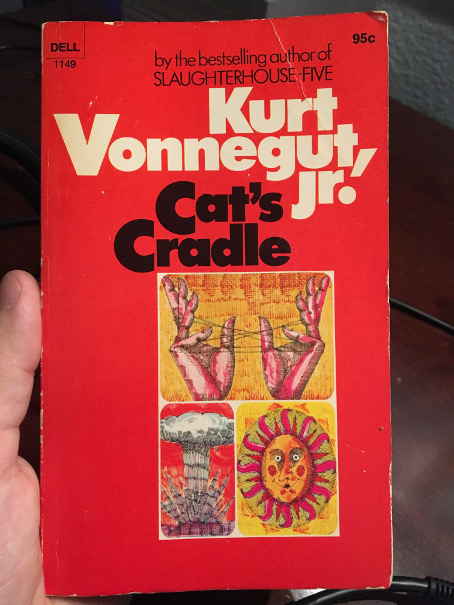
Cat's Cradle
by Kurt Vonnegut, Jr.
It’s been a while since I read any Kurt Vonnegut. This book was referenced in Among Others, which borrows the terms karass (for a group of people cosmically bound together) and granfalloon (a fake karass, such as people who are all Hoosiers, so they think they are bound together).
As usual, the actual plot is bizarre but somehow works in service to his philosophical points.
Philosophical observations
I know there must be a lot written about KV’s philosophy, and I know he was a humanist. From this book, I imagine he was once tempted toward nihilism, but the logical consequences were just too harsh for him. Here’s what happens when the narrator encounters a nihilist on page 59:
I had met [Krebbs] at a cocktail party where he presented himself as National Chairman of Poets and Painters for Immediate Nuclear War. ... [Later,] I found my apartment wrecked by a nihilistic debauch. Krebbs was gone; but before leaving, he had run up three-hundred dollars' worth of long-distance calls, set my couch on fire in five places, killed my cat and my avocado tree, and torn the door off my medicine cabinet.
He wrote this poem, in what proved to be excrement, on the yellow linoleum floor of my kitchen... [there's a short poem about owning a garbage disposal]
There was another message, written in lipstick in a feminine hand, on the wallpaper over my bed. It said: "No, no, no, said Chicken-licken."
There was a sign hung around my dead cat's neck. It said, "Meow."
...After I saw what Krebbs had done, in particular what he had done to my sweet cat, nihilism was not for me. Somebody or something did not wish me to be a nihilist.

I love this description of the outcome of nihilism. If nothing matters, anything goes – literally anything. No, no, no, said Chicken-licken. If there’s no God, nihilism seems to make the most sense, but if this is what “making sense” looks like, “nihilism was not for me.” If there is a God, He “did not wish me to be a nihilist.”
I think part of the reason he can’t stomach nihilism is that he recognizes so much beauty in life, in spite of all the pain and suffering. This quote shows that, but in the end it also shows that he can’t understand how to reconcile beauty and suffering.
[They put on a record of piano music by Meade Lux Lewis, and Angela plays the clarinet along with the record.]
She improvised around the music of the Pullman porter's son [i.e., Lewis]; went from liquid lyricism to rasping lechery to the shrill skittishness of a frightened child, to a heroin nightmare.
Her glissandi spoke of heaven and hell and all that lay in between.
Such music from such a woman could only be a case of schizophrenia or demonic possession.
My hair stood on end, as though Angela were rolling on the floor, foaming at the mouth, and babbling fluent Bablyonian.
When the music was done, I shrieked at Julian Castle, who was transfixed, too, "My God--life! Who can understand even one little minute of it?"
"Don't try," he said. "Just pretend you understand."
A lot of the plot centers of the religion of Bokononism, which is openly made-up, but everyone on the island of San Lorenzo believes it anyway.
Truth was the enemy of the people, because the truth was so terrible, so Bokonon made it his business to provide the people with better and better lies.
Does he see this as the point of religion (lies, but better than the truth)? Or even of his own philosophy? His response to suffering seems to simply be that we must try to improve things:
[Speech at the anniversary celebration for the Hundred Martyrs to Democracy:]
"But if today is really in honor of a hundred children murdered in war," he said, "is today a day for a thrilling show?
"The answer is yes, on one condition; that we, the celebrants, are working consciously and tirelessly to reduce the stupidity and the viciousness of ourselves and all mankind."
This is consistent with his humanism, I guess. Perhaps he thinks that, with all the beauty and suffering in the world, the goal of mankind should be to decrease suffering and increase beauty. Perhaps he also knows that this is a lie he tells himself, but it’s better than the truth, which is that nothing matters and the insanity of nihilism was right all along. (This is not my view, but apart from God, this is a view I would find sadly compelling.)
Why is it called “Cat’s Cradle”?
The idea of a cat’s cradle (a sort of net made with string between one’s fingers) comes up early in the book. Several of the main characters are children of Felix Hoenikker, Nobel Prize-winning physicist. Felix made a cat’s cradle to show Newt (who was a baby at the time).
Later, Newt is talking about how the cat’s cradle is one of the oldest games there is. “Even the Eskimos know it…”
"For maybe a hundred thousand years or more, grown-ups have been waving tangles of string in their children's faces...
"No wonder kids grow up crazy. A cat's cradle is nothing but a bunch of X's between somebody's hands, and little kids look and look and look at all those X's..."
"And?"
"No damn cat, and no damn cradle."
A few pages later, they learn that a particular couple is unhappy in their marriage.
"From the way she talked," I said, "I thought it was a very happy marriage."
Little Newt held his hands six inches apart and he spread his fingers. "See the cat? See the cradle?"
I take that to mean that the happy marriage was spoken about but was never real, and that should have been obvious (just as a cat’s cradle obviously lacks both a cat and a cradle).
Right after Angela’s exalted clarinet performance, it comes up again:
Little Newt snorted. "Religion!"
"Beg your pardon?" Castle said.
"See the cat?" asked Newt. "See the cradle?"
So the cat’s cradle symbolizes lies we all mutually agreee on (just like Bokononism).
Other quotes I just liked
A winded, defeated-looking fat woman in filthy overalls trudged beside us... She hated people who thought too much. At that moment, she struck me as an appropriate representative for almost all mankind.
[Philip Castle stays up all night with his father, working at the hospital:]
It was all we could do to find a live patient to treat. In bed after bed after bed we found dead people.
"And Father started giggling," Castle continued.
"He couldn't stop. He walked out into the night with his flashlight. He was still giggling. He was making the flashlight beam dance over all the dead people stacked outside. He put his hand on my head, and do you know what that marvelous man said to me?" asked Castle.
"Nope."
"'Son,' my father said to me, 'someday this will all be yours.'"
[Newt paints a cat's cradle, a spider web of black, gummy scratches, and shows it to some people.]
"I don't think it's very nice," Angela complained. "I think it's ugly, but I don't know anything about modern art. Sometimes I wish Newt would take some lessons, so he could know for sure whether he was doing something or not."