Aspects of Forgiveness
April 18, 2019
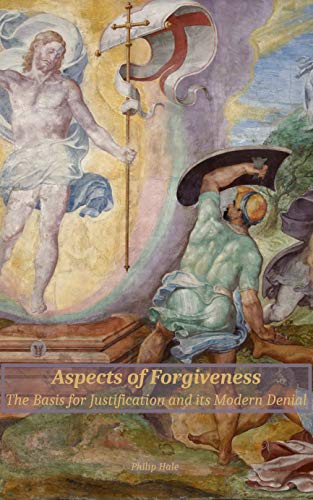
Pastor recommended this book about the doctrine of Objective Justification, recently written by Rev. Philip Hale, a son of our congregation. I read it a few pages a day during Lent. The following comes mainly from marginal notes to myself, so it is not intended to be a structured summary or defense, just personal notes to help me recall some things from the book.
OJ means that Christ’s death on the cross paid for the sins of all the world, not just the sins of the elect. This forgiveness is received through faith – accusations of universalism are unfounded. But while faith receives the forgiveness, it does not create or cause it. Right off the bat (p. 6-7), Pastor Hale quotes a number of Bible verses that support this point:
- He is the propitiation for our sins, and not for ours only but also for the sins of the whole world. (1 John 2:2)
- For to this end we toil and strive, becuse we have our hope set on the living God, who is the Savior of all people, especially of those who believe. (1 Timothy 4:10)
- the Lamb of God, who takes away the sin of the world (John 1:29)
- God sent forth his Son, born of woman, born under the law, to redeem those who were under the law. (Galatians 4:4-5)
- Just as one trespass resulted in condemnation for all people, so also one righteous act resulted in justification and life for all people. (Romans 5:18)
- God was reconciling the world to himself in Christ, not counting people’s sins against them. (2 Corinthians 5:19)
He concludes, “this redemption is complete, from the vantage point of Christ’s work. Without faith, however, no one benefits from Christ’s universal redemption.”
Absolution and the Resurrection
Quoting Walther (on page 17): “As soon as a man is a man he is indeed in possession of the curse, but he is not similarly also at once in possession of the merit of Christ. The treasure is indeed there for all men, the debt of all is paid, so that in the blood of Christ all men’s righteousness, life, and salvation are brought back.”
This is why a pastor can forgive sins. He can proclaim the absolution over the congregation – without condition, and not as a reminder of some other absolution – because the forgiveness of sins is really won for all those present. If justification were not objective, how could the pastor forgive sins? He would have to know whether you have faith.
The forgiveness in the absolution is tied to Christ’s resurrection (fitting, since it is Easter morning as I write this!).
- “And if Christ has not been raised, then our preaching is in vain and your faith is in vain.” (1 Cor. 15:14)
- “If you confess with your mouth that Jesus is Lord and believe in your heart that God raised Him from the dead, you will be saved.” (Rom. 10:9)
- “He was delivered over to death for our sins and raised to life for our justification.” (Rom. 4:25)
Christ’s death is only part of the Gospel. As Pastor Hale writes, “without Christ’s rising there is no forgiveness.” And, “without the acceptance of His sacrifice, the actual discharging of our debt, God is not reconciled.”
Terminology
A problem in the debate over OJ is that the reformers didn’t use the term “objective justification,” and they often refered to salvation “by faith alone.” But 1) “by faith alone” is really a shorthand for “by grace through faith alone,” since we are saved by God’s grace, not by our faith. Pastor Hale refers to “justification by faith” as a slogan (see Chapter 3), and we can’t form our theology from slogans. And 2) they were contrasting faith with works, so they spoke/wrote in that context.
“We do not expect people unacquainted with a modern and novel error to speak directly to it, so looking only to past men’s words and old slogans is not a way out of this controversy, as the deniers would wish.” (p. 65)
Applying OJ to individuals
If you apply OJ to individuals, you end up saying things like this quote by WELS pastor Siegbert Becker: “If it is true that God has forgiven the sins of the world then it is also true that He forgave the sins of Judas.” (quoted on p. 81) As Pastor Hale writes, “This is not how Scripture speaks – it is a pure fabrication of sinful reason.”
I don’t doubt that there was forgiveness available for Judas, just as it is available to me. But if Judas’s actual sin of betraying Christ is personally forgiven, then his only sin is unbelief – indeed, that would be the only sin remaining for all mankind. But “if unbelief is the only sin, then one can rule out using the law to condemn actual sins. God’s wrath is not directed just at unbelief, but over all sin of those in Adam.” (p. 85)
This is an area of the book that I still have questions about.
Other notes
The danger of abandoning OJ is that we would see faith as a work, and we would seek to be saved by that work rather than by Christ.
When does the Father accept Christ’s payment for my sins? “If it happens [when I have faith], the Gospel is not the ‘power of God,’ as God declares that it is; rather, it is powerless information, confronting the sinner with a choice.” (p. 43)
The key words for understanding the difference between OJ and universalism are the words “in Christ.” “In Christ God was reconciling the world to Himself.” The OJ is not applied indiscriminantly to individuals. We are condemned “in Adam” and justified “in Christ.” All of us are in Adam through natural birth, but to be in Christ we must be born again.
A few quotes
A possible future justification, provided man meets God's criteria of faith, is not a biblical justification at all. It is the equivalent of saying that because Adam sinned, all might be condemned who meet the condition of being a "sinner" in the future. (p. 57)

Simply stated, the whole debate on justification today may be summed up in one question: What does the Gospel deliver to the unbeliever? The denial of objective justification parallels the error in the Lord's Supper, in which the body and blood of Christ are said to be present, but only insofar as the believer and his faith make it so. In the Supper, the quesiton of what it is must be separated from faith, so the determining demarcation is: What does the unbeliever receive? Does the one without faith receive Christ's body and blood, or merely bread and wine? So, also with objective justification, the question is: What does the unbeliever receive in the proclamation of the true Gospel? (p. 107)
In Christ, the totality of man is forgiven and already righteous, yet because sinners are in Adam from birth, they are complete heirs of hell, fully under God's condemnation.
In avoiding one extreme, the deniers of OJ marry themselves to another and become no better than the "evangelical" Christian, with his acceptance language and sinner's prayer. Though one is dressed up in more biblical language and pious Lutheran phrases, both see salvation completed in man, as faith must do what Christ left undone. (p. 97)